
The Weekly Anomaly Report: May 27th - June 3rd

Crypto markets often move in unusual ways. Most of it is noise, but once in a while there’s a blip that could mean something. A token suddenly dominating crypto Twitter, whales dumping ETH, price spiking while network usage flatlines — you get the gist.
We call these anomalies. They often lead to trading opportunities — and this report helps you find them. In it, we look at signals from the 8 anomaly types we track, tell the bigger story, and details what’s worth tracking over the next week.
This report is for analysts, traders, and anyone curious about what crypto’s on-chain and social data are showing.
Let’s dig in!
This Week in Brief
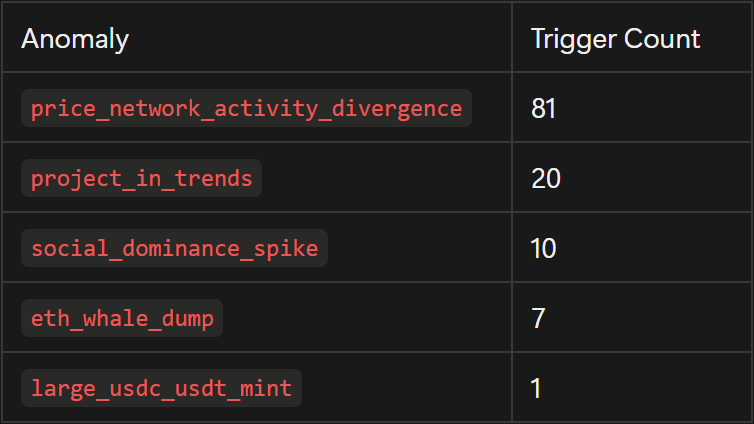
Between May 27th and June 3rd we detected 119 total trigger events across 5 of the 8 anomaly types we track.
To keep things short and noise-free, we usually talk about assets $50M+ in market cap, unless otherwise noted.
The backdrop framed everything this week: Bitcoin slid from roughly $69.5K toward the mid-$60Ks, US spot BTC and ETH ETFs logged a record multi-day outflow streak, and Michael Saylor’s disclosure that Strategy sold ~32 BTC — a symbolic break from years of “never sell” rhetoric — became the single most-discussed story on social.
The week was led by price_network_activity_divergence, with 81 trigger events across a long tail of assets, but the two names that mattered were Maker and Whitebit. project_in_trends was concentrated in bitcoin, stellar, and a few other projects. social_dominance_spike was smaller this week, led by usdd, sui, axelar, axie-infinity, and kusama.
- Decentralized USD, $USDD: the week's social-dominance leader by repeat count, but spike-day optimism soured into negative sentiment.
- Sui, $SUI: two dominance spikes as a CME-futures launch ran straight into a multi-hour mainnet outage.
- Stellar, $XLM: the strongest eligible non-BTC/ETH project-trends row, riding a DTCC settlement catalyst and a ~40% rally.
- Maker, $MKR: the dominant price-network divergence outlier, a structural artifact of the MKR-to-Sky migration.
- Bitcoin, $BTC: the highest raw project-trends peak in the dataset, driven by Saylor's 32-BTC sale and record ETF outflows.
Spotlights
USDD | SUI | XLM | AXL | AXS | KSM
Decentralized USD ($USDD, and the $TRX ecosystem)
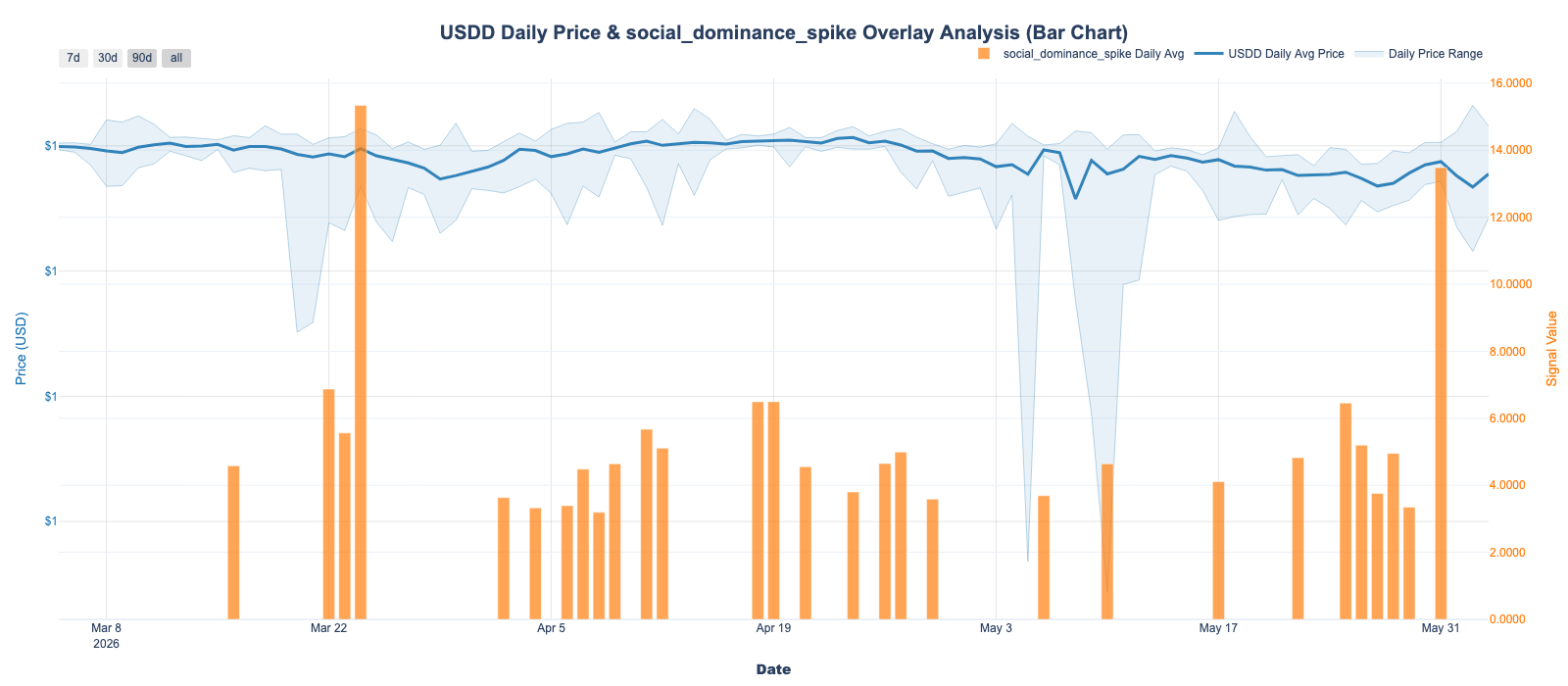
USDD was the standout of the social table this week — five repeat social_dominance_spike triggers, a peak social-dominance score of 13.48 on May 31, the strongest single reading in the section by a wide margin, and a sentiment arc that flipped from clearly positive on the spike day (+4.30) to negative by the latest reading (-0.45). High repeat count plus a sentiment reversal is the signature of an attention build that gets reframed mid-run.
The spike landed inside a busy stablecoin news week. RLUSD’s expansion into Türkiye and Mastercard’s rollout of 24/7 settlement for regulated stablecoins kept the whole “digital dollar” category in the conversation, and as TRON’s flagship native stablecoin, USDD caught the spillover. The positive spike-day reading tracks that broader narrative attention.
The turn to negative latest sentiment is the more telling part, and it lines up with USDD’s structural baggage. USDD is an algorithmic-leaning stablecoin now backed primarily by TRON’s volatile TRX token — the same model lineage that draws perpetual TerraUSD comparisons. The reserve picture has been a live concern since the TRON DAO Reserve quietly removed roughly $732M of Bitcoin collateral without a DAO vote earlier in 2026, and Justin Sun’s ongoing public, litigious feud with World Liberty Financial keeps founder risk in the headlines. That combination tends to convert attention into scrutiny rather than enthusiasm.
The takeaway: trust-scrutiny attention — the signal flags that USDD is in the conversation, but the conversation is about reserves and founder risk, not a bullish bid. This is a concern indicator.
Sui ($SUI)
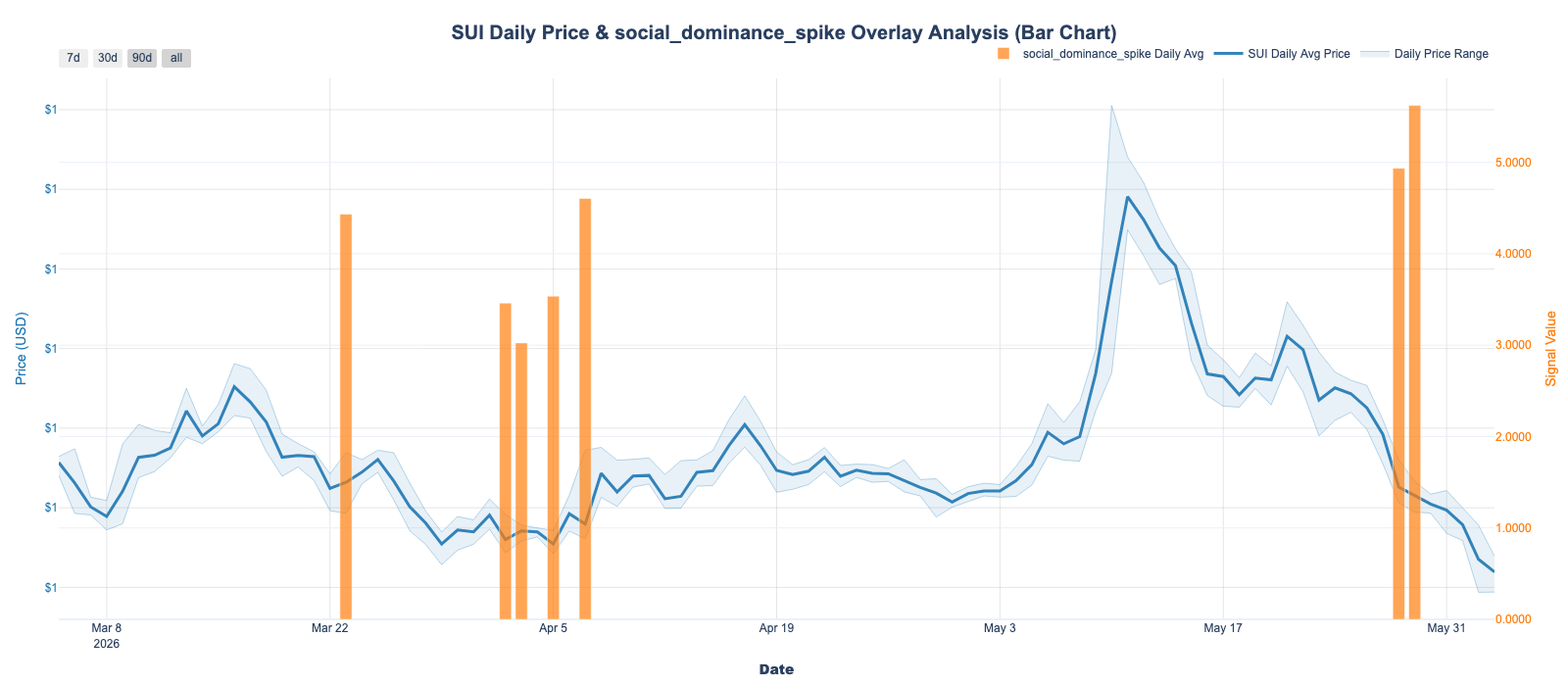
Sui posted two social_dominance_spike triggers and a peak of 5.62 on May 29 — and unlike the classic euphoria-then-reversal pattern, sentiment was already negative on the spike day (-4.52) and stayed negative on the latest reading (-0.39). That is the fingerprint of a problem-driven attention spike, not an excited one.
The catalysts collided in the same 48-hour window. On the bullish side, CME Group launched SUI futures on May 29 — a genuine institutional-credibility milestone that adds regulated derivatives access and market depth. On the bearish side, and far louder, Sui’s mainnet halted: the chain stopped producing blocks on May 28 and ran through consecutive outage incidents totaling around 9.5 hours across May 28–29, triggering an immediate ~8% price drop while the team paused transactions to ship a fix. The negative sentiment is the outage talking over the futures launch.
This is the second meaningful Sui reliability scare of 2026 after the January mainnet outage, so the network-stability thread is not new. The futures listing is the kind of catalyst that usually reads bullish; here it was simply drowned out.
The takeaway: catalyst overshadowed — a real adoption milestone got buried under an infrastructure failure. The signal is reading the outage, and reliability is the variable to watch before the institutional story can reassert itself.
The One-Off Social Spikes: Axelar, Axie Infinity, and Kusama
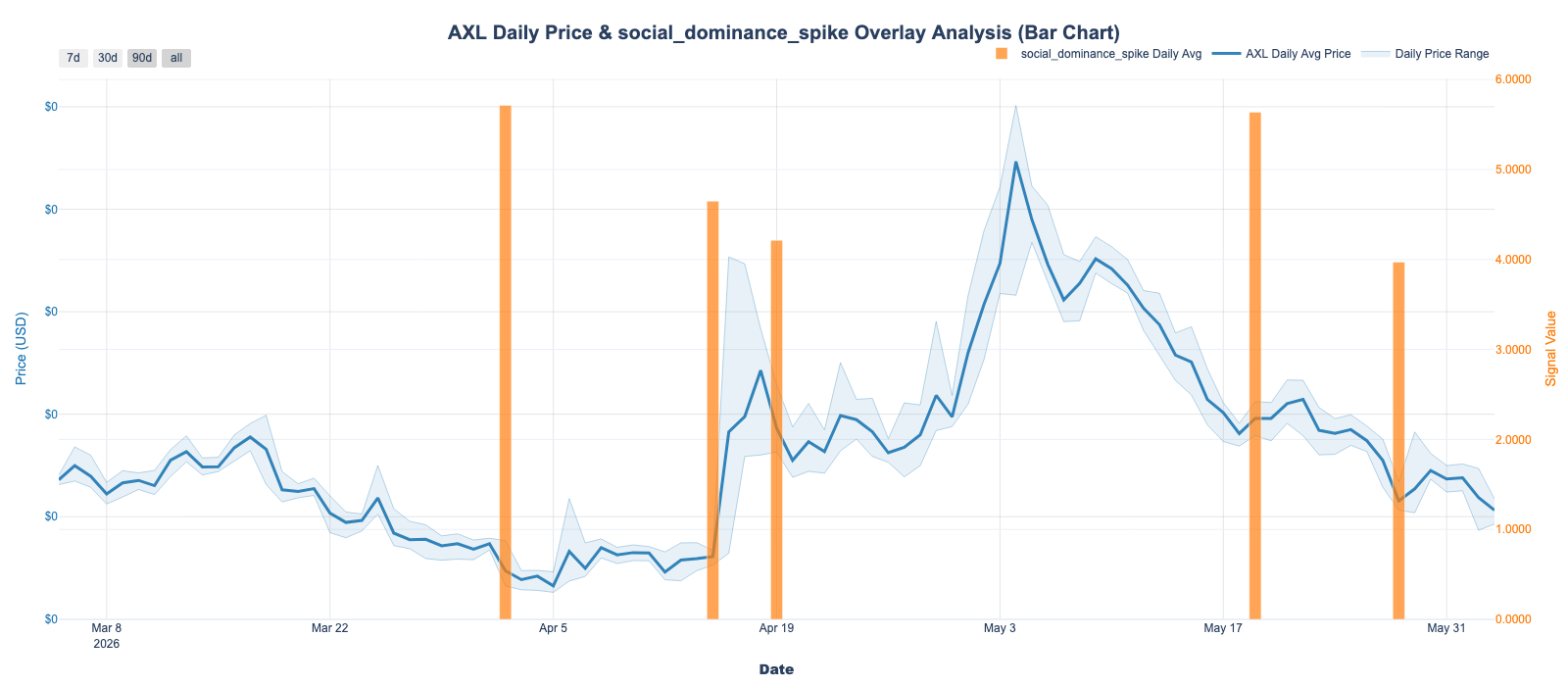
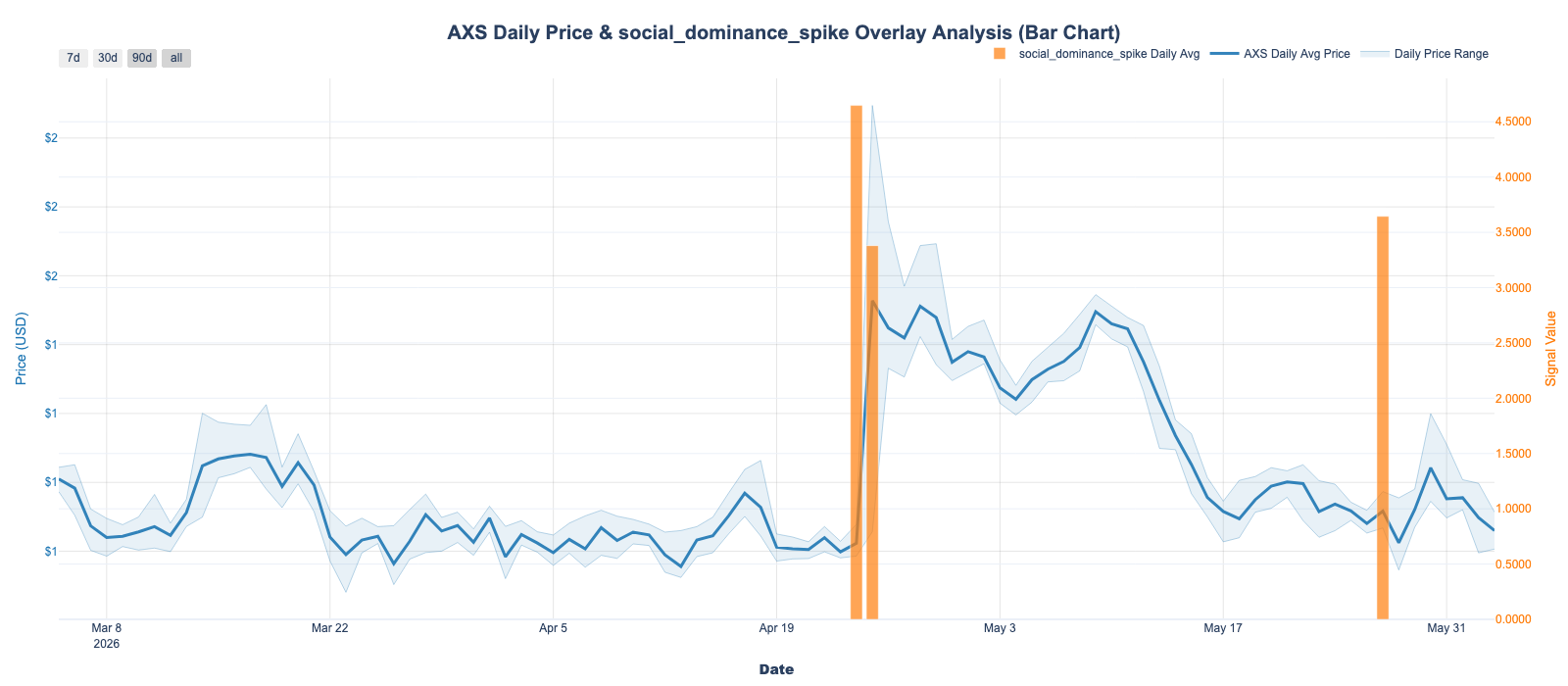
Three assets each produced a single social_dominance_spike with negative sentiment on both the spike day and the latest reading. Single prints with sentiment already in the red are low-conviction by construction — worth a line each, not a full spotlight.
- Axelar ($AXL, peak 3.97, May 28) spiked off its late-May self-serve interface launch (app.axelar.network, starting with nine EVM chains), but sentiment stayed negative — the token has carried a "value proposition in question" overhang since Circle acquired the dev team in December 2025, leaving AXL behind under community governance.
- Axie Infinity ($AXS, peak 3.64, May 27) caught attention as the GameFi-comeback-versus-dead-cat-bounce debate ran on. The low sentiment was due to skepticism towards the play-to-earn model and the broad market sell-off. The Ronin migration to an Ethereum L2 is the longer-term fundamental value driver, but the spike-day conversation was more negative than positive by a small margin.
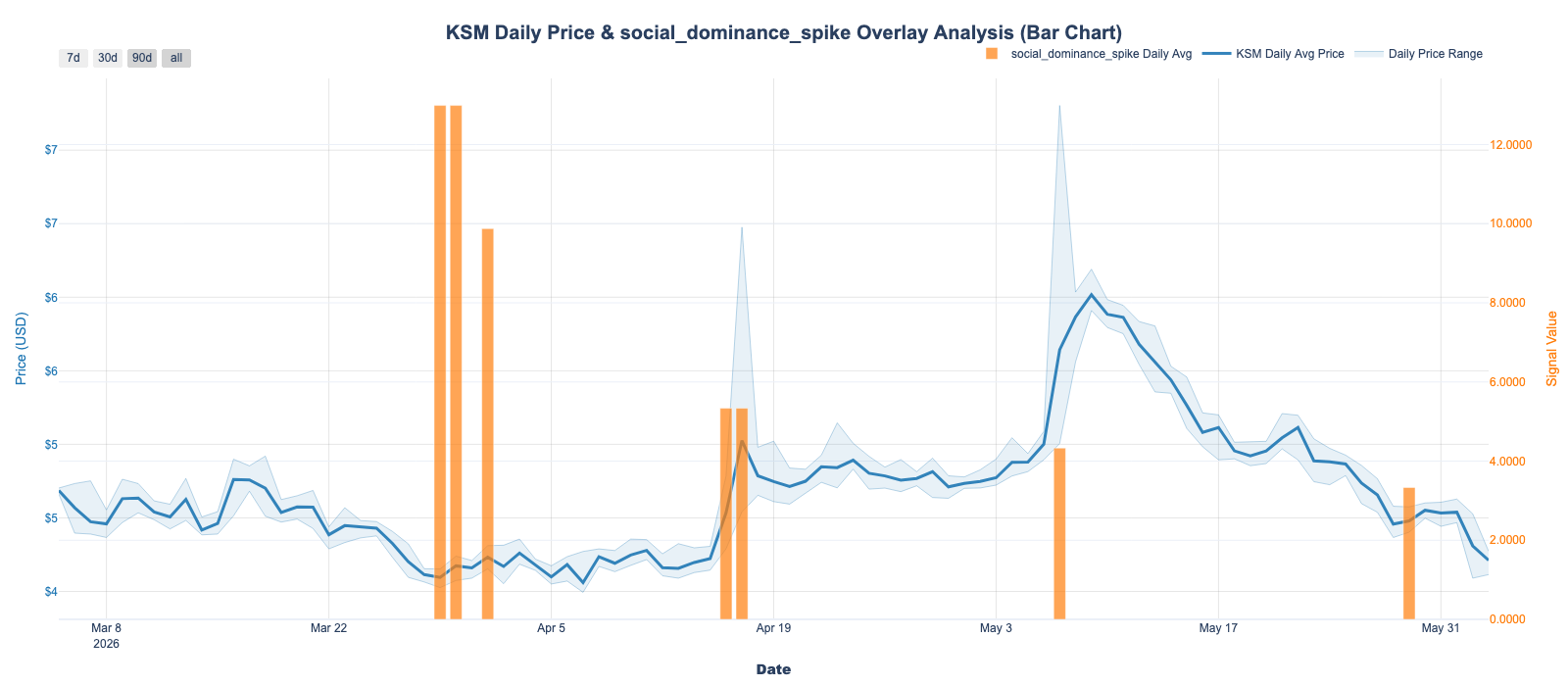
- Kusama ($KSM, peak 3.33, May 29) — just above the standard market-cap filter at roughly $80–88M — spiked on existential questions: the proposed sunset/merger of Kusama into Polkadot (converting KSM to DOT) plus a broader Polkadot ecosystem decline in TVL, users, and leadership stability.
The takeaway: attention without alignment — three different stories, same deal. Each is a single negative-sentiment print tied to an unresolved structural question, so none make a good trading opportunity based on this data alone.
Project in Trends
BTC | ETH | XLM | BNB
For context on the majors: bitcoin had 6 project_in_trends triggers and the highest raw peak in the dataset at 893.69 on June 3, 07:00 UTC — the Saylor 32-BTC sale, the slide to the mid-$60Ks, and the record ETF outflow streak put BTC at the center of the feed all week. ethereum had 2 triggers with a peak of 80.46 on May 28, 03:00 UTC, tied to the same outflow story and the running commentary on large ETH treasury holders sitting on unrealized losses.
Beyond the majors, the eligible higher-market-cap rows were stellar and binance-coin. (mstr2100 logged 5 triggers and a peak of 467.03 but sits at roughly $577K in market cap, so it stays out of the selected table.)

Stellar ($XLM)
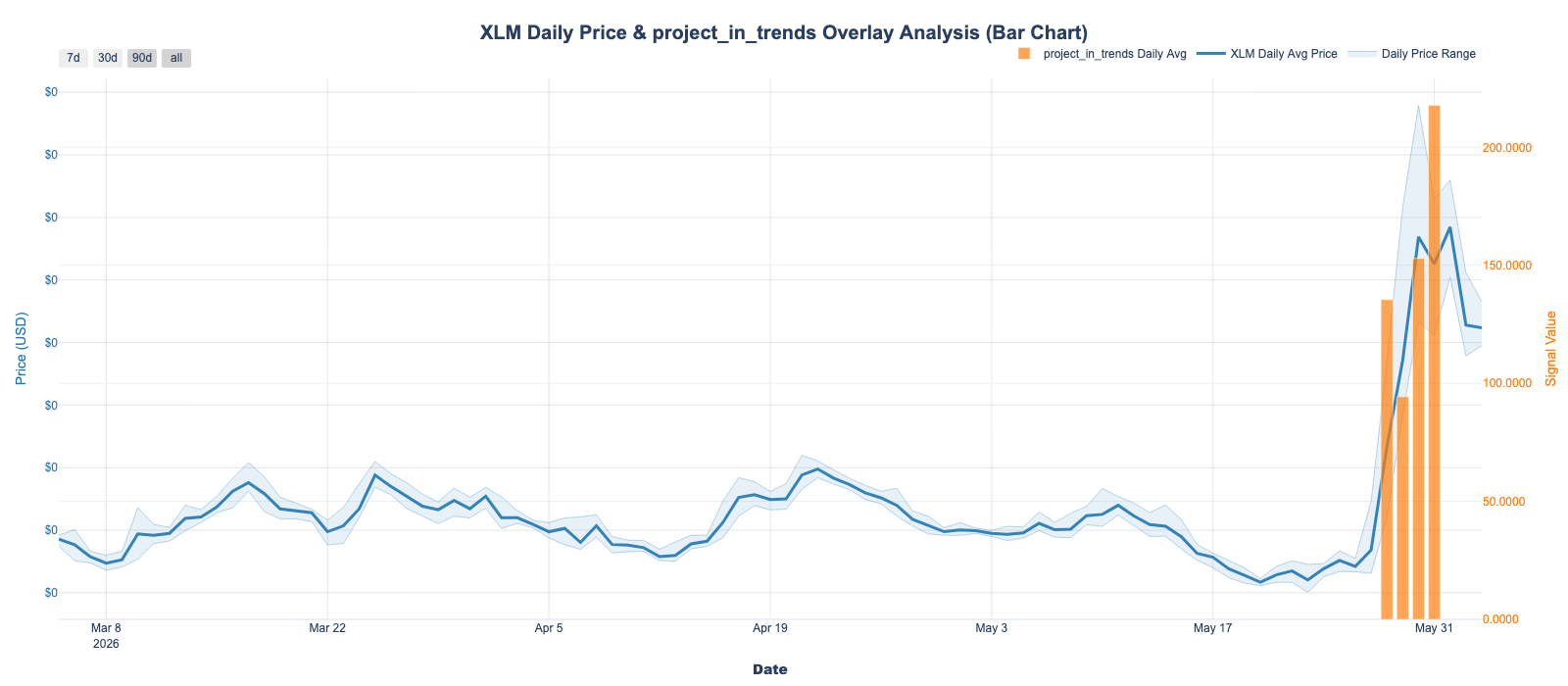
Stellar was the strongest eligible non-BTC/ETH project-trends name (6 triggers, peak 242.48 on May 31), and unlike most of this week's social activity, its attention was catalyst-led and constructive. XLM appreciated roughly 40% across late-May sessions — printing a ~23% single-day move around May 29 — on a mix of an on-chain activity spike and a major institutional development: a settlement partnership with the Depository Trust & Clearing Corporation (DTCC), which slots Stellar into traditional securities-settlement plumbing.
That sits on top of Stellar's longer-running institutional-adoption thesis — the March 2026 SEC/CFTC digital-commodity designation that opened custodial eligibility, $1B+ in tokenized real-world assets, and anchors like Franklin Templeton and PYUSD. For a network that has spent years executing on payments rails while the token lagged, a DTCC headline is exactly the kind of catalyst that pulls XLM into trends with price and attention moving the same direction.
The takeaway: institutional catalyst with teeth — this is the one major social-trends story of the week where the rally and the conversation are aligned and fundamentally anchored. Watch whether XLM holds the $0.19–$0.20 zone, since that's the line between a catalyst that sticks and a profit-taking fade.
BNB ($BNB)
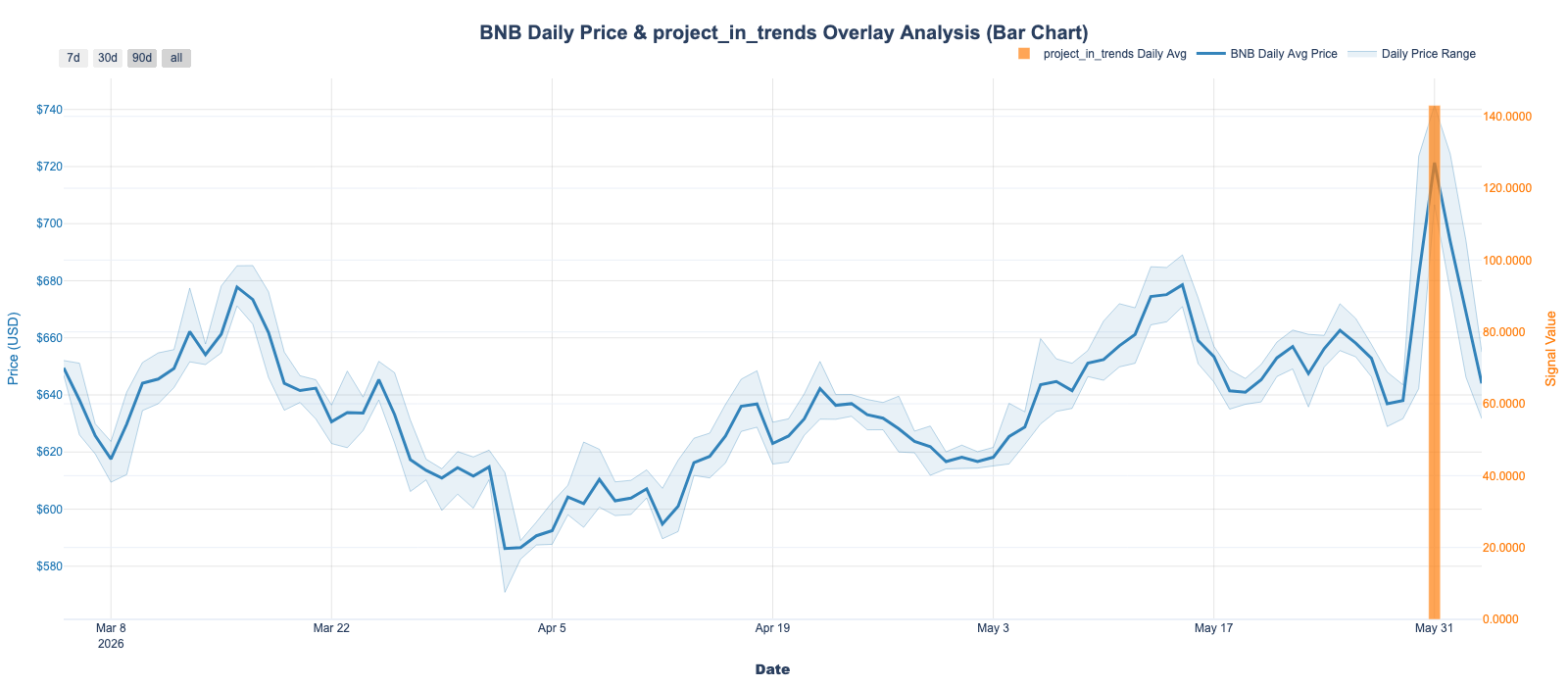
Binance Coin logged a single project_in_trends trigger (peak 143.04 on May 31, 15:00 UTC) on a clean relative-strength day: BNB jumped roughly 7% on May 31 to around $710 even as Bitcoin was sliding and the broad market bled. When a top-10 asset rallies hard against a red tape, it earns a mention in the feed — that's the whole story here. One trigger, one strong day, an exchange-token-and-burn fundamental holding up better than its peers during a risk-off stretch.
The takeaway: relative-strength print — a single trend trigger on a counter-trend up day, not a sustained attention build. Notable as a strength tell against weak market breadth rather than as a standalone signal.
Price-Network Activity Divergence: Maker Leads a Top-Heavy Table
MKR | WBT | EURS | BIT | EIGEN
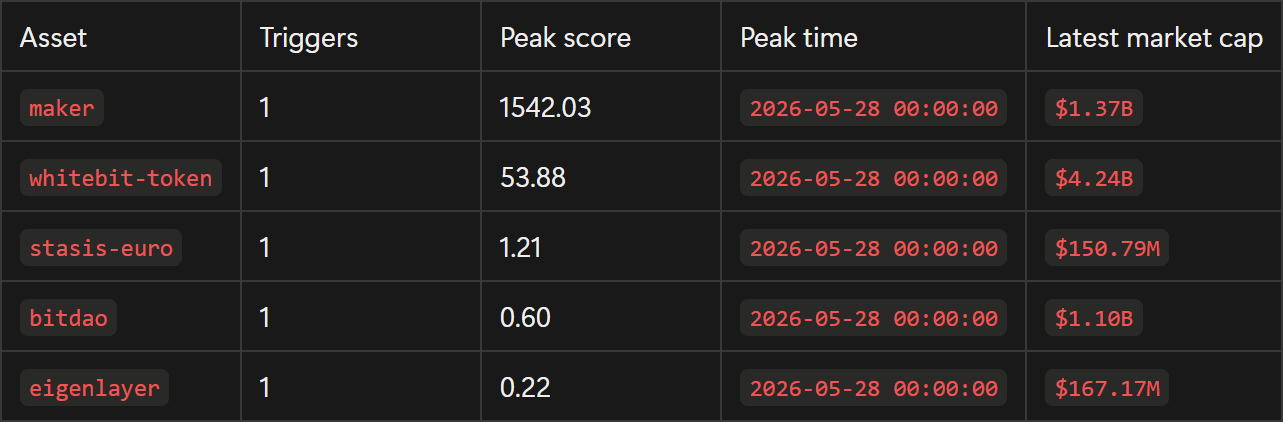
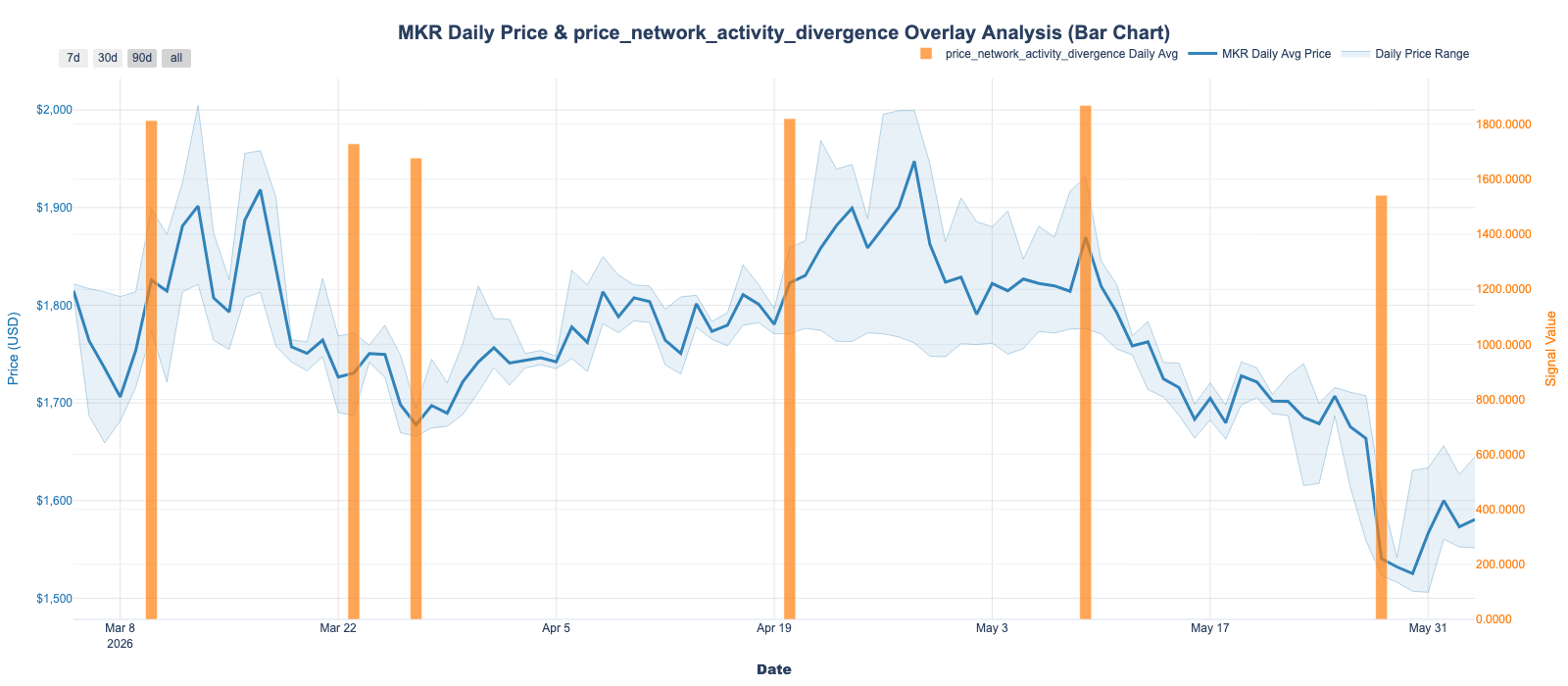
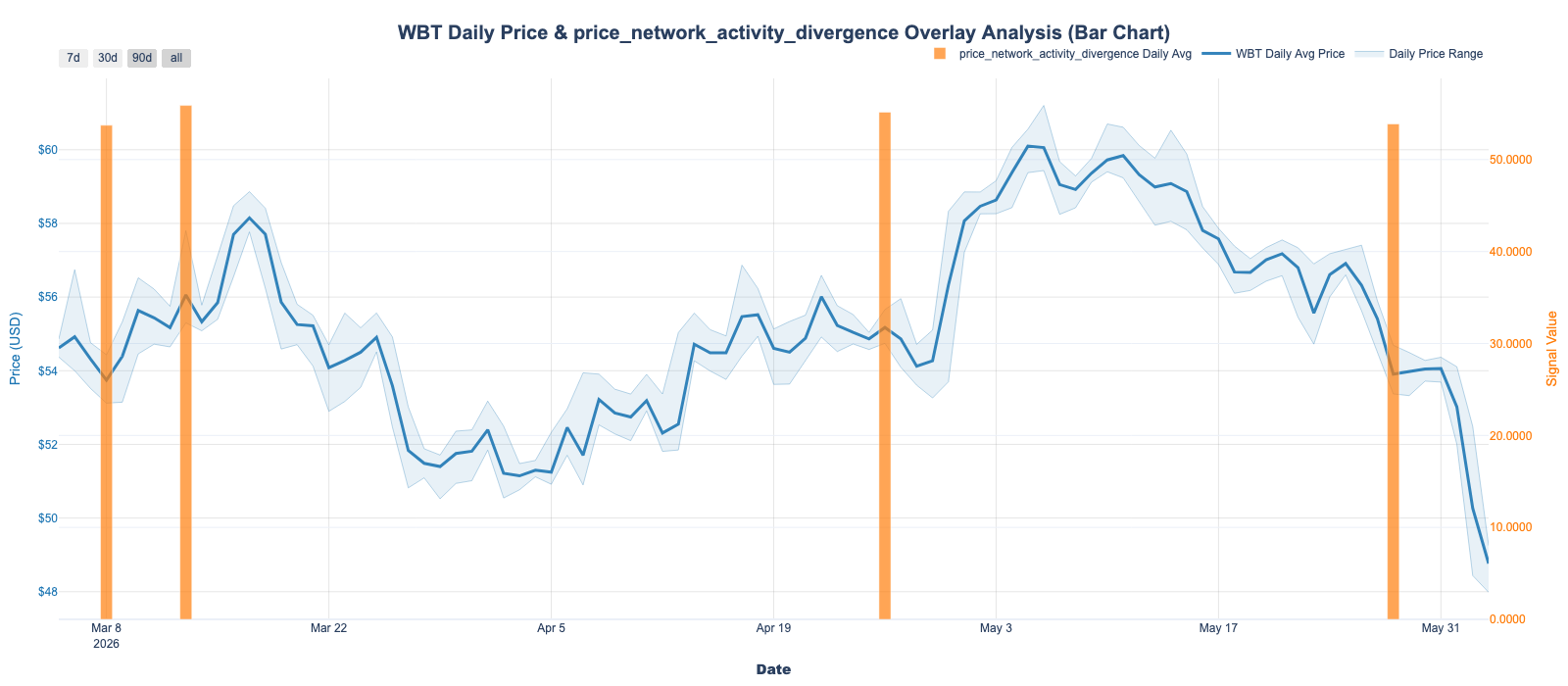
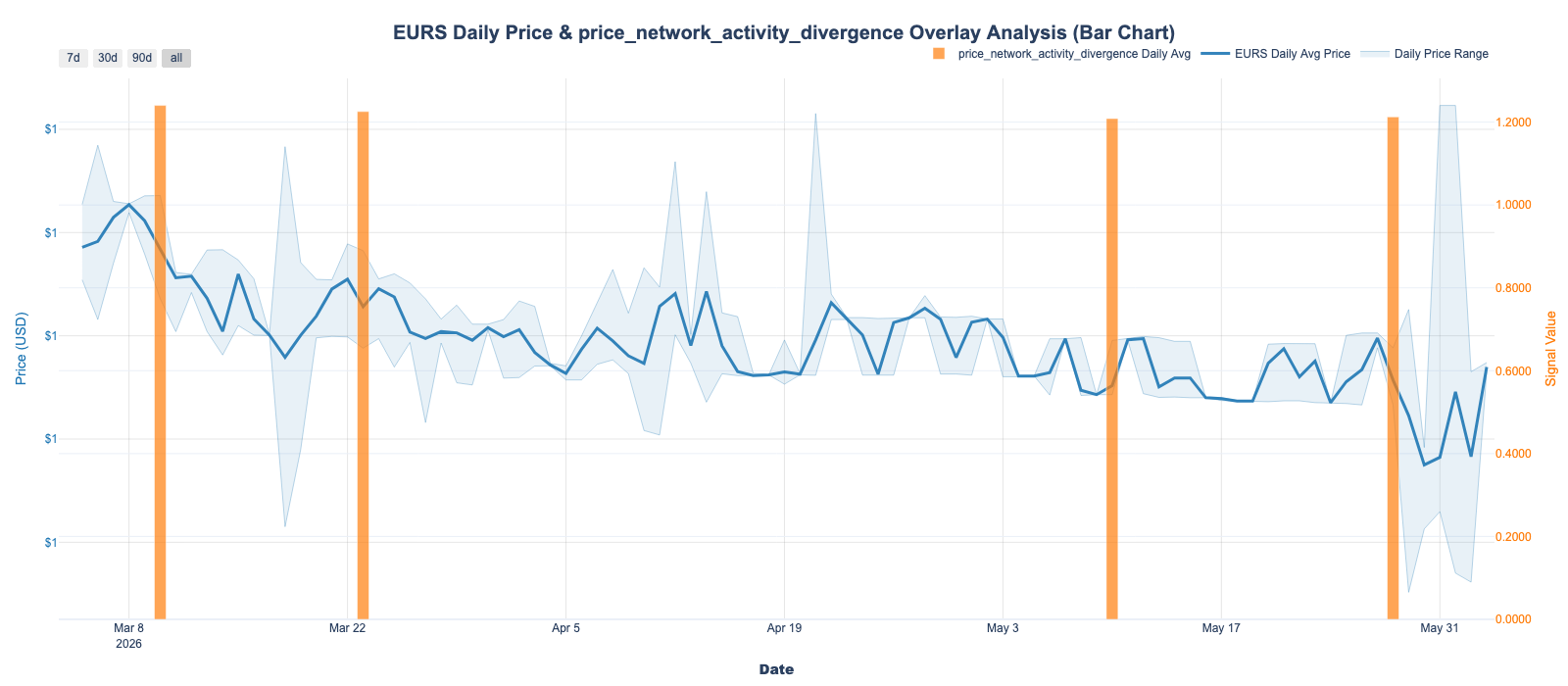
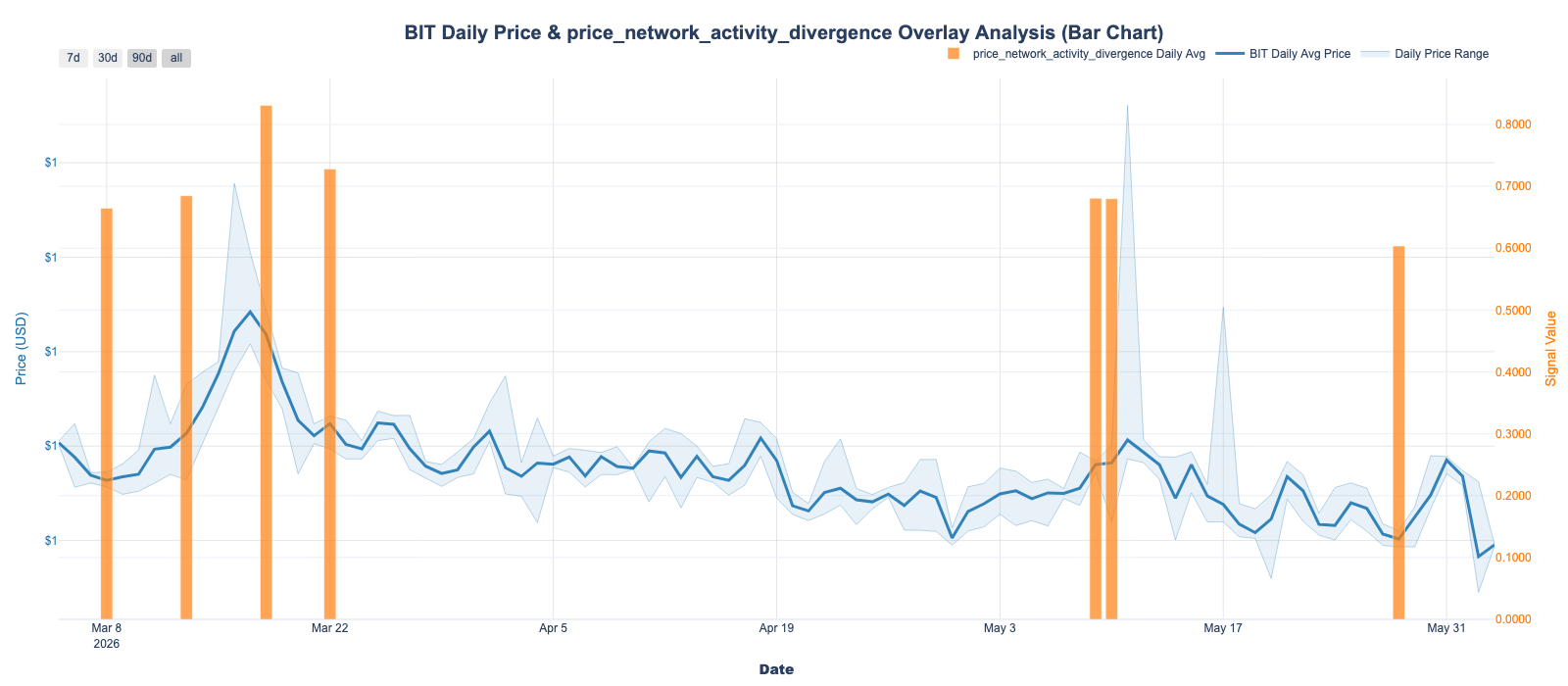
price_network_activity_divergence fired 81 times this week, but the distribution is the opposite of last week's sub-$130M long tail: the top of the table is large-cap with enormous raw peaks, and the values fall off a cliff after the first two names. All five eligible leaders triggered once, all on May 28.
Maker ($MKR)
Maker's peak of 1542.03 is not just the top of this table — it dwarfs the entire rest of the section, and the reason is structural rather than a fresh breakout. MKR is the legacy governance token of MakerDAO, and the protocol's ongoing rebrand to Sky has split value accrual and activity away from MKR itself: holders migrate at 1 MKR to 24,000 SKY, and USDS now stands as the DAI successor. The live network — stablecoin issuance, fee flow, on-chain usage — increasingly runs through Sky and USDS, not through the MKR token.
That makes MKR almost definitionally divergent. The signal flags a same-day price move above 3% that isn't matched by a corresponding rise in network activity; when a token's own network activity has been hollowed out by a migration and the token trades thinly (its 24h volume can sit in the low thousands), even a modest price twitch produces a vast divergence reading. The 1542 print on May 28 is that mechanism at maximum.
The takeaway: structural divergence — this is a migration artifact, not a signal that MKR is mispricing live network growth. The "network" worth watching is Sky/USDS; MKR is the residual leg until conversion completes.
WhiteBIT Token ($WBT)
WhiteBIT Token is the only other name above 10 (peak 53.88, ~$4.24B cap), and it's a different flavor of the same idea: an exchange utility token whose price is governed by tokenomics and exchange fundamentals rather than on-chain network activity. WBT trades around $50–53 and is driven by an aggressive deflationary buy-back-and-burn program (committed to removing roughly half the total supply, with no new issuance), plus catalysts like S&P Dow Jones crypto-index inclusion, a regulated US launch, and high-profile partnerships. Because its value is scarcity- and venue-driven while measurable on-chain usage stays low, a price move detaches cleanly from "network activity."
The takeaway: tokenomics-driven divergence — price reflects burns and exchange growth, not on-chain throughput, so the divergence is the norm for this asset class rather than an event.
The Tail
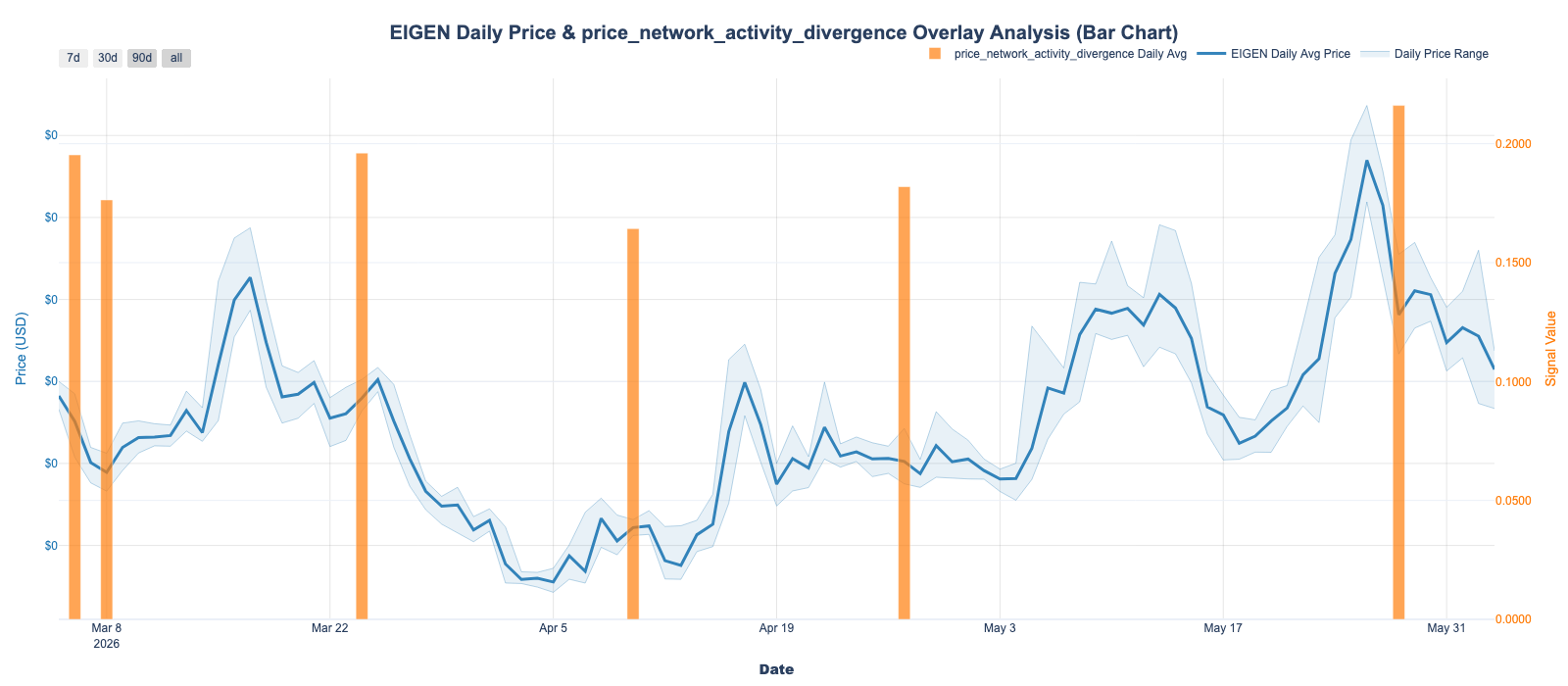
After WBT, the values collapse: stasis-euro (1.21), bitdao (0.60), and eigenlayer (0.22) round out the eligible top five with the kind of small prints that show up when a project's network is doing something the token isn't pricing in, or vice versa. None is spotlight-grade on its own; together they're the long-tail basket that always sits beneath the headline divergence names.
What Else Happened
ETH | USDC | USDT
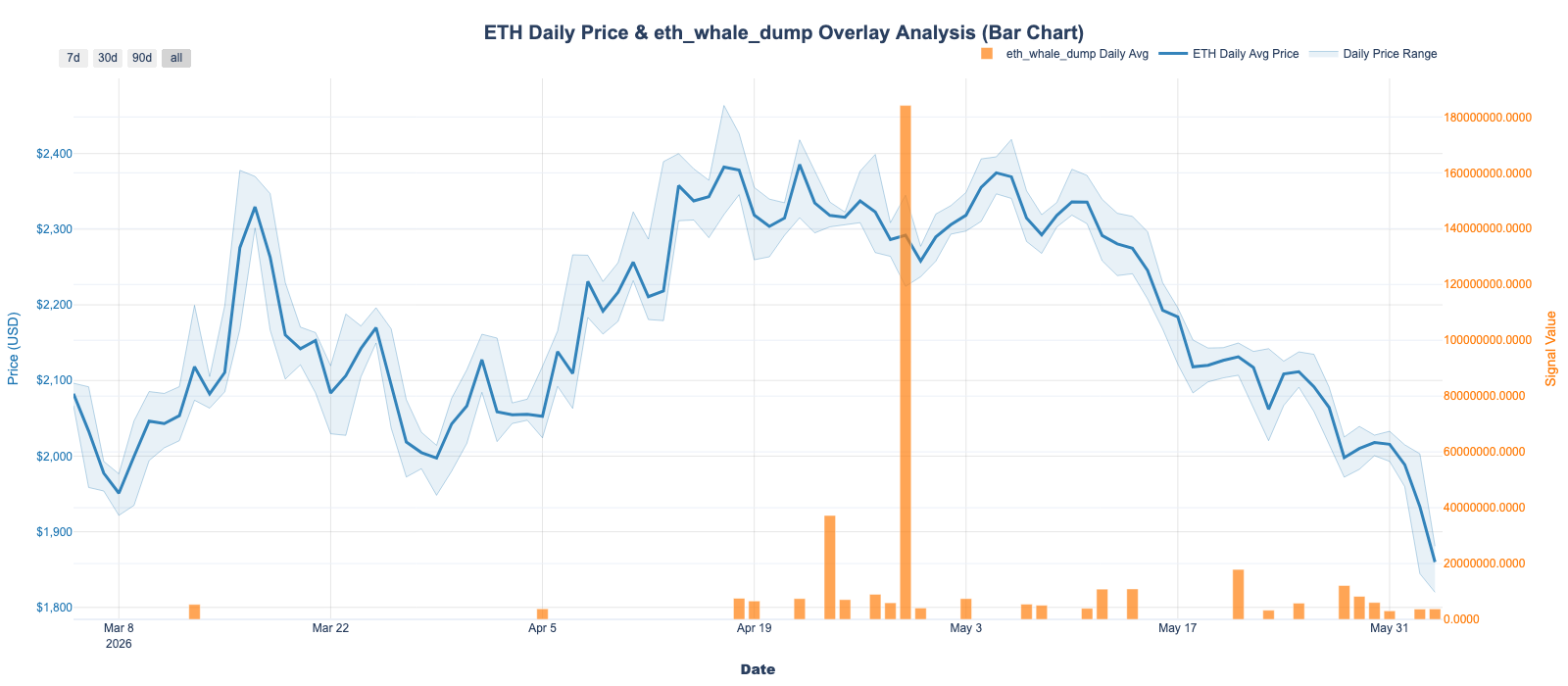
eth_whale_dump v2 triggered 7 times on ethereum, with an average value of 6,134,454.14 and a weekly peak of 12,123,786.00 at 2026-05-28 18:41:47, active from that timestamp through 2026-06-03 07:59:47. The signal is ETH-only by design, so the read is persistence and timing rather than cross-asset comparison: seven hits stretched across roughly six days is consistent with active distribution, and it fits the week's tape — ETF outflows, large ETH treasury holders underwater, and broad de-risking. Absent a clean corresponding price break, treat it as a positioning observation rather than a directional call.
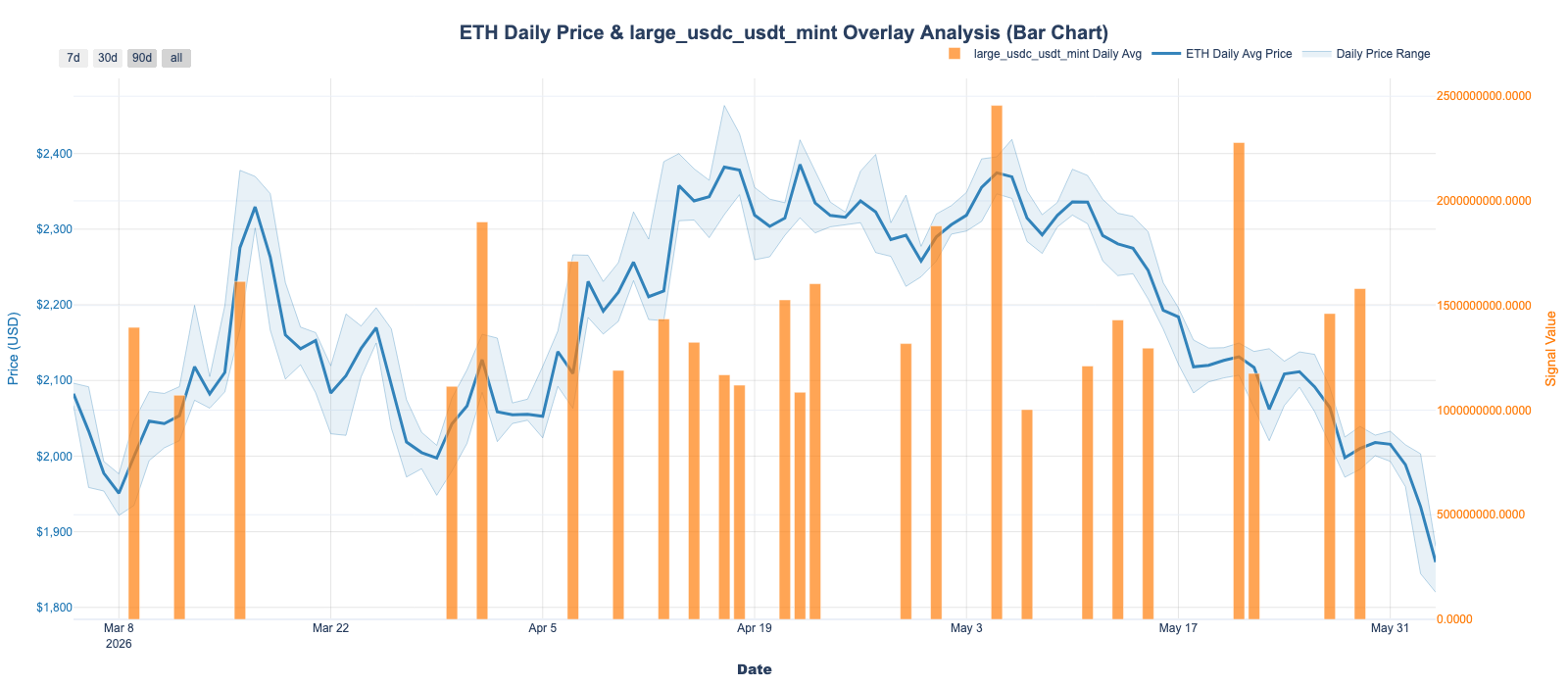
large_usdc_usdt_mint triggered once, with a combined value of $1.58B at 2026-05-29 00:00:00. Because this signal is global and has no asset row, it should be read as a market-liquidity datapoint rather than an asset-specific anomaly — large in absolute terms, but a single routine mint in current conditions.
Worth Watching
- Maker: the dominant price-network divergence outlier — but watch Sky/USDS for the real activity story; MKR's reading is a proxy.
- Bitcoin: the highest raw project-trends peak; track whether the Saylor-sale and ETF-outflow narrative resolves into a flush or extends the downside.
- USDD: the strongest repeat social-dominance sequence, but latest sentiment is negative — presence here is a trust-scrutiny tell, not a bullish bid.
- Stellar: the strongest eligible non-BTC/ETH project-trends row, and the cleanest catalyst-aligned move of the week; track whether the DTCC catalyst holds above $0.19–$0.20.
Total Triggers
The Anomalies We Track
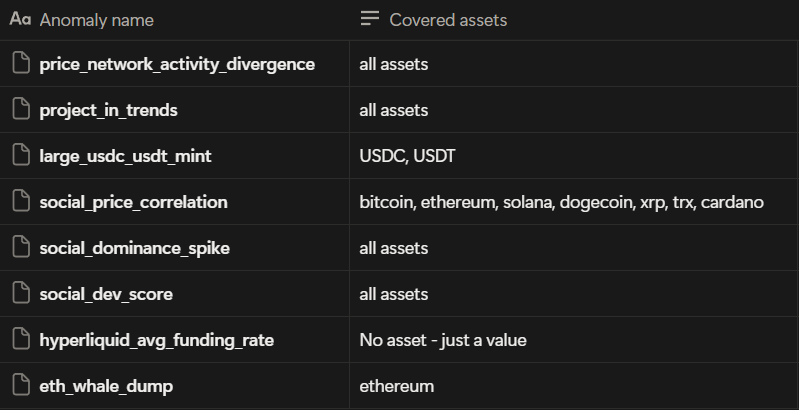
Network Activity & Price Divergence Anomaly — detects price surges that are not accompanied by a corresponding rise in network activity (real growth). Triggered only if the price growth exceeds 3% on the same day, ensuring the alert is relevant for significant bullish moves.
Project in Trends Anomaly — detects when a specific crypto token gains significant traction in online discussions, placing it among the top 10 most-mentioned words in crypto-related conversations.
Large USDC-USDT Mint Anomaly — detects daily combined $1 billion or larger minting events of USDC and USDT stablecoins on the Ethereum blockchain.
Social Price Correlation Anomaly — detects whether social sentiment and price are behaving in an unusually aligned or unusually decoupled way. Currently runs on 1h X.com social data for bitcoin, ethereum, solana, dogecoin, xrp, trx, and cardano.
Social Dominance Spike Anomaly — detects abnormal spikes in social dominance metrics. Alerts when values exceed a statistical significance threshold of 3 standard deviations over 30 days.
Social-Dev Score Anomaly — detects unusual activity compared to recent 30-day history of social media metrics and development activity. The score is weighted 60/40 for social and dev activity.
Hyperliquid Average Funding Rates Anomaly — detects when rates exceed predefined high/low thresholds of +40% and -20%, measured hourly.
ETH Whale Dump Anomaly — detects potential large-scale ETH dumps by monitoring whale wallet behaviors. Uses a 500 ETH threshold and a 30-day holding period to distinguish normal trading from potential dump scenarios.
—
Thanks for checking out this week’s Santiment Anomaly Report. For real-time anomaly alerts and the underlying data, head to Sanbase.
See you next week!
Anomalously yours, Santiment
Disclaimer: This report is for reference purposes only and is not intended as financial or investment advice. Always DYOR.