Monthly Market Report: May 2026

After a relatively resilient April, May ended up becoming a month defined by renewed focus back on crypto, and a backing off from war discussions and global events. Traders who had spent much of the spring focused on geopolitical headlines, regulation, and security failures gradually shifted their attention back toward certain altcoin sectors, and the latest improvements and innovations happening across various cryptocurrency sectors. The result was a noticeable increase in market engagement even as many assets struggled to generate meaningful gains.
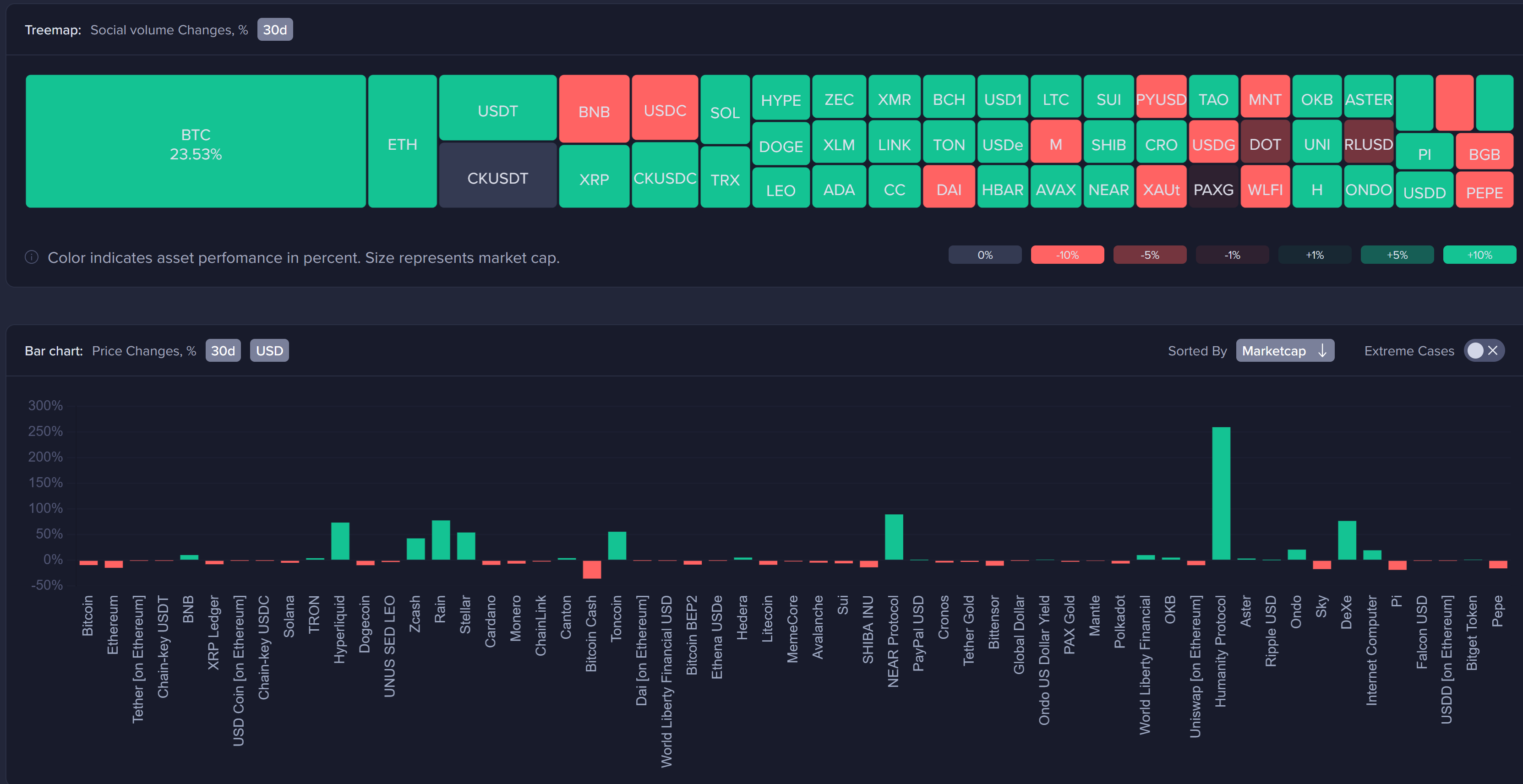
Social activity reflected this change clearly. Compared to April, discussions surrounding Bitcoin rose by roughly +24%, while Ethereum-related conversations surged by +54%. These increases suggested that traders were becoming more interested in positioning for future opportunities, even if they weren't yet convinced enough to deploy capital across the broader market.
At the same time, the gains were far from evenly distributed. While the majority of cryptocurrencies experienced mild declines or sideways movement, a select group of assets broke away from the pack. Humanity Protocol led the charge with a roughly 260% gain, while NEAR Protocol, Rain, Dexe, Hyperliquid, Toncoin, Stellar, and Zcash all posted impressive advances. May became a reminder that crypto markets rarely move together. Instead, capital tends to rotate aggressively into whichever narratives are attracting the most attention.
A Flock to Stocks?
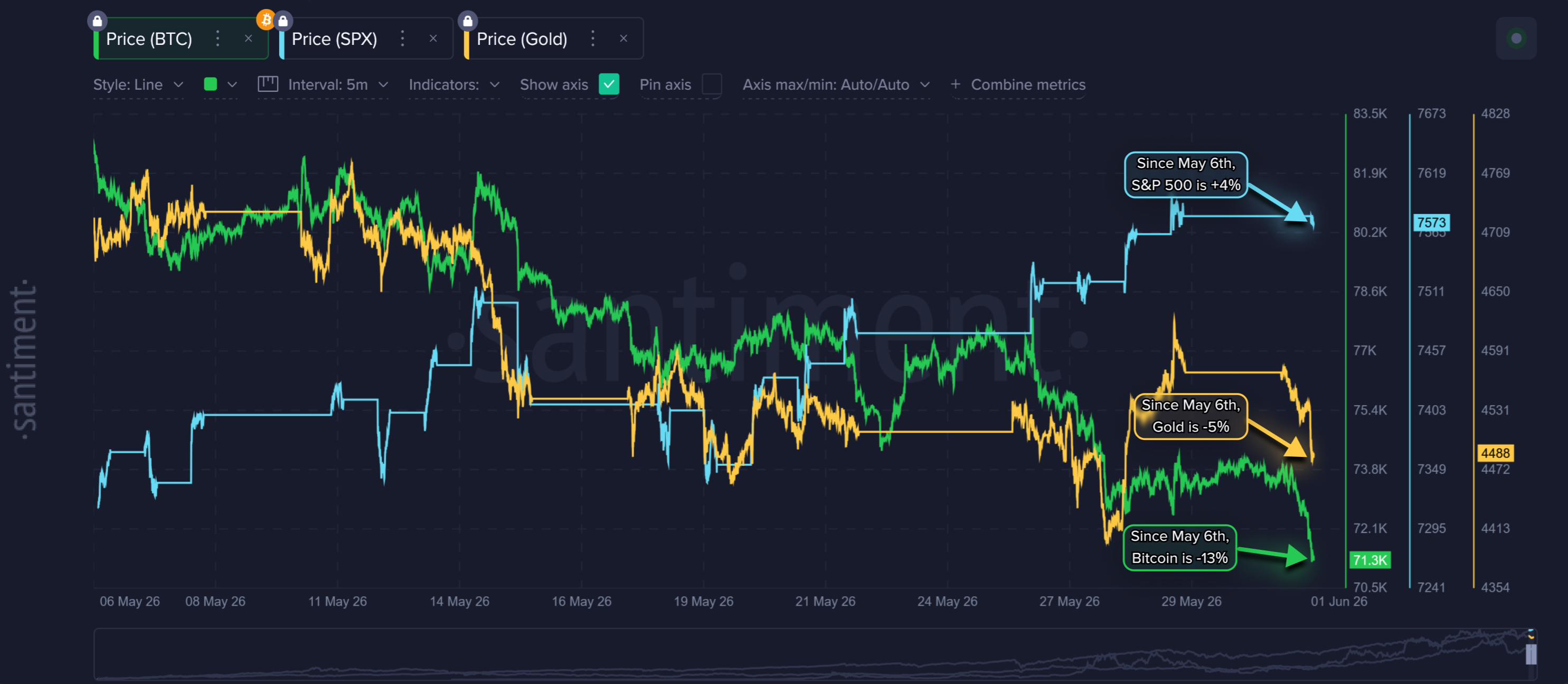
One of the more interesting shifts throughout 2026, which went into overdrive in May, has been the growing migration of trader attention away from cryptocurrencies and toward traditional equities. While a handful of standout altcoins have managed to generate respectable returns, the constant new all-time highs of stock market indices have drawn many traders out of the crypto sector to plant their money in stocks. Of course, there are still die-hards who think it is just a matter of time until the trend flips back:
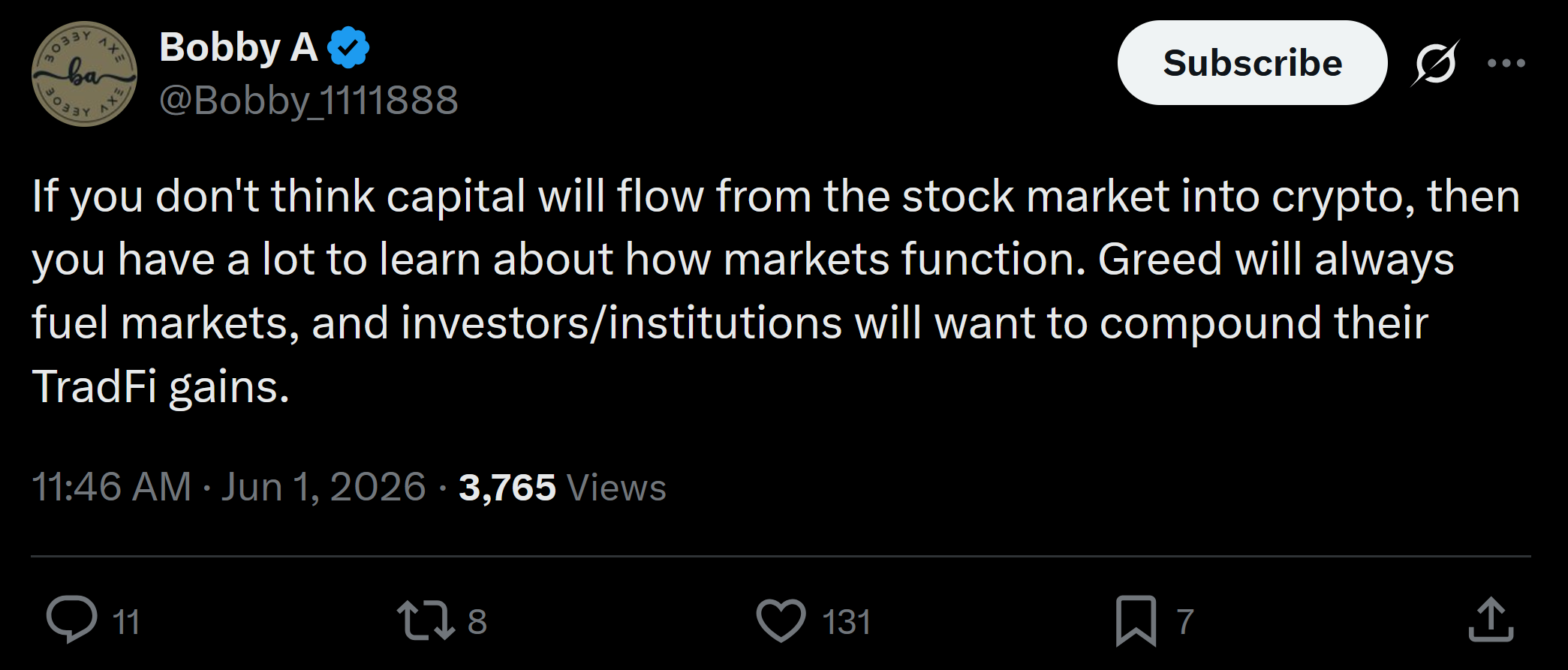
Artificial intelligence companies, semiconductor manufacturers, defense contractors, and major technology firms have consistently rewarded investors, while many crypto assets remain well below their previous cycle highs. As a result, traders who once viewed crypto as the highest-upside opportunity in finance have increasingly diversified into stocks, chasing sectors that have delivered stronger momentum, clearer earnings growth, and less volatility. This rotation is evident not only in price performance, but also in the growing amount of online discussion surrounding stocks, ETFs, and traditional financial products among communities that were once almost exclusively crypto-focused.
Perhaps the clearest example of this trend is Binance's recent push into stock trading. The world's largest crypto exchange is preparing to offer access to thousands of U.S. stocks and ETFs for non-U.S. users, allowing traders to buy fractional shares using assets like USDT, USDC, and BNB. Rather than fighting the migration of capital toward equities, Binance appears to be embracing it.
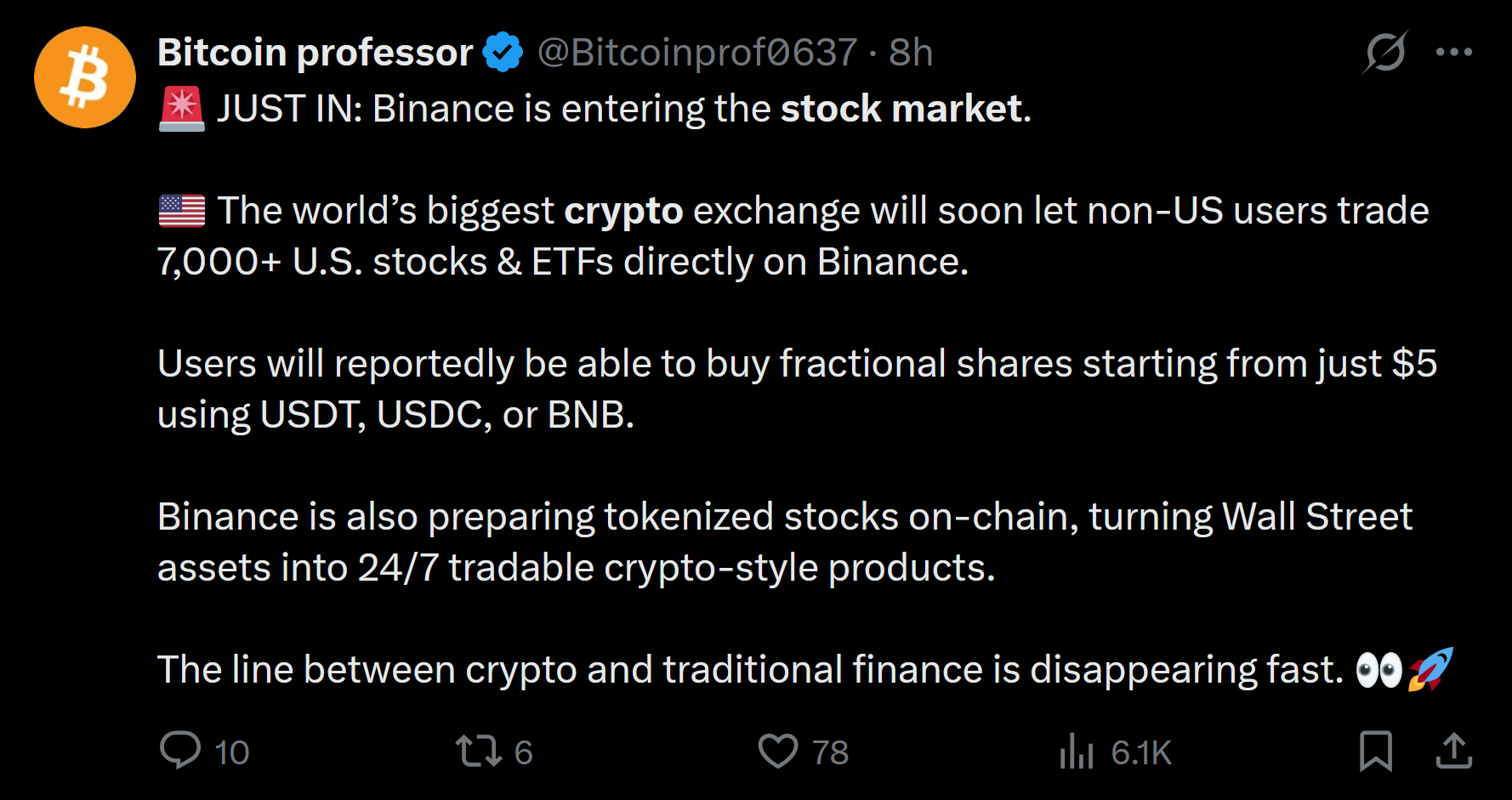
The move reflects a growing reality that many crypto traders now want exposure to both markets, especially when stocks have been producing stronger returns than most digital assets. In many ways, Binance's expansion is a perfect symbol of 2026's changing landscape: the lines between crypto and traditional finance continue to blur, and traders are increasingly following performance rather than remaining loyal to any single asset class.
Privacy and AI Become the Market's Favorite Narratives
If one theme dominated May, it was the combination of privacy and artificial intelligence. Coins associated with these sectors dramatically outperformed the rest of the market, with projects such as Monero, Zcash, NEAR Protocol, and Venice Token becoming some of the strongest performers across all of crypto.
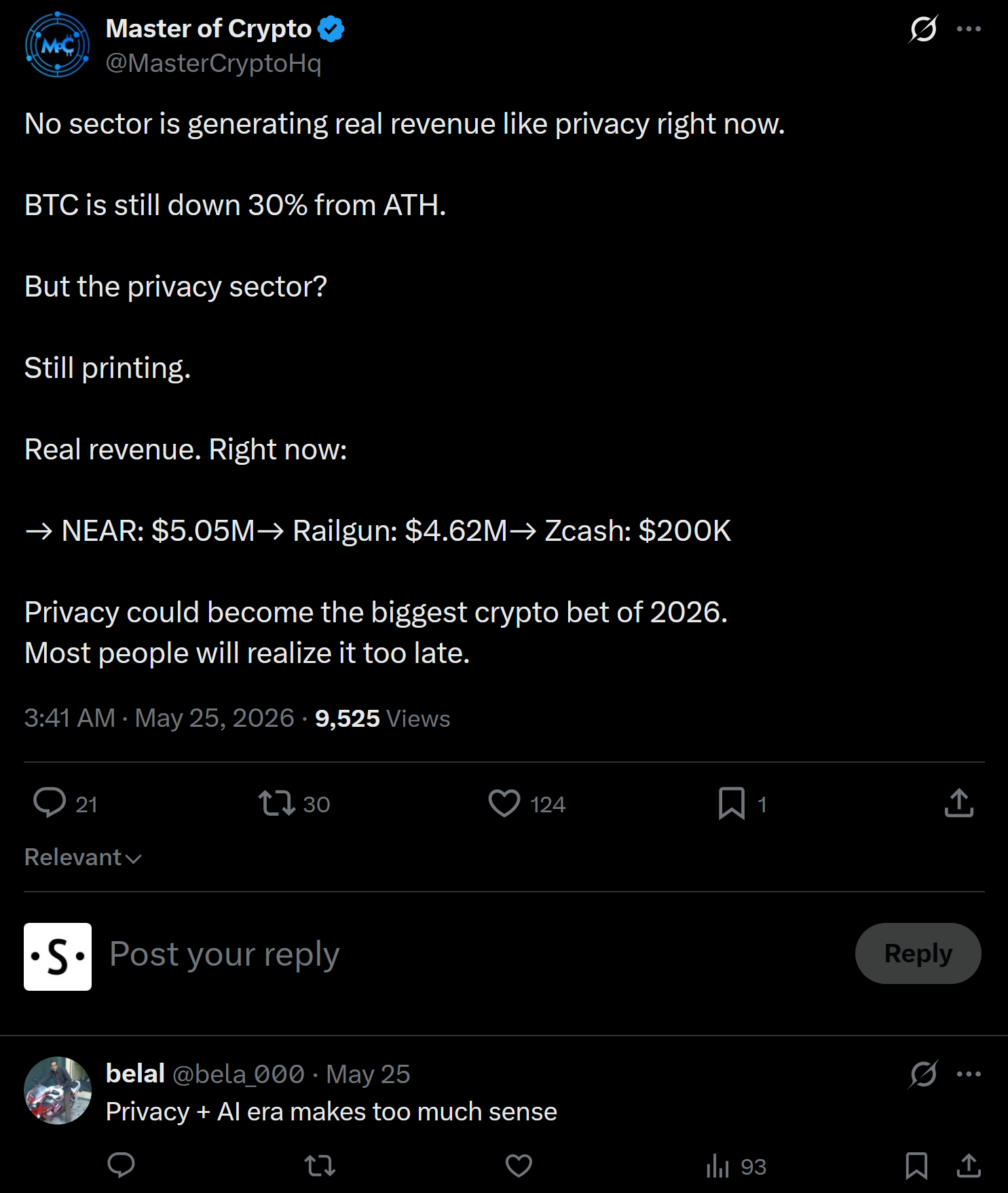
The AI narrative continued building on momentum that has been growing for well over a year. Investors increasingly viewed decentralized AI infrastructure as one of the few sectors capable of attracting meaningful real-world demand. Projects tied to machine learning, data markets, and AI computation benefited from growing optimism that blockchain technology could play a meaningful role in the next wave of technological development.
Privacy-focused assets also enjoyed a major resurgence. Growing concerns surrounding financial surveillance, data collection, and regulatory oversight helped push traders toward networks that emphasize anonymity and censorship resistance. While privacy coins have often spent years out of favor, May demonstrated how quickly sentiment can shift when investors begin prioritizing personal sovereignty and financial freedom once again.
The Weekend Iran Whipsaw
Although crypto traders largely shifted their attention back toward AI, privacy, and other crypto-native narratives throughout May, geopolitical developments remained an unavoidable source of volatility. The conflict involving Iran, Israel, and the United States no longer dominated discussion the way it did earlier in the spring, but it continued to influence markets whenever major developments emerged.
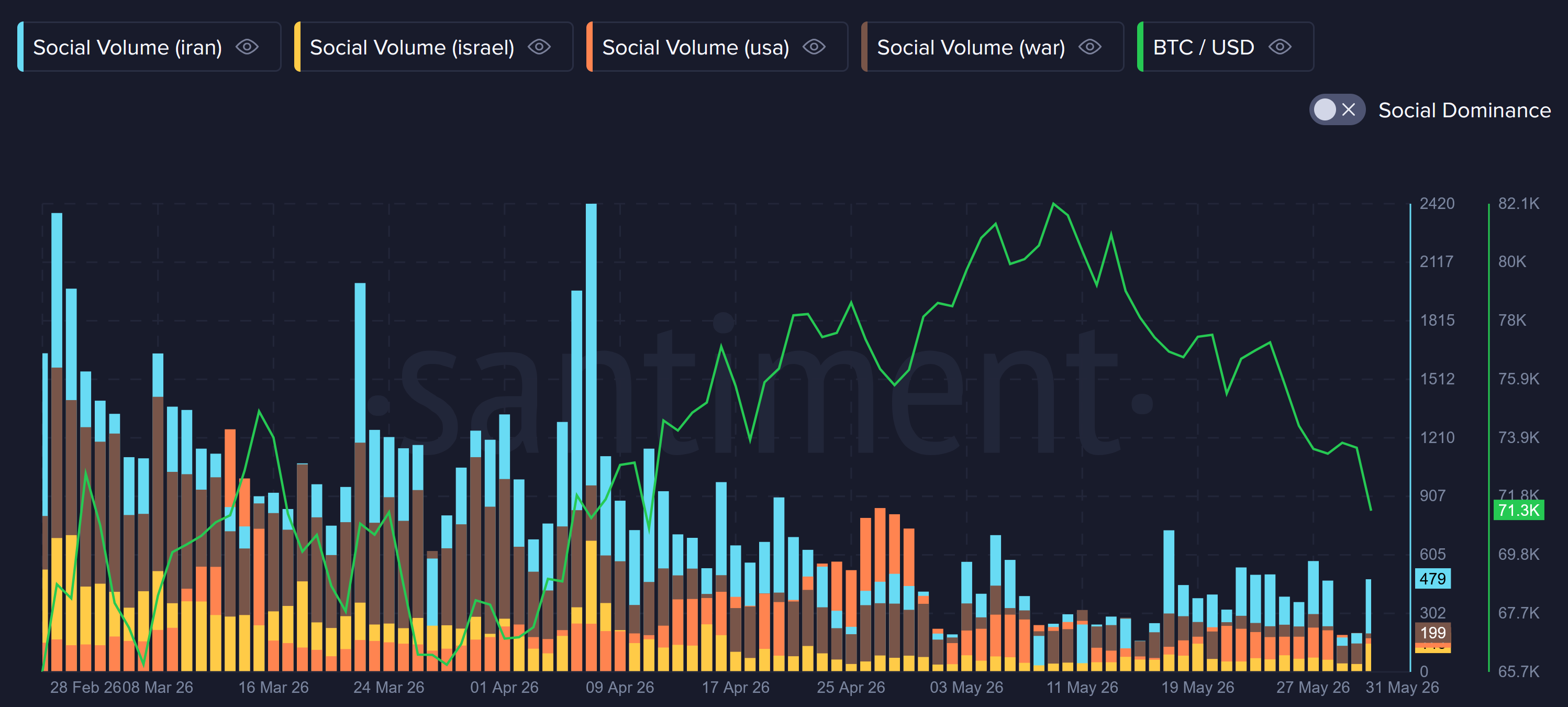
A recurring pattern developed where important announcements would arrive over weekends, often after traditional financial markets had already closed. Depending on the latest statement from political leaders, oil prices would either surge or collapse, creating immediate ripple effects across stocks, commodities, and cryptocurrencies. These reactions were often sharp but short-lived, as traders quickly returned their focus to the narratives and sectors driving crypto's strongest gains.
For crypto traders, the challenge wasn't simply understanding the news. It was determining whether the latest headline would still matter by Monday morning. Markets repeatedly experienced whipsaw price action as new information contradicted previous reports, creating brief periods of fear or optimism before attention shifted back toward crypto-specific developments. Even as traders became more engaged with digital assets again, geopolitical headlines remained capable of temporarily disrupting momentum at a moment's notice.
Hyperliquid Continues Its Rise
Few projects benefited more from this environment than Hyperliquid. As uncertainty increased and traders searched for ways to gain exposure to global markets outside of traditional trading hours, Hyperliquid's position became increasingly attractive. As we can see illustrated in the massively rising social dominance (in blue) and positive comments tracked (in green) in the chart below, they "hype" around Hyperliquid’s native token ($HYPE) has been undeniable:
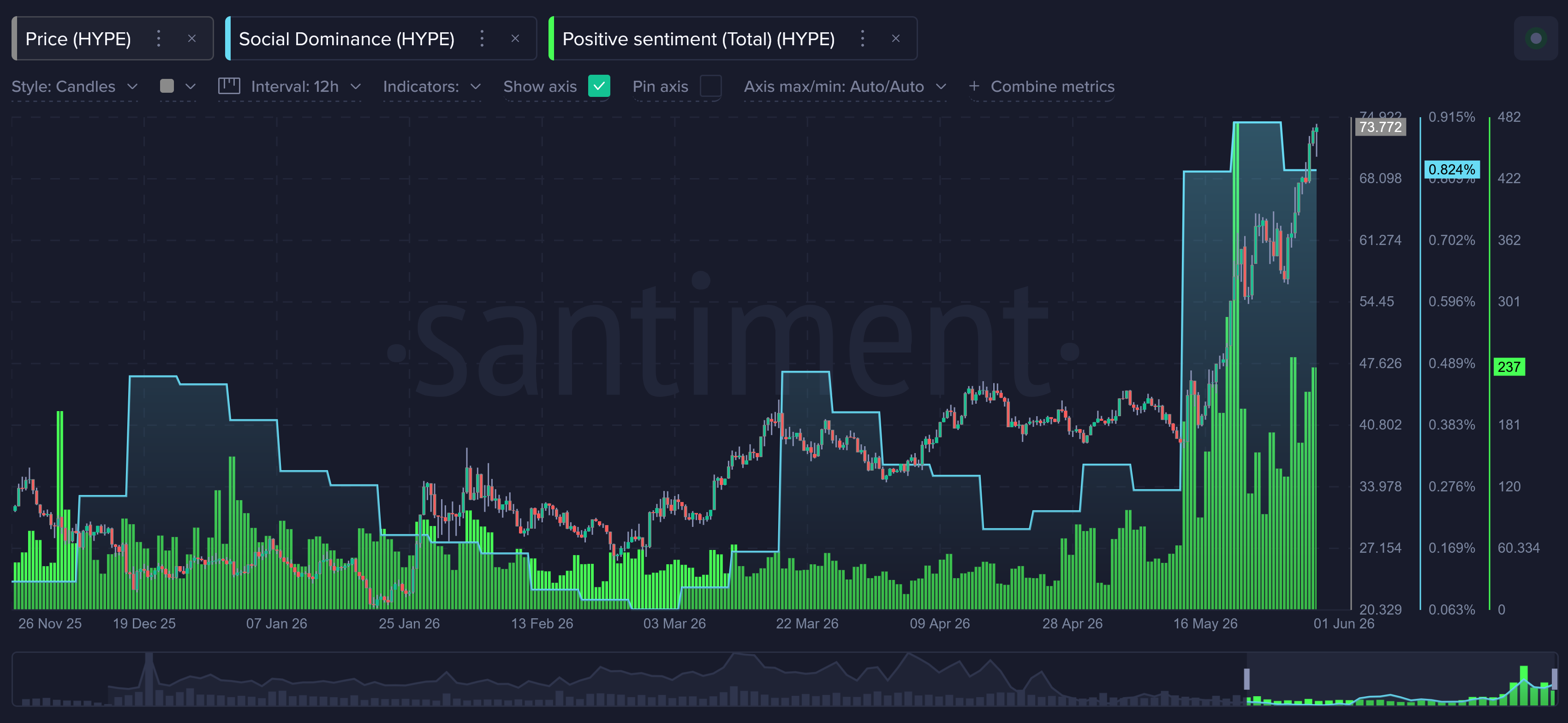
The platform itself has steadily evolved beyond a crypto-only exchange. With traders increasingly interested in commodities, equities, and macroeconomic events, Hyperliquid has become one of the most important venues for accessing these opportunities when traditional markets are closed. This was particularly valuable during weekends, when geopolitical developments often emerged and traders needed immediate ways to react.
The strength of the platform itself also helped support the HYPE token. The team has built a strong reputation for execution, the exchange continues to gain market share, and unlike many competing projects, there is relatively little concern about large venture capital investors eventually flooding the market with tokens. These factors helped HYPE climb +81% in May, reinforcing its position as one of the market's strongest-performing large-cap assets.
TON's Explosive Rally and Reality Check
Not to be outdone, another major winner in May was Toncoin. Excitement surged after Pavel Durov announced that Telegram would take a much larger role in the TON ecosystem, including becoming the network's largest validator and dramatically reducing transaction fees.
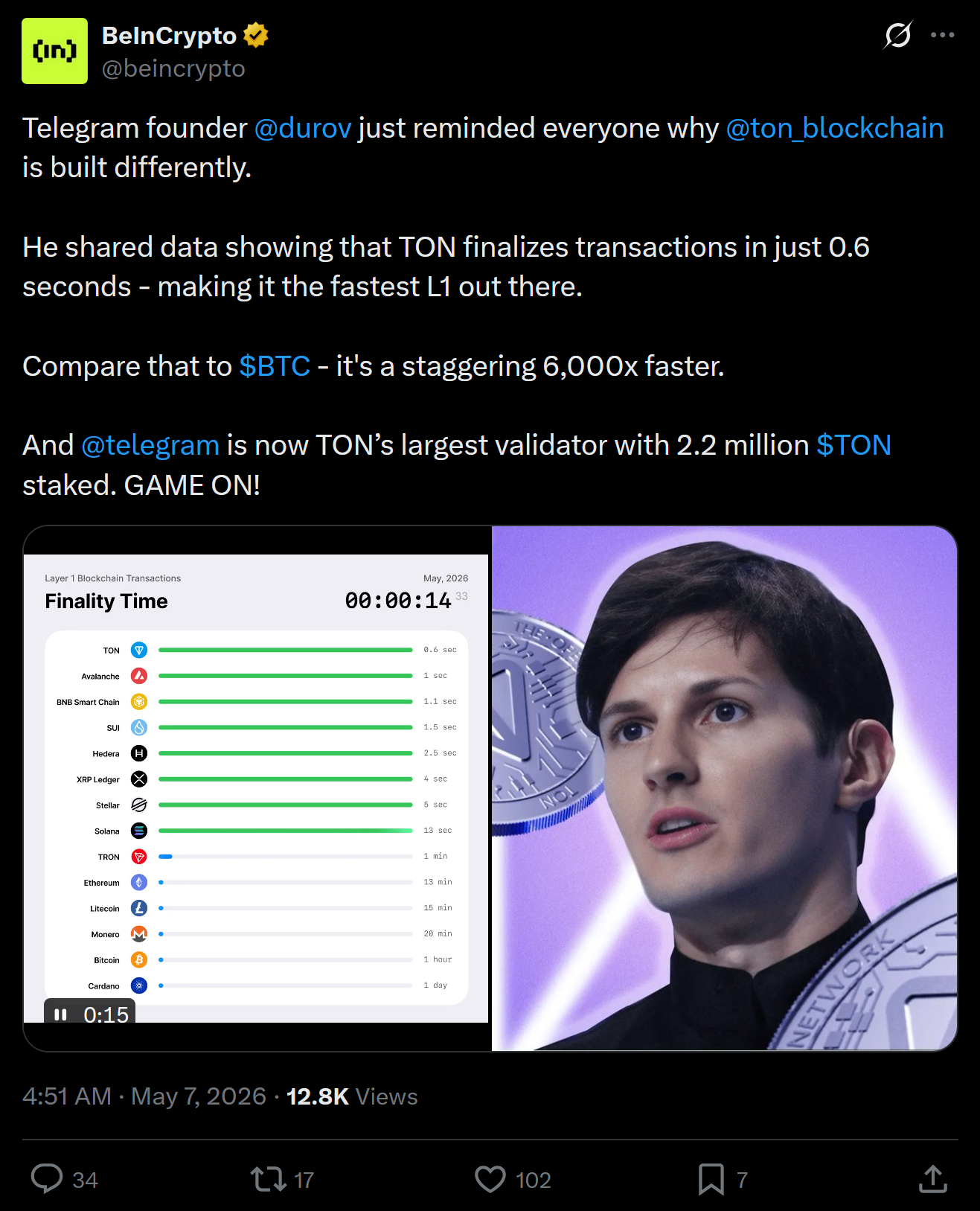
These announcements immediately reignited enthusiasm throughout the ecosystem. Lower fees encouraged activity, developers became more interested in launching applications, and a new memecoin wave quickly emerged. As speculative activity accelerated, TON's native token experienced a sharp rally. However, the excitement was eventually tempered by concerns that have followed the project for years. Unlike Hyperliquid, TON still faces significant questions surrounding investor unlocks and venture capital ownership. As profit-taking emerged and traders reassessed valuations, much of the rally faded. The result was a powerful reminder that even strong narratives can struggle to overcome tokenomic concerns.
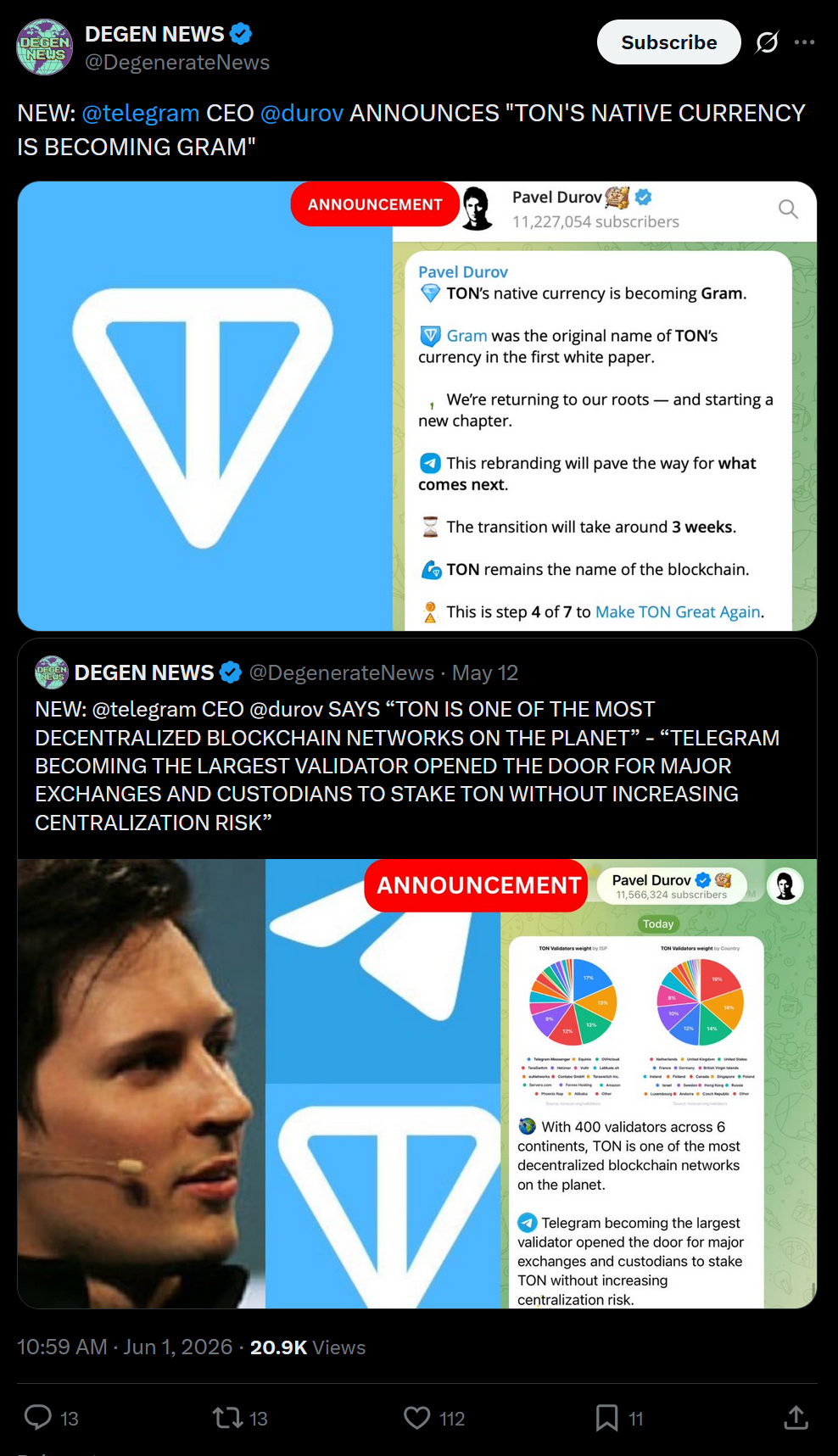
Also worth noting, June has already started with a bang for Toncoin. Pavel Durov announced that TON's native currency would be renamed from Toncoin back to Gram, reviving the original name introduced in Telegram's first blockchain white paper. According to Durov, the rebranding is intended to reconnect the ecosystem with its roots and signal the beginning of a new chapter for the network. The announcement generated considerable discussion throughout the crypto community, with supporters viewing it as a symbolic step toward tighter integration between Telegram and the TON ecosystem.
Strategy's Identity Crisis
Strategy continued to be one of crypto's most closely watched companies during May. During its first-quarter earnings call on May 5th, several important developments emerged that challenged long-standing assumptions about the company's future.
Perhaps the most surprising revelation involved the company's mNAV threshold. For years, many investors had assumed that Strategy's business model depended heavily on maintaining a premium significantly above its Bitcoin holdings. Management clarified that the breakeven threshold was much lower than many expected, providing a new framework for evaluating the company's sustainability.
Strategy continued to be one of crypto's most closely watched companies during May. During its first-quarter earnings call on May 5th, several important developments emerged that challenged long-standing assumptions about the company's future.
Perhaps the most surprising revelation involved the company's mNAV threshold. For years, many investors had assumed that Strategy's business model depended heavily on maintaining a premium significantly above its Bitcoin holdings. Management clarified that the breakeven threshold was much lower than many expected, providing a new framework for evaluating the company's sustainability.
Another major discussion point arrived immediately after May ended. On June 1st, Strategy disclosed the sale of 32 BTC worth approximately $2.5 million, marking the first publicly recorded Bitcoin sale in the company's history. The amount was insignificant relative to its massive holdings of hundreds of thousands of BTC, but the optics generated intense debate throughout the crypto community. For years, Michael Saylor's "never sell" philosophy had become one of the company's defining characteristics. As a result, even a tiny sale was enough to spark questions about whether Strategy's approach to Bitcoin ownership is beginning to evolve.

Even more notable was Michael Saylor's shift in messaging. Rather than presenting Strategy purely as a Bitcoin holding company, he described the business more like a Bitcoin real estate developer. Investors also learned that selling Bitcoin was no longer completely off the table. The company had previously suggested that Bitcoin could potentially be used in the future to fund dividends, repay obligations, or support broader corporate objectives if necessary. This represented a meaningful departure from the rigid accumulation narrative that investors had grown accustomed to.
At the same time, Strategy demonstrated that it remains firmly committed to holding Bitcoin whenever possible. Despite speculation that the company might liquidate some of its holdings to address approximately $1.5 billion of convertible debt, management instead used existing cash reserves and left its Bitcoin treasury largely untouched. The combination of the June 1st sale and the debt repayment decision produced mixed reactions among investors. Some viewed the small sale as a warning sign that no Bitcoin treasury is truly permanent, while others saw it as evidence that Strategy is becoming a more flexible and mature financial vehicle without abandoning its long-term conviction in Bitcoin.
The CLARITY Act Remains in Limbo
Throughout May, optimism surrounding the CLARITY Act continued to rise as lawmakers, industry leaders, and crypto-focused media repeatedly suggested that meaningful regulatory clarity was finally approaching. The bill advanced through key committee discussions and remained one of the most actively discussed pieces of legislation in the digital asset industry. With each hearing, statement, and procedural milestone, traders became increasingly convinced that the United States was on the verge of establishing a comprehensive framework for cryptocurrencies.
The proposed legislation remains one of the most anticipated developments in the industry because it could provide much-needed guidance on how digital assets should be classified and regulated in the United States. One of its primary objectives is to draw clearer lines between securities and commodities while establishing rules for exchanges, issuers, brokers, and decentralized finance platforms. Clearer regulations would reduce legal uncertainty, encourage institutional participation, and potentially unlock a new wave of investment into the sector.

However, the defining characteristic of May was not progress itself, but rather the constant expectation that progress was imminent. Week after week, traders were told that the legislation was "just around the corner," only for another delay, debate, or procedural hurdle to emerge. The month even saw a public war of words erupt between JPMorgan CEO Jamie Dimon and Coinbase CEO Brian Armstrong, highlighting the deep divide that still exists between parts of the traditional financial system and the crypto industry. Supporters of the bill argued that regulatory clarity would help the United States remain competitive in digital assets, while critics warned that aspects of the legislation could weaken existing financial safeguards. As the month came to an end, the bill still had not become law. The repeated cycle of optimism followed by postponement gradually transformed excitement into frustration. For many market participants, the CLARITY Act began to resemble a finish line that continuously moved farther away every time the industry thought it was within reach.
Ethereum's Vision Crisis Deepens
While Bitcoin and several alternative sectors enjoyed strong narratives, Ethereum faced a very different challenge. Criticism surrounding the Ethereum Foundation reached levels rarely seen in previous cycles, with many community members questioning both its leadership and overall direction.
A major source of frustration involved perceptions that the Foundation had become disconnected from the needs of builders, investors, and users. Critics argued that while competitors focused on growth, adoption, and execution, Ethereum's leadership often appeared more interested in philosophical debates and ideological discussions.

The situation worsened as several prominent advocates distanced themselves from the ecosystem. Departures from the Foundation, continued criticism regarding ETH sales, and the decision by the Bankless team to fully exit their ETH positions all contributed to a growing sense of uncertainty. Although Vitalik Buterin recently outlined plans for organizational changes and future improvements, the market's reaction was largely skeptical. For some investors, this wave of criticism represented a warning sign. For others, it was viewed as a classic capitulation event and a potential long-term bottom signal.
A Market Searching for Leadership
May 2026 demonstrated that crypto markets are once again being driven by narratives rather than broad participation. While Bitcoin and Ethereum discussions surged, most assets failed to benefit. Instead, capital concentrated into a handful of sectors and projects that offered compelling stories and strong momentum.
The strongest performers all shared a common trait: they gave traders something to believe in. Whether it was AI, privacy, Hyperliquid's growing influence, or TON's Telegram integration, investors rewarded projects that appeared to have clear direction and purpose.
As June begins, many of the market's biggest questions remain unresolved. Regulatory clarity remains elusive. Geopolitical tensions continue to generate volatility. And Ethereum is still searching for a vision capable of reuniting its community. Yet despite these uncertainties, one thing became increasingly clear throughout May: attention has returned to crypto, and history suggests that capital often follows attention sooner or later.
-----
Free two-week trials to Sanbase PRO (to access all mentioned Santiment data in this article, and plenty more) are AVAILABLE HERE!
-----
Disclaimer: The opinions expressed in the post are for general informational purposes only and are not intended to provide specific advice or recommendations for any individual or on any specific security or investment product.