
Santiment Anomaly Report: May 13th to 19th

The Santiment Anomaly Report
will become its own newsletter soon — join the mailing list!
Crypto markets often move in unusual ways. Most of it is noise, but once in a while there’s a blip that could mean something. A token suddenly dominating crypto Twitter, whales dumping ETH, price spiking while network usage flatlines — you get the gist.
We call these anomalies. They often lead to trading opportunities — and this report helps you find them.
In it, we look at triggers from the 8 anomaly types we track, tell the bigger story, and list things to watch next week.
This report is for analysts, traders, and anyone curious about what crypto’s on-chain and social data are showing.
Now, let’s dig in!
Last Week in Brief
We detected 71 trigger events across 6 of the 8 anomaly types we track.
To keep things short and noise-free, we only talk about assets with $50M+ in market cap, unless otherwise noted.
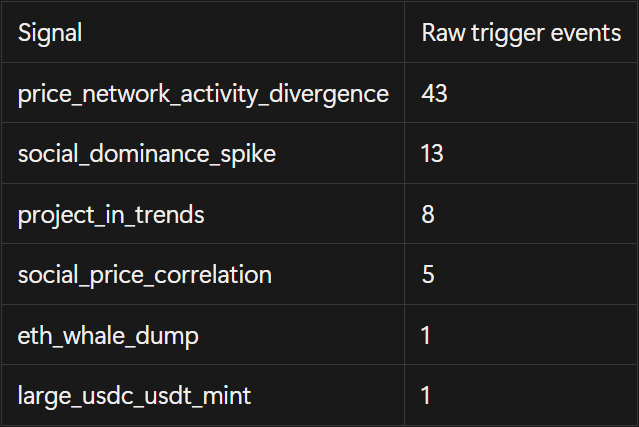
Most triggers happened in ‘price_network_activity_divergence’ — but for assets under $50M market cap only, so this week was more about social anomalies.
- THORChain — strongest social dominance, due to a hack
- XDC Network — big names and marketing push at big industry conference
- USD-Coin — non-BTC/ETH trend peak, driven by regulatory news
- Onbeam — riding Hyperliquid momentum
THORChain ($RUNE)
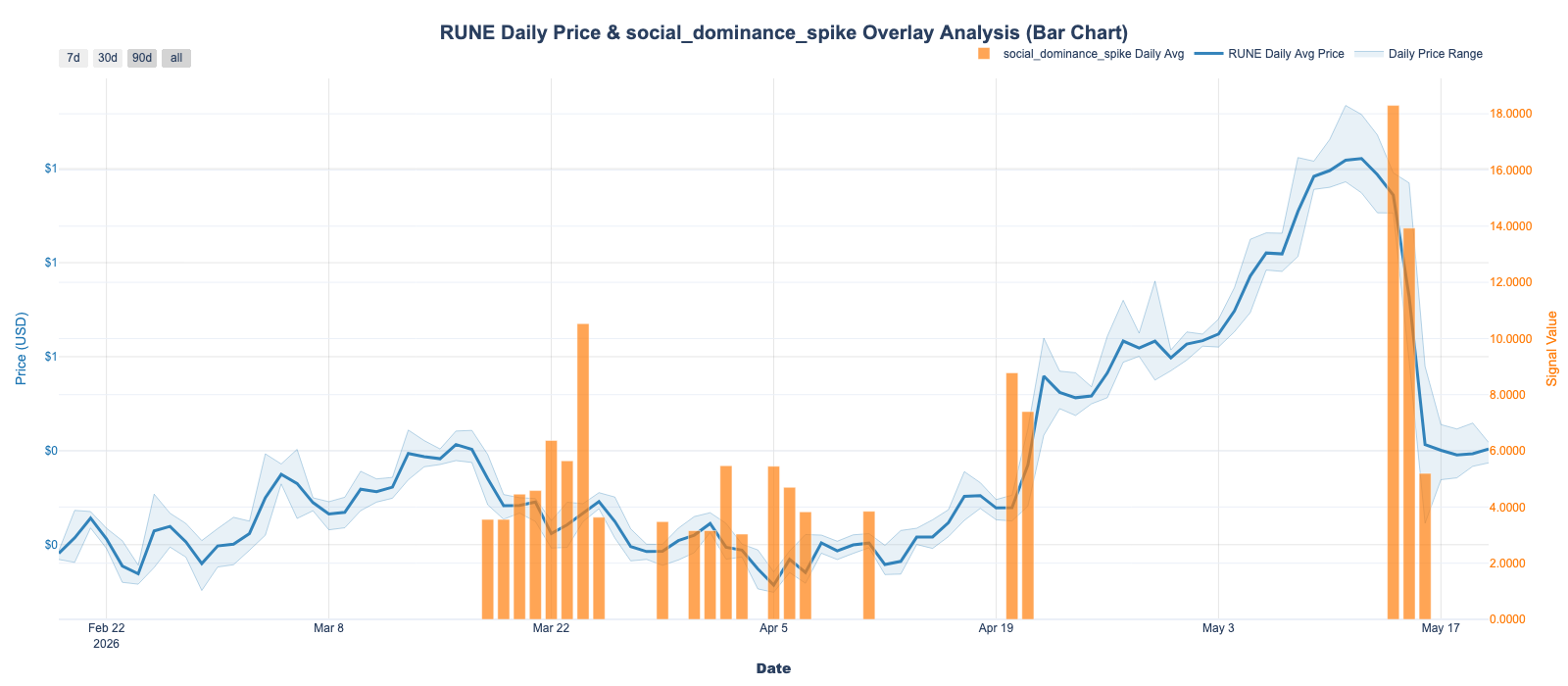
RUNE's peak social dominance score of 18.30 alongside 4 other triggers reflects a violent, multi-wave social cycle driven first by an ecstatic bullish announcement, then a catastrophic security breach.
Multiple X posts from May 12 describe XMR swaps on THORChain as live or in final testing with real funds — a long-awaited integration that put RUNE squarely back on crypto Twitter’s radar.
A few days later, on May 15-16th, THORChain halted trading after a $10.8 million exploit. What a week.
The takeaway: RUNE’s peak attention came from a binary mix of bullish anticipation and post-hack confusion — the kind of social-dominance cluster that often produces volatile, asymmetric price action rather than directional follow-through.
XDC Network ($XDC)
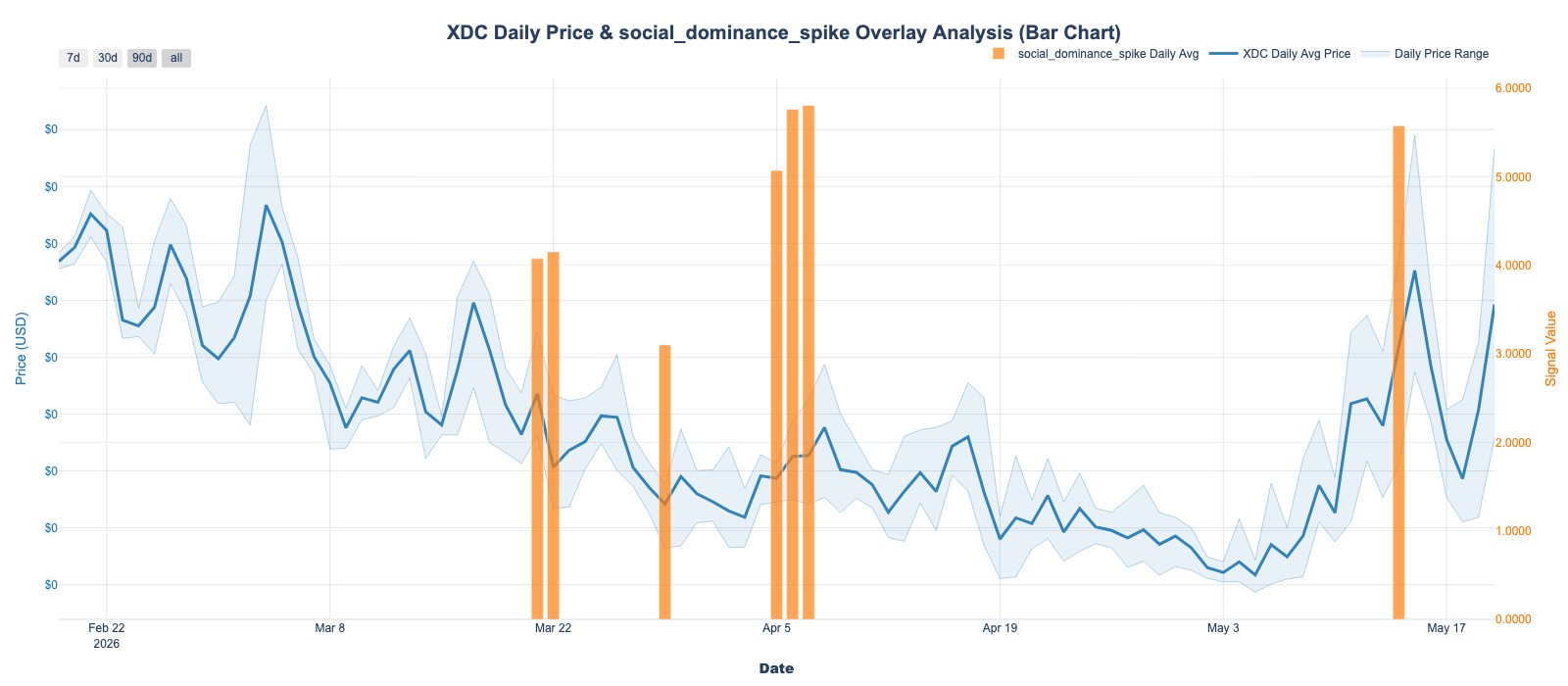
The first trigger of the social dominance spike anomaly happened on May 13th, coinciding with their participation in Consensus Miami with 20K+ participants from companies managing $4T+ in assets.
The second trigger occurred the following day on the back of a viral interview titled ‘XDC is solving a $15 trillion problem.’ The accompanying post highlighted XDC’s acquisition of Contour Network — with Citi, HSBC, and Standard Chartered as infrastructure partners — and announced $80M USDC now live on the XDC network.
The takeaway: institutional partnerships and a Consensus presence drove a clean upward narrative — the kind of dominance spike that tends to extend rather than reverse, especially with continued bank-partner news flow.
OriginTrail ($TRAC)
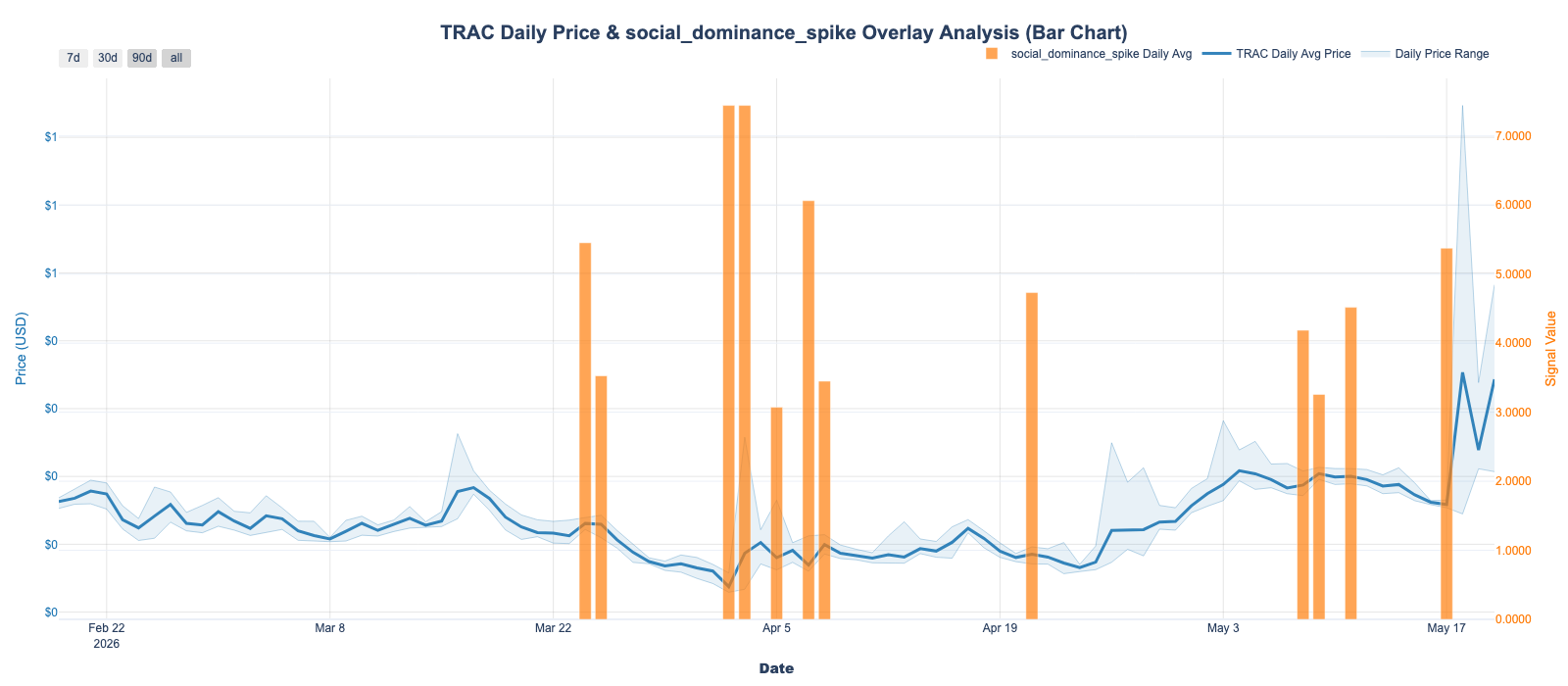
The social dominance spike triggered at May 17 16:00 UTC is the announcement day spike — Upbit officially confirmed support for OriginTrail across three major trading pairs: KRW, BTC, and USDT. Trading is scheduled to begin on May 18 at 16:00 KST.
Upbit consistently leads South Korean trading volume, and the Korean won (KRW) market is one of the most active retail trading environments on the planet. Previous Upbit listings of data and AI-adjacent tokens have resulted in sharp short-term price movements.
The second trigger (also on May 17) may reflect X amplification as the AI narrative added momentum to the rally, with OriginTrail continuing to promote its push toward a verifiable internet combining AI, blockchain, and web infrastructure.
The takeaway: an Upbit listing in a Korean retail-heavy environment, paired with the AI narrative, sets up the kind of attention-driven price action that tends to spike on listing day and fade within days unless the underlying narrative compounds.
JasmyCoin ($JASMY)
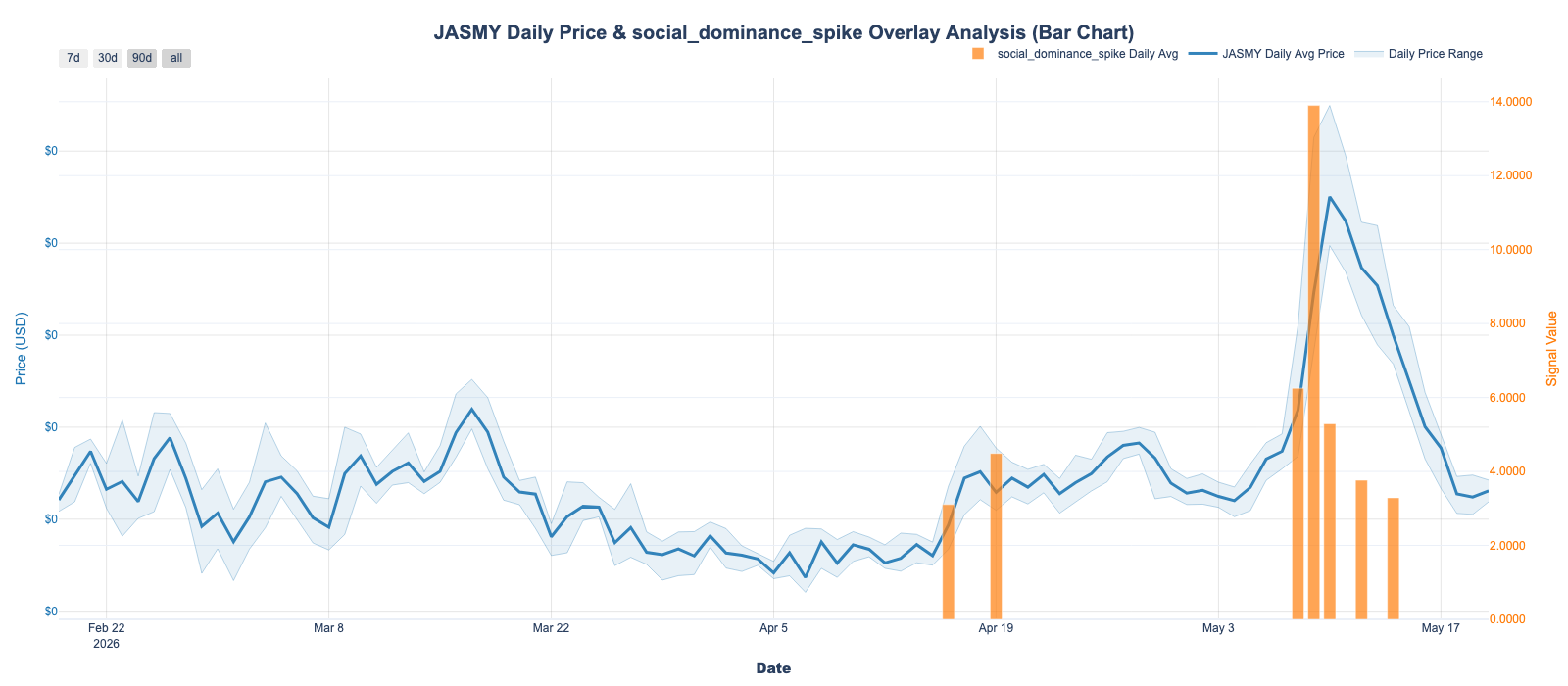
JASMY’s May 14 12:00 UTC spike is the smallest in this dataset. The most likely explanation is a combination of macro altcoin rotation and a specific Japan-tech narrative being amplified on X.
The community has been circulating an unconfirmed “strategic partnership” with Apple, which would supposedly integrate JASMY with Japan’s “My Number” digital ID card via iPhone. X discussions around Japanese government digital identity projects were active in this period, and JASMY is the primary crypto beneficiary of that narrative.
The narrower truth: JASMY has previously been connected to the My Number system through the iTrust authentication service, and a partnership with CyberTrust Japan enables blockchain-based authentication and encryption. So JASMY has a legitimate, though indirect, connection to the My Number infrastructure — but that is very different from a partnership with Apple.
The takeaway: a narrative trade where the rumor is louder than the underlying truth is likely a bad long term driving of positive price action. Deeper research is recommended.
USDD (and potentially $TRX)
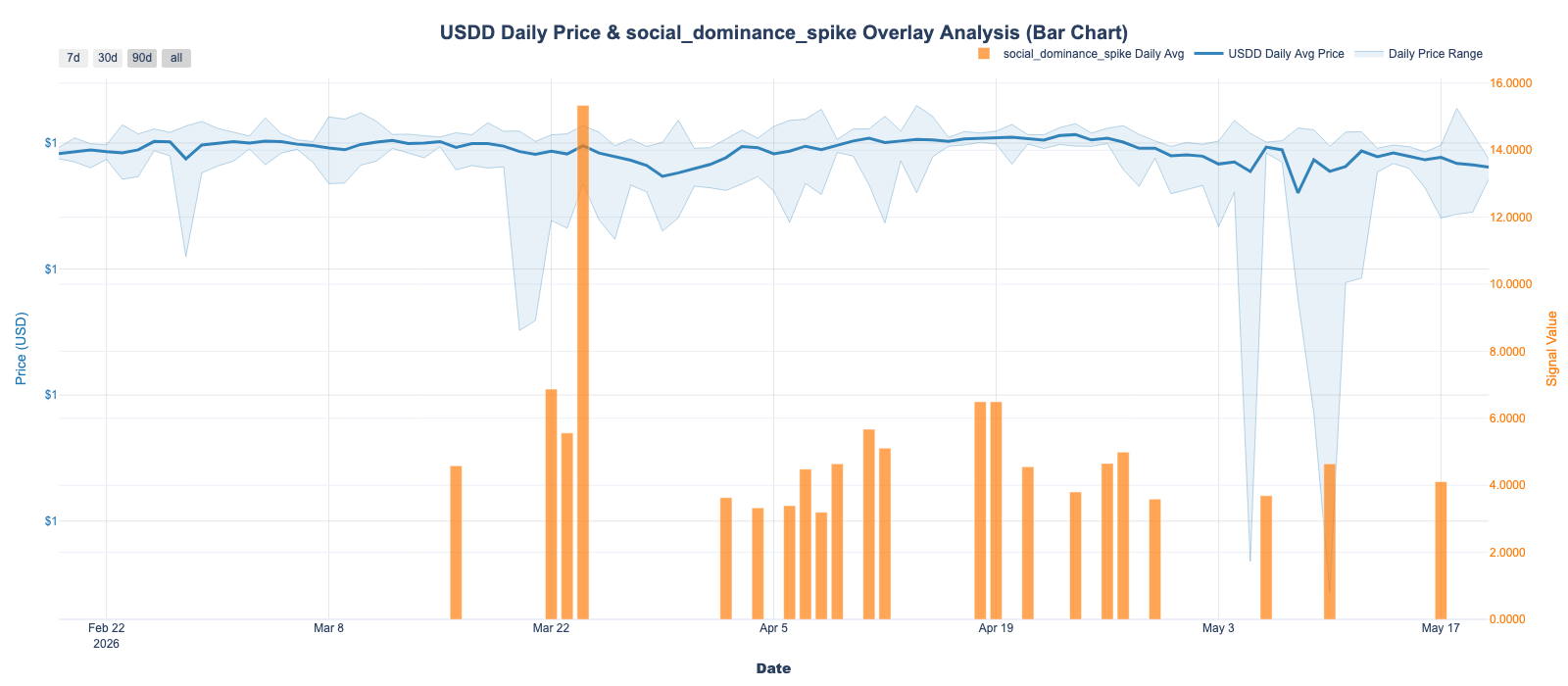
The week of May 14–17 was the most active week in the stablecoin regulatory debate of 2026. The US GENIUS Act was moving through Senate, and discussions on X were polarized between those supporting the bill and those warning it would entrench USDT/USDC dominance while squeezing decentralized alternatives like USDD.
USDD, as a decentralized, over-collateralized stablecoin with a $1.53B market cap, was specifically cited as an example of the category that the GENIUS Act would treat differently from fiat-backed stablecoins.
USDD has persistent negative sentiment, consistently gaining attention through concern and scrutiny, not enthusiasm. This is likely due to the industry’s natural skepticism and caution around Tron and Justin Sun.
The takeaway: attention driven by regulatory worry, not enthusiasm — the kind of spike that doesn’t translate cleanly into bullish positioning, though TRX may move on continued GENIUS Act and USDD positive news flow.
USD-Coin ($USDC, $COIN, and $HYPER)
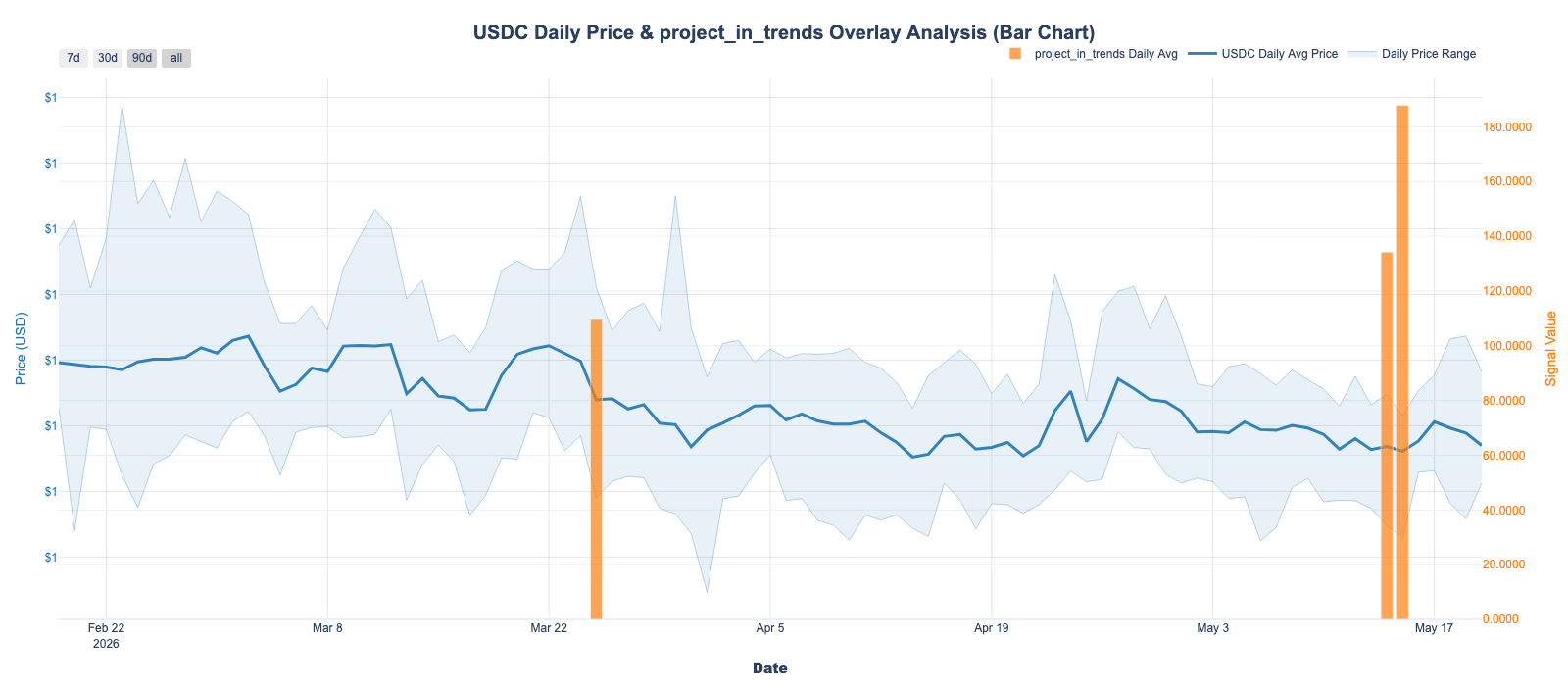
The first social dominance spike triggered on May 14: after months of back and forth, the US CLARITY Act passed the Senate Banking Committee markup vote in a landmark 15-9 bipartisan vote. This was the most consequential legislative hurdle in a 10-month push since the House passed a version 294-134 in July 2025. The bill draws a clear line between SEC and CFTC oversight for digital assets, and crucially for USDC, addresses stablecoin issuance rules directly.
On May 15, Coinbase expanded its support for Hyperliquid by becoming the platform’s official treasury deployer of USDC. In their announcement, Coinbase framed the move bluntly: “On-chain markets operate 24/7 and require collateral that is always available, instantly transferable, and deeply liquid — USDC delivers exactly that.”
This landed the same morning as the CLARITY Act news cycle was still cresting, and directly drove Hyperliquid’s 24% rally that week. The X narrative on May 15 was USDC being positioned simultaneously as the foundation of regulated US stablecoin law AND the collateral of choice for the hottest on-chain trading venue — a rare double-legitimacy moment.
The takeaway: a rare moment where regulatory and ecosystem catalysts stacked in the same week. The trade isn’t USDC itself — it’s the names that benefit from USDC’s ascendancy: COIN, HYPE, and stablecoin-adjacent infrastructure.
OnBeam ($BEAM)
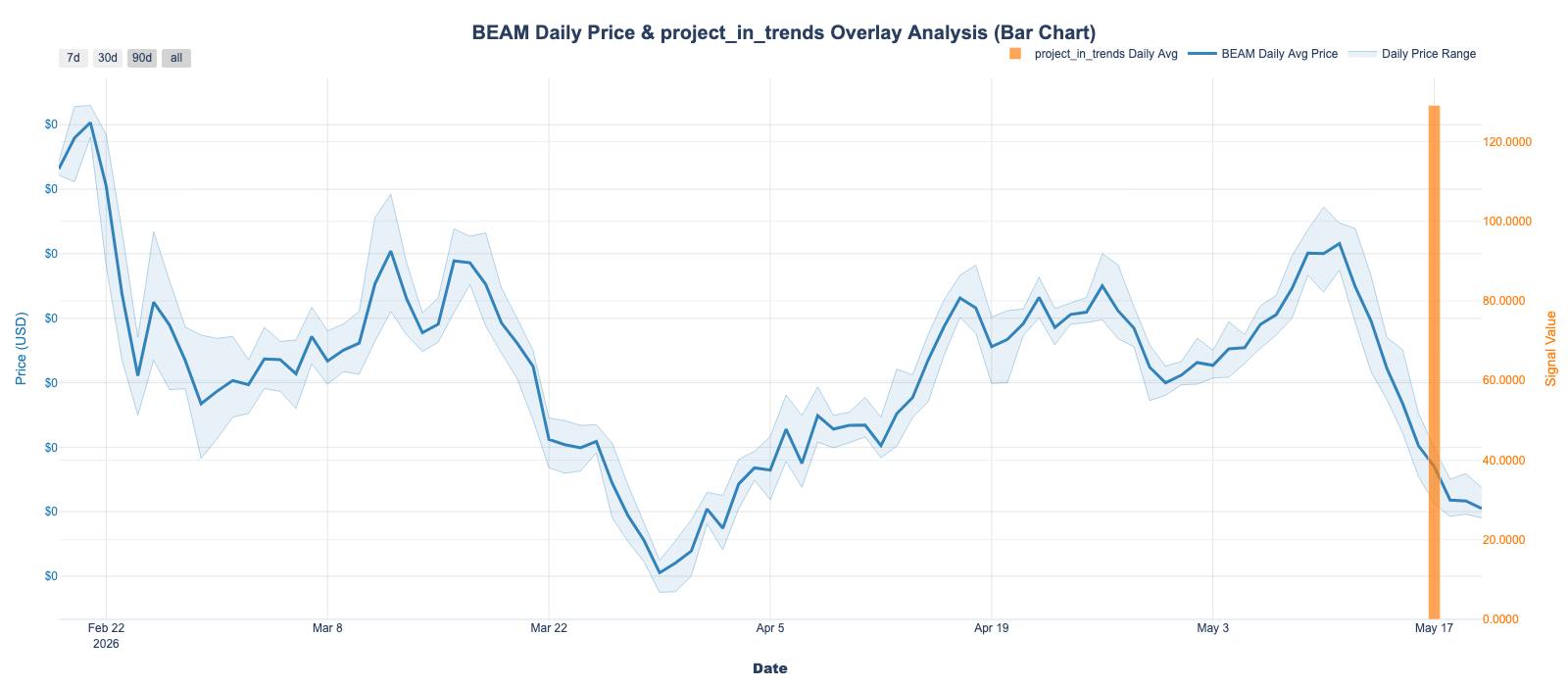
This social dominance spike trigger is best explained as a delayed second-order effect of the dominant narratives this week — combined with a specific Beam catalyst.
Dreamcash, Beam’s mobile front-end for trading on Hyperliquid, had processed over $2.7 billion in volume since its beta launch, with plans to introduce HIP-3 markets and a WebApp. When Hyperliquid surged 24% during May 13–17 on the back of the Bitwise BHYP ETF launch and Coinbase’s USDC treasury deployer announcement, Dreamcash’s deep integration with Hyperliquid made BEAM a direct secondary beneficiary — any surge in Hyperliquid activity translates to Dreamcash volume, which accrues back to the BEAM token.
The takeaway: a beta trade on Hyperliquid via Dreamcash exposure — pays as long as the underlying momentum continues, but doesn’t survive without it.
What Else Happened
No asset in ‘price_network_activity_divergence’ passed the $50M market-cap filter this week. The signal still produced 43 raw trigger events, but they were concentrated in smaller assets such as league-of-kingdoms, polymath-network, akita-inu, and human.
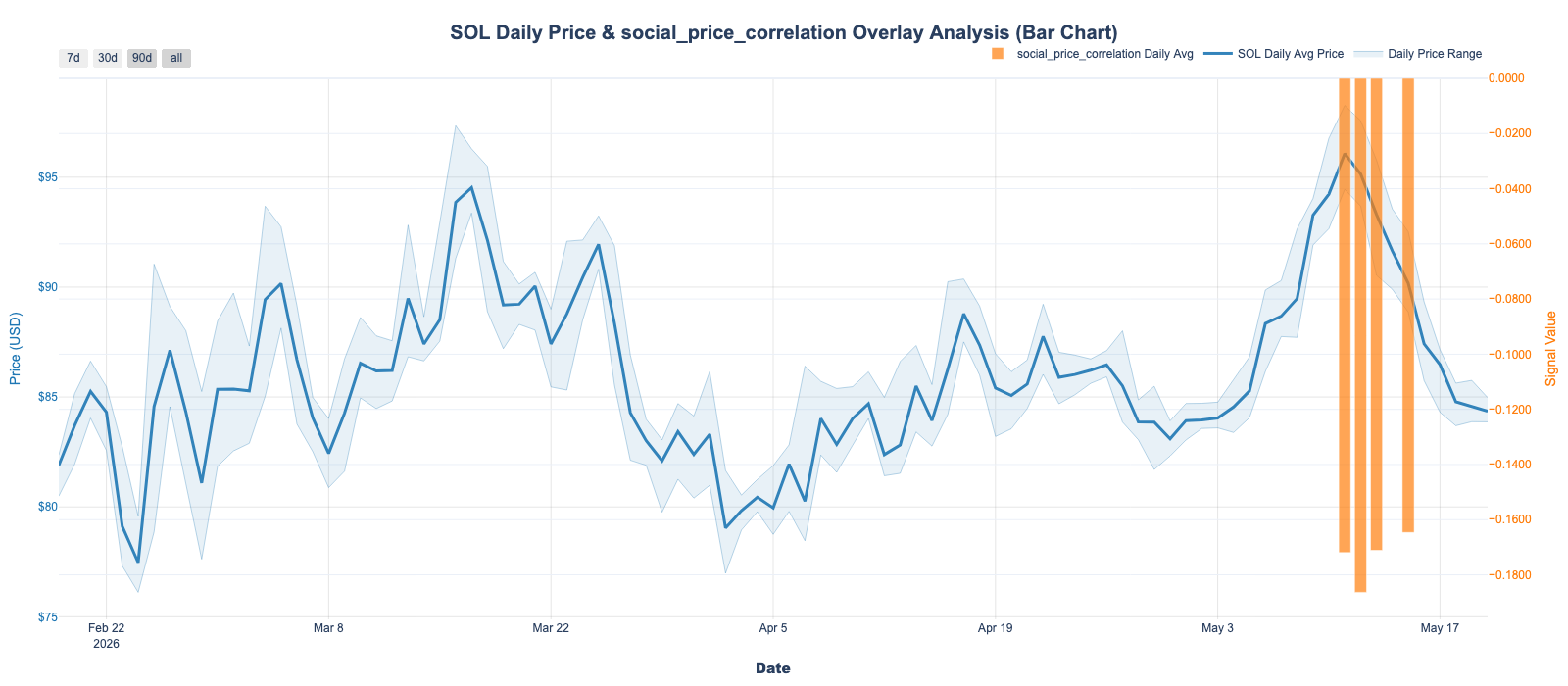
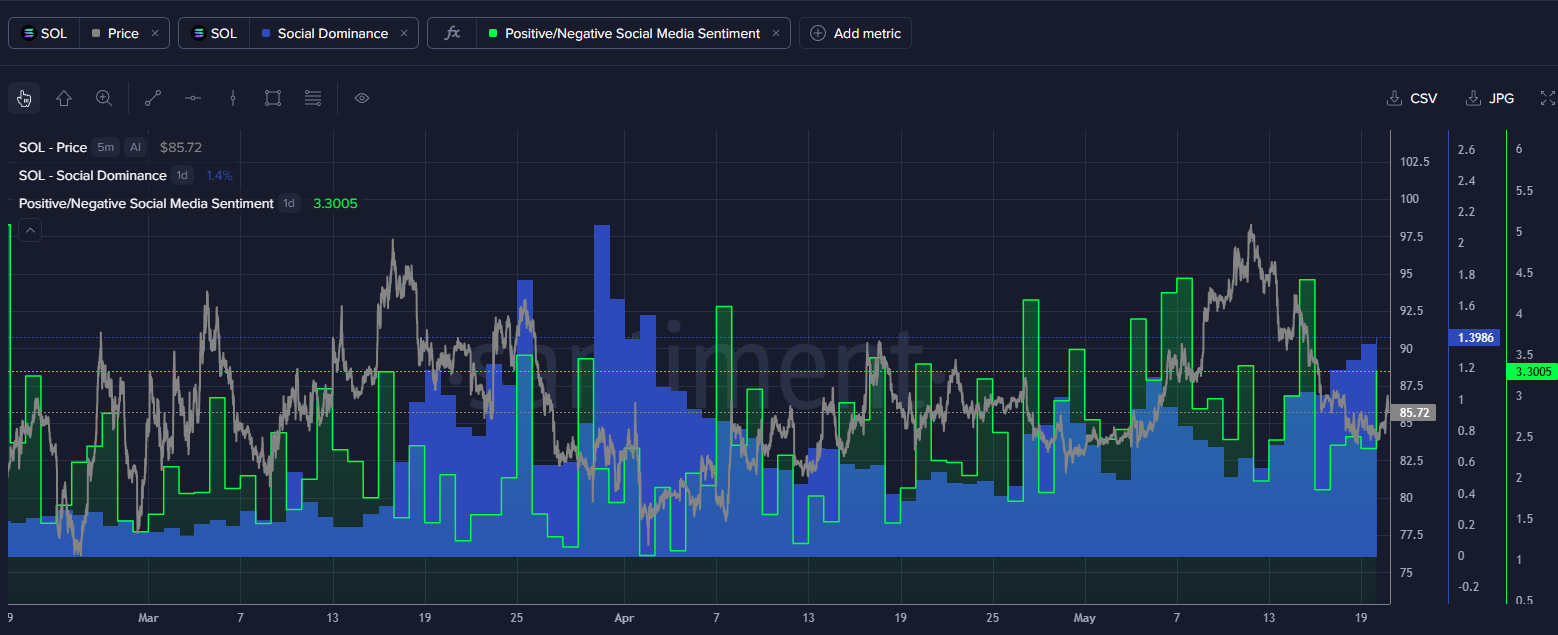
‘social_price_correlation’ produced 5 eligible events, all on ‘solana’, with a value of -0.16 across May 15. This anomaly detects when social sentiment and price are unusually aligned or unusually decoupled. Here, they were decoupled: Solana sold off from $95 to $85 while sentiment spiked up during the move down.
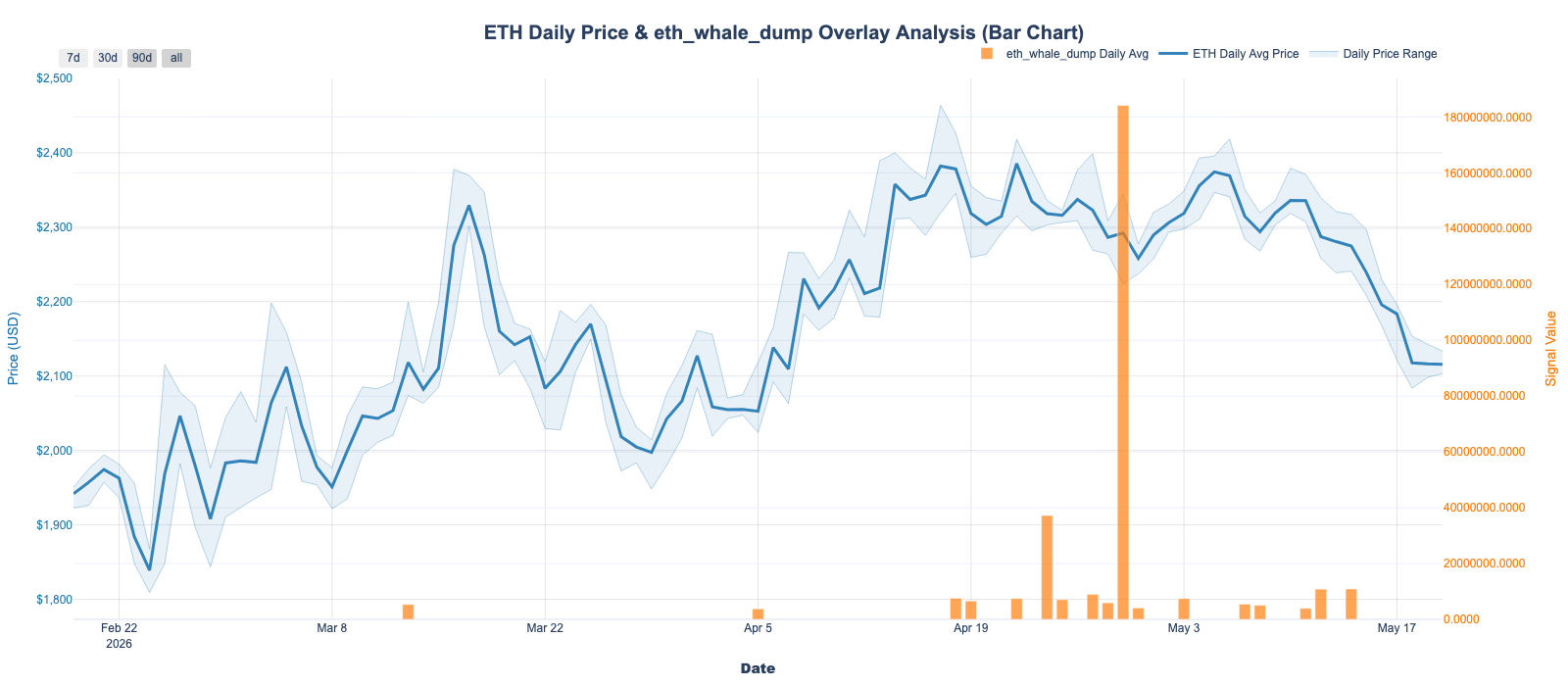
‘eth_whale_dump’ v2 produced 1 ETH-only event on 2026-05-14 22:15:59, with a value of $10,903,892. This signal is ETH-only by definition, so the read is about the timing and size of the ETH event rather than a cross-asset comparison. We’ve also made this anomaly less sensitive so more abnormal events will be highlighted.
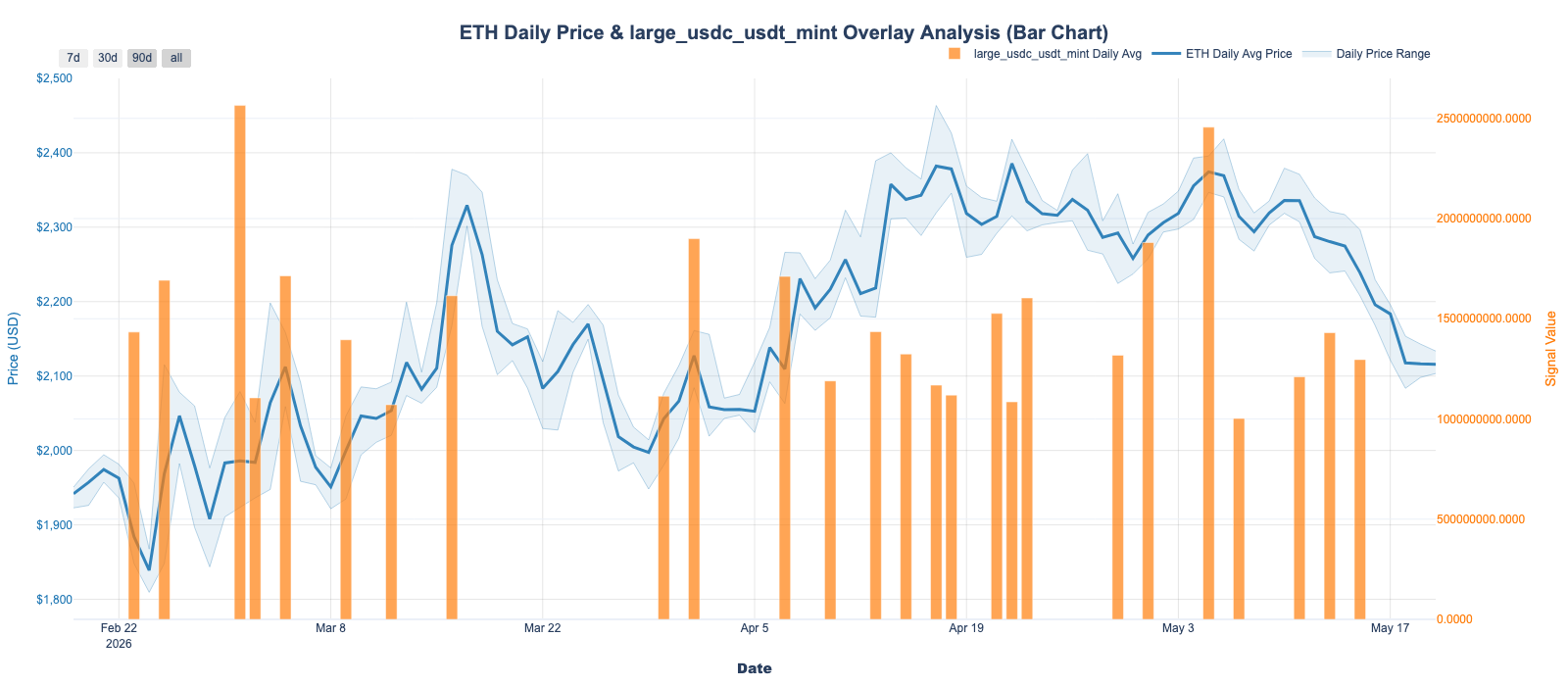
‘large_usdc_usdt_mint’: a single $1.3B mint event on May 15 — large in absolute terms but routine in current market conditions. Worth tracking but not actionable on its own.
Worth Watching
- THORChain: strongest social-dominance spike by both count and peak.
- USD-Coin: highest eligible non-BTC/ETH project-trend peak; this may act as a proxy to other stablecoin projects affected by the CLARITY Act.
- Coinbase and Hyperliquid: positively affected by the recent regulatory news in the US.
- Onbeam: a beta play on Hyperliquid growth via Dreamcash.
- XDC Network: historically alternative blockchains have performed poorly, but with the big names and marketing perhaps XDC is worth tracking.
The Anomalies We Track
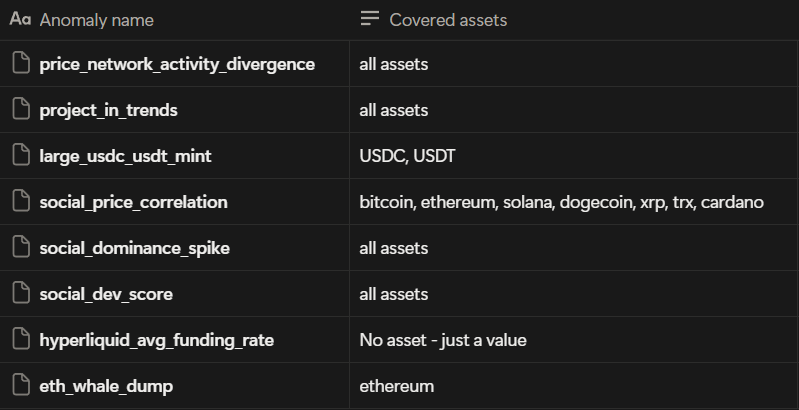
Network Activity & Price Divergence Anomaly — detects price surges that are not accompanied by a corresponding rise in network activity (real growth). Triggered only if the price growth exceeds 3% on the same day, ensuring the alert is relevant for significant bullish moves.
Project in Trends Anomaly — detects when a specific crypto token gains significant traction in online discussions, placing it among the top 10 most-mentioned words in crypto-related conversations.
Large USDC-USDT Mint Anomaly — detects daily combined $1 billion or larger minting events of USDC and USDT stablecoins on the Ethereum blockchain.
Social Price Correlation Anomaly — detects whether social sentiment and price are behaving in an unusually aligned or unusually decoupled way. Currently runs on 1h X.com social data for bitcoin, ethereum, solana, dogecoin, xrp, trx, and cardano.
Social Dominance Spike Anomaly — detects abnormal spikes in social dominance metrics. Alerts when values exceed a statistical significance threshold of 3 standard deviations over 30 days.
Social-Dev Score Anomaly — detects unusual activity compared to recent 30-day history of social media metrics and development activity. The score is weighted 60/40 for social and dev activity.
Hyperliquid Average Funding Rates Anomaly — detects when rates exceed predefined high/low thresholds of +40% and -20%, measured hourly.
ETH Whale Dump Anomaly — detects potential large-scale ETH dumps by monitoring whale wallet behaviors. Uses a 500 ETH threshold and a 30-day holding period to distinguish normal trading from potential dump scenarios.
Thanks for checking out this week’s Santiment Anomaly Report. See you next week!
Anomalously Yours,
Santiment
Disclaimer: This report is for reference purposes only and is not intended as financial or investment advice. Always DYOR.