Deep Dive: Reliable Social Trend Signals During Times of Uncertainty!

With markets showing improvements as of late, and the war between the U.S, Iran, and Israel still technically ongoing, it's time for us to take a look at which Social Trends signals can be helpful to see which way the crowd is leaning.
As we consistently discuss, markets will typically move the opposite direction of the retail crowd's expectations. So if you're seeing fellow traders getting greedy, it's a warning sign that a rally may soon come to an end. On the flip side, if fellow traders are getting fearful, it may be time for you to dip your toes in and try to buy into others' fear.
Our Social Trends tool is a great spot to search for any word or combination of words, adjust time intervals and date ranges, and see how often your query is being mentioned. Big spikes in a specific topic could provide fantastic alpha, and you could be among the first to know about a market pump or dump right before it starts!
So without further adieu, here are several great Social Trends examples (with links for you to bookmark for future use) that we provide live updates on below:
Greed-Related vs. Fear-Related Words:
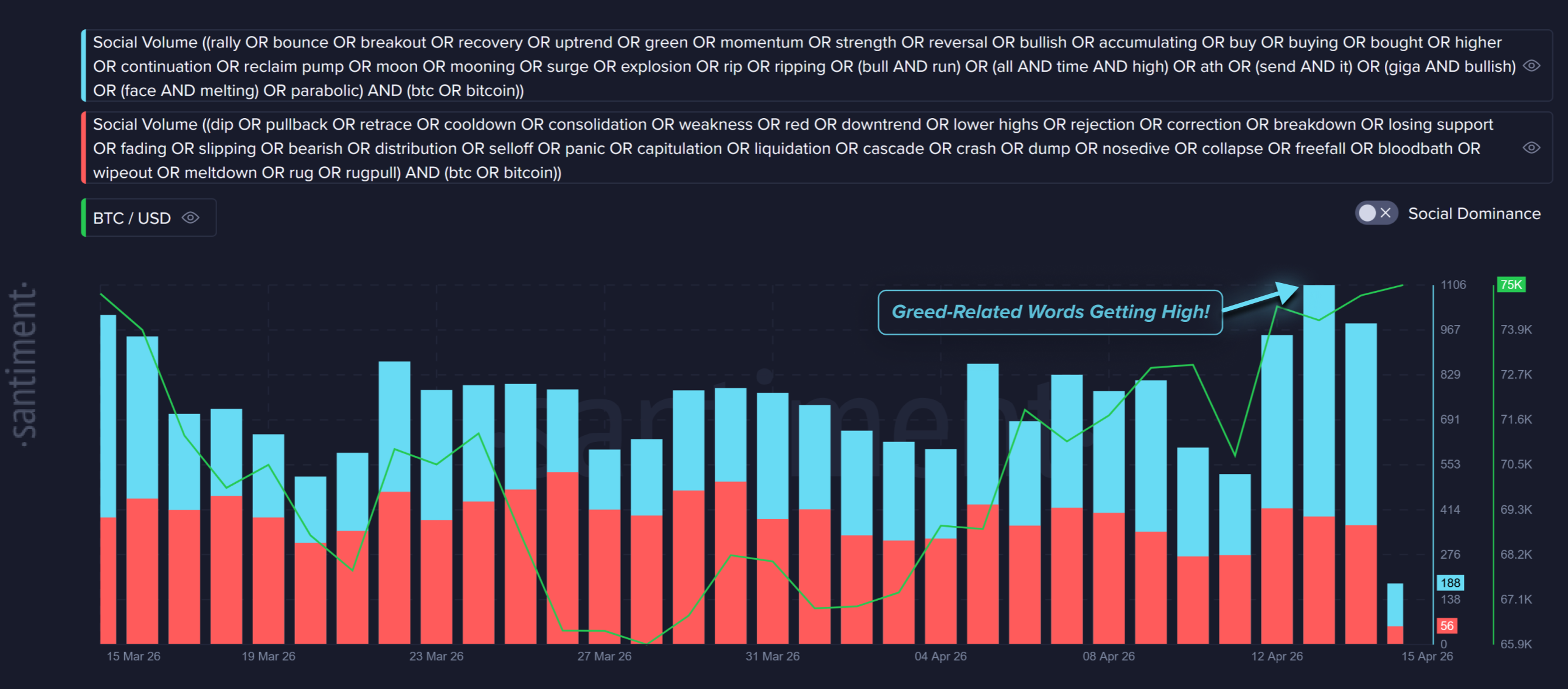
How often are greed-related keywords being mentioned vs. fear-related words? This can best be answered through looking at a combination of traditional keywords that reflect either greed (such as rally, breakout, or bullish) vs. fear (such as fading, selloff, or dump).
Historically, when the ratio of bullish vs. bearish keywords gets high, this is a sign that price tops could be forming (like in mid-March or the past couple of days here in April). Alternatively, when the ratio is getting much lower, this is a prime time that you can buy with much less risk (like in late March and early April).
50K vs. 90K BTC Mentions:
Another completely different way you can analyze fear and greed is by looking at how often price mentions and predictions are pouring in for a given asset. Of course, when looking at fearful and greedy price predictions, it's important to not include current prices. Otherwise, a high frequency of price discussions are just observations of where markets are... not where traders think they are going to be.
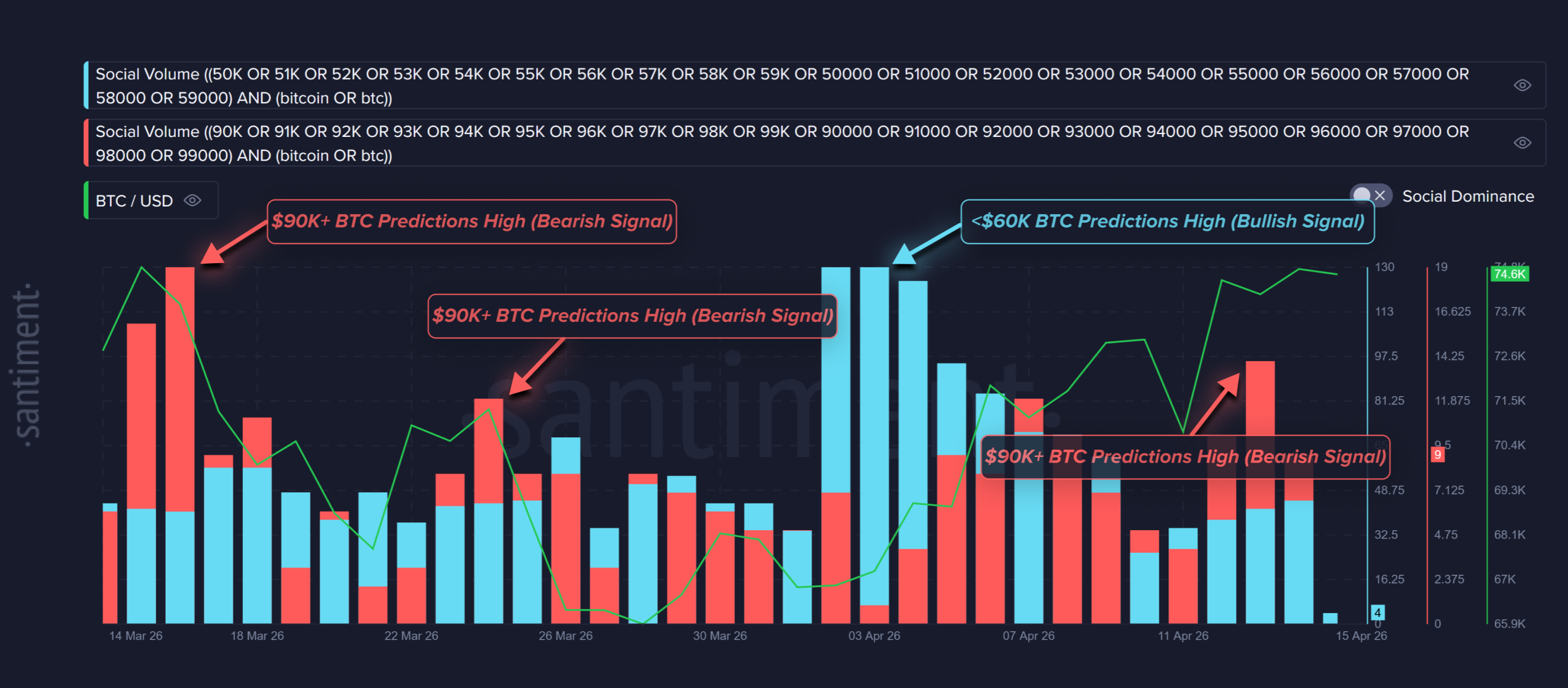
For example, Bitcoin's current price is ~$75K. If we look at how often the $70K's are being mentioned, it would be meaningless. But if we plot all of the round number prices from 50K-59K and 90K-99K, comparing the frequency directly against one another, we can see fascinating results. Bitcoin obviously has not had a market value below $60K or above $90K in the past month... yet we still see tons of discussion about these Bitcoin prices every day. That's how we know they are prediction discussions (for the most part), and very valuable as signals.
Notice in the chart below how high spikes of $90K+, especially while <$60K is very low, has reliably been a top signal for cryptocurrency markets. And alternatively, just as <$60K was being mentioned very frequently in early April, Bitcoin suddenly took off!
Dip vs. Crash Recognition
One of the more nuanced, but incredibly telling, signals comes from how traders label a market pullback. Not all red candles are created equal, and the crowd’s choice of words can reveal whether there is true fear in the market… or just mild inconvenience.
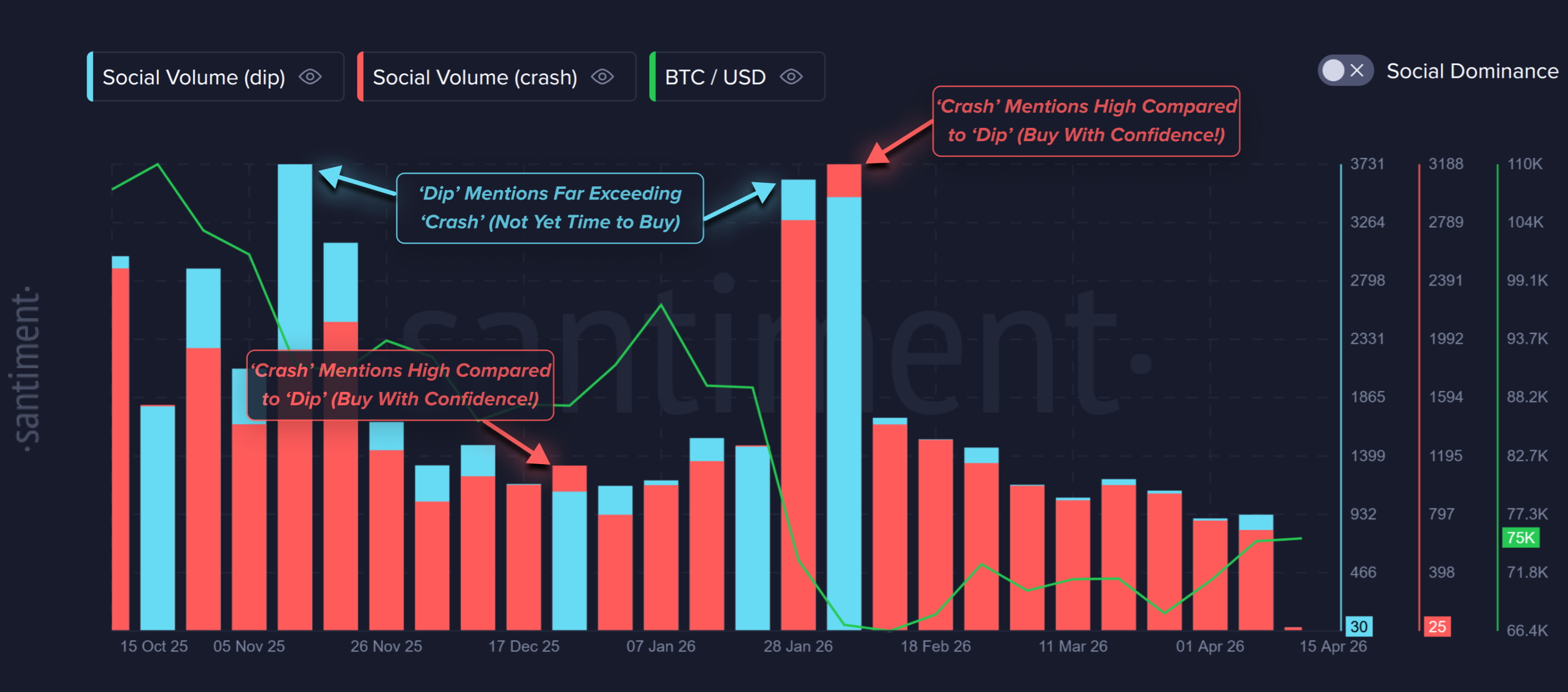
When a pullback is widely being referred to as a “dip”, this typically indicates that traders are still confident. They view the move as a temporary buying opportunity rather than something structurally wrong with the market. While this optimism may seem bullish on the surface, it often suggests that there hasn’t been enough pain yet to form a true bottom. In many cases, dips that are quickly “bought” by an overly confident crowd can continue lower until that confidence begins to crack.
On the other hand, when the narrative shifts and traders begin calling the same move a “crash”, that’s when things get interesting. “Crash” language reflects urgency, fear, and even panic. It’s no longer about casually buying the dip. It’s about traders worrying that something has gone seriously wrong. Historically, these spikes in “crash” mentions tend to align much more closely with local bottoms, as weaker hands exit and selling pressure becomes exhausted.
This contrast creates a powerful signal. When “dip” mentions are dominating and “crash” mentions are relatively quiet, it’s often a sign that markets may not be done correcting just yet. But when “crash” discussions suddenly surge compared to their usual rate vs. “dip” conversations, that’s typically when risk begins to shift back in favor of buyers.
At the end of the day, Social Trends aren’t about predicting the future with certainty, they’re about understanding positioning and psychology in real time. Markets move based on supply and demand, but sentiment is what fuels both. When you can clearly identify when the crowd is leaning too far in one direction, you put yourself in a position to act before the reversal happens, not after it’s already obvious.
By consistently monitoring shifts in language, expectations, and narratives, you can begin to separate emotional reactions from true opportunity. Whether it’s greed overwhelming fear, unrealistic price targets dominating discussion, or “dip” optimism delaying a bottom, these signals can help you stay one step ahead.
Bookmark the Social Trends dashboards linked in this article, or head over to the Social Trends tool and let us know what kinds of discoveries you make off of your own custom queries! In a market where timing and positioning matter as much as anything, this kind of edge can make all the difference.
-----
Free two-week trials to Sanbase PRO (to access all mentioned Santiment data in this article, and plenty more) are AVAILABLE HERE!
-----
Disclaimer: The opinions expressed in the post are for general informational purposes only and are not intended to provide specific advice or recommendations for any individual or on any specific security or investment product.