
The Weekly Anomaly Report: W2 May 2026

This Week in Brief
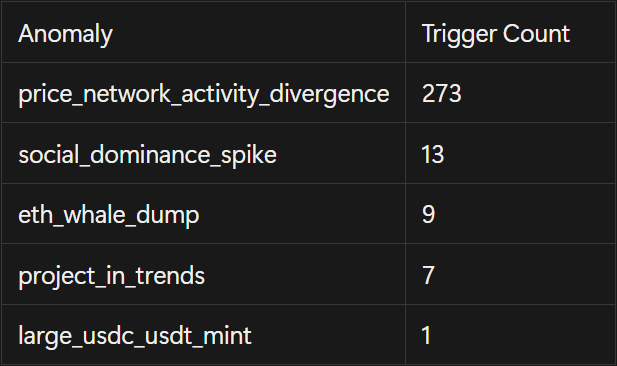
The last 7 days produced 343 total trigger events across 5 out of 8 tracked data anomaly signals between 2026-05-07 04:00:00 and 2026-05-13 15:00:00.
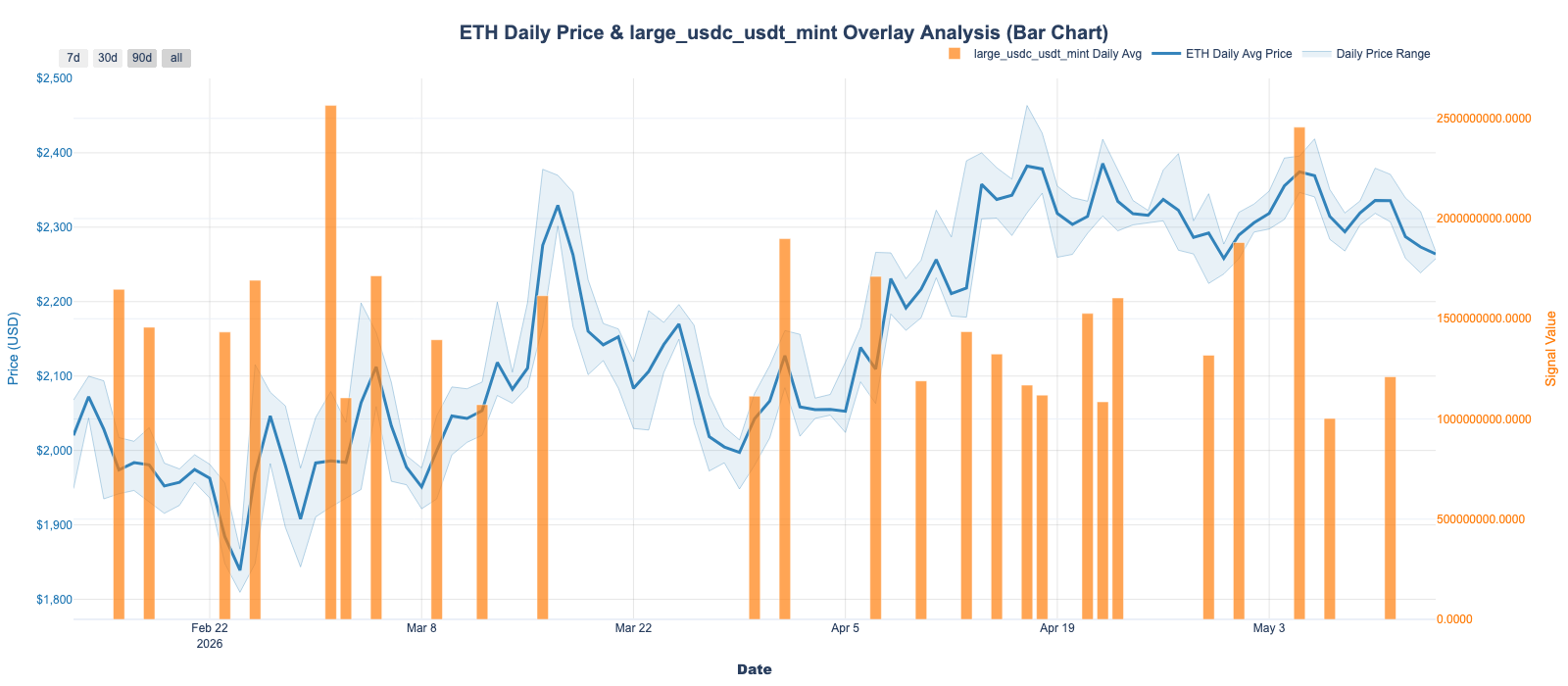
This report applies a market-cap filter of latest_marketcap_usd > $50M for all sections and charts unless otherwise specified. This is to reduce noise and focus attention on names with better market liquidity. The only exception is large_usdc_usdt_mint, which is a global mint signal without an associated asset; its chart uses ETH price as a market reference, not as an asset-specific mint signal.
Sentiment direction in the tables uses sentiment_volume_consumed_v2_1d: above 0 is positive, below 0 is negative; z-score is not used for this label.
The week was dominated by price_network_activity_divergence, with 273 trigger events. The social-attention basket was led by jasmy, origintrail, and apecoin-ape by repeat count. For project_in_trends, only arb-arbitrum and toncoin passed the market-cap filter after excluding ETH and BTC.
Trigger Count Table
Social Attention Spike With Weighted Sentiment Context
This is the main social-attention section for the week. The table keeps the attention spike and sentiment direction together.
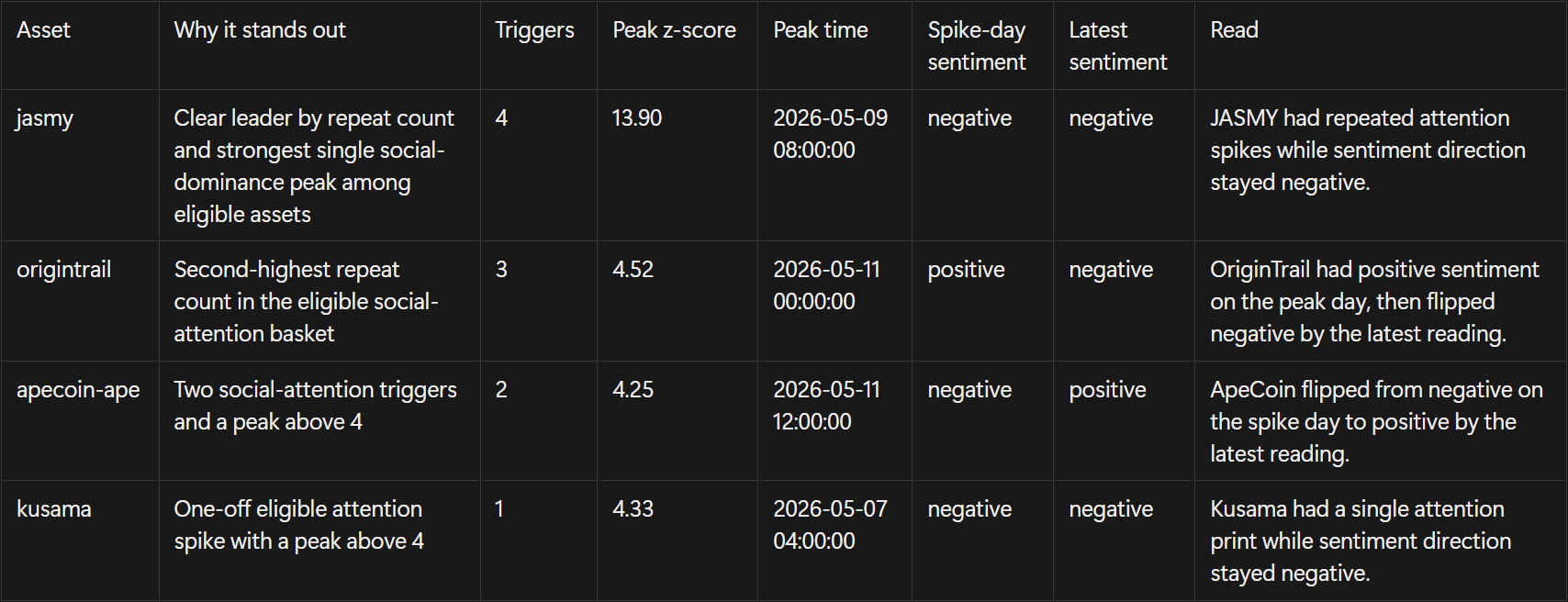
The social section is mostly negative by sentiment direction. origintrail and apecoin are the two rows where the direction changed between the spike day and the latest reading.
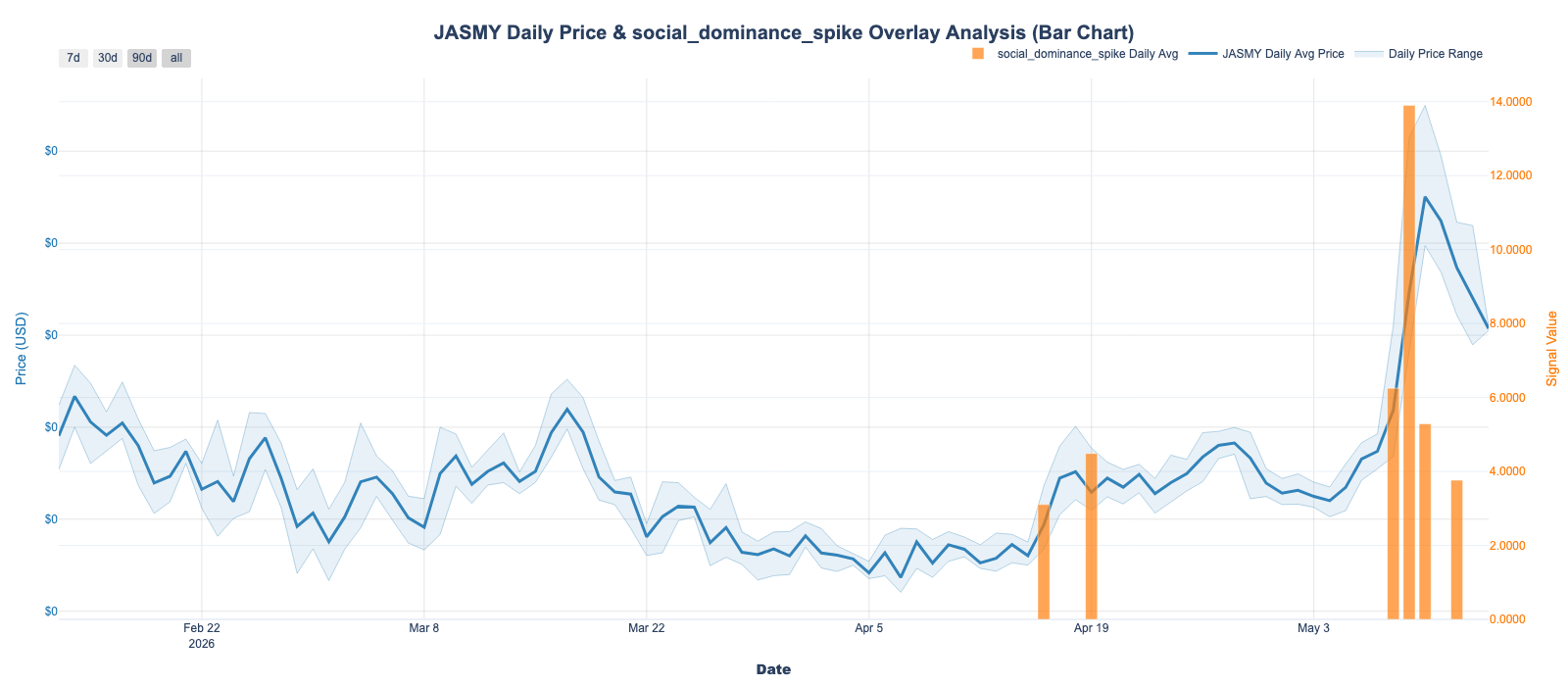
Jasmy($JASMY): Exchange supply dropped to 7.04 billion, down from a March 31 high of 11.51 billion: a sign that holders are moving tokens to self-custody. This, combined with rising futures open interest reaching over $33 million (its highest level in months), drove the triggers. The ****negative sentiment throughout is due to retail traders debating "is this a bull trap?" on X as the price ran, rather than celebratory buying.
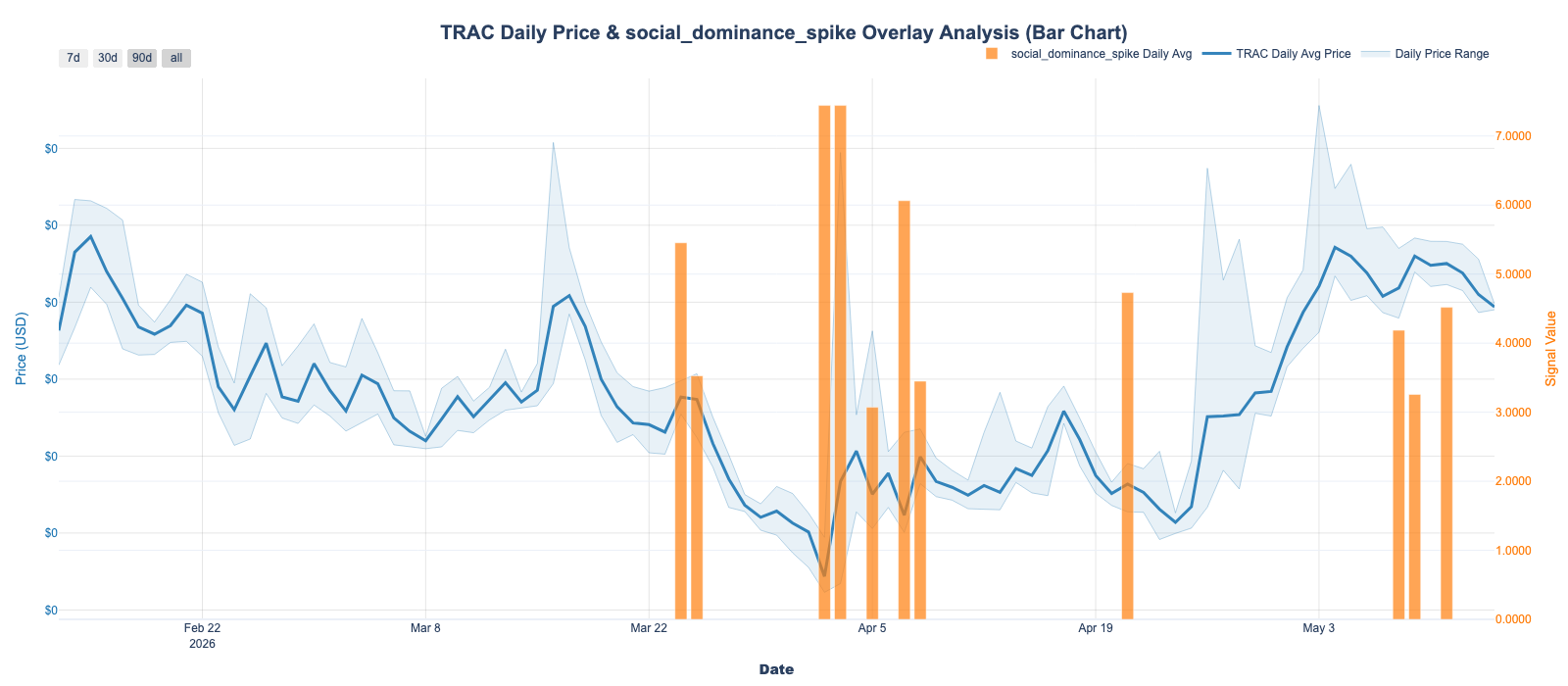
Origintrail($TRAC): The narrative driving TRAC's growth seems to be AI infrastructure. They gained traction with a recent integration into Microsoft Copilot via MCP. The second and third triggers were likely driven by a viral valuation thread that had been circulating. An analysis noted TRAC's price-to-revenue ratio of just 46 compared to 401 for FET and 524 for NEAR — based on $4.8M in protocol revenue — framing it as the "biggest sleeper in AI right now." This kind of comparative valuation content spreads fast on X during altcoin rotation phases. The positive spike-day sentiment flipping to negative is the classic post-thesis pattern: the X community bought into the "undervalued AI infrastructure" story at the peak, then sentiment soured as price failed to hold above key resistance.
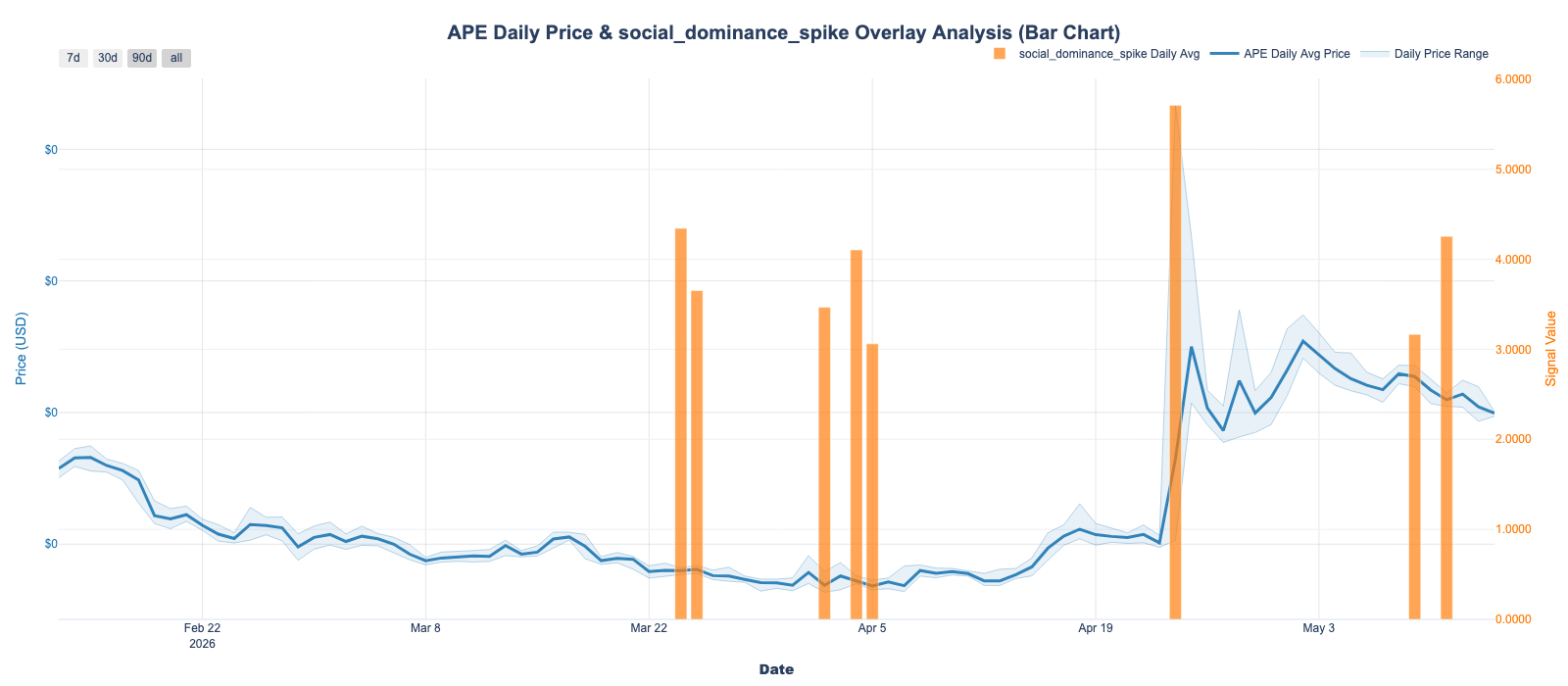
Apecoin-ape($APE): APE's peak on May 11 is the second wave of a story that began on April 24–25. Price surged 80% on April 24, jumping from $0.10 to a high of $0.19, as Yuga Labs confirmed Michael Figge as CEO. Around 80% of tracked gaming tokens also outperformed Bitcoin over the same 30 days. The sentiment flip from negative on spike-day to positive by latest reading is particularly interesting and unusual. It suggests the second wave of discussion on May 11 was initially skeptical ("is this real or a pump?") but community conviction improved as the Yuga Labs story solidified and gaming token sector rotation continued.
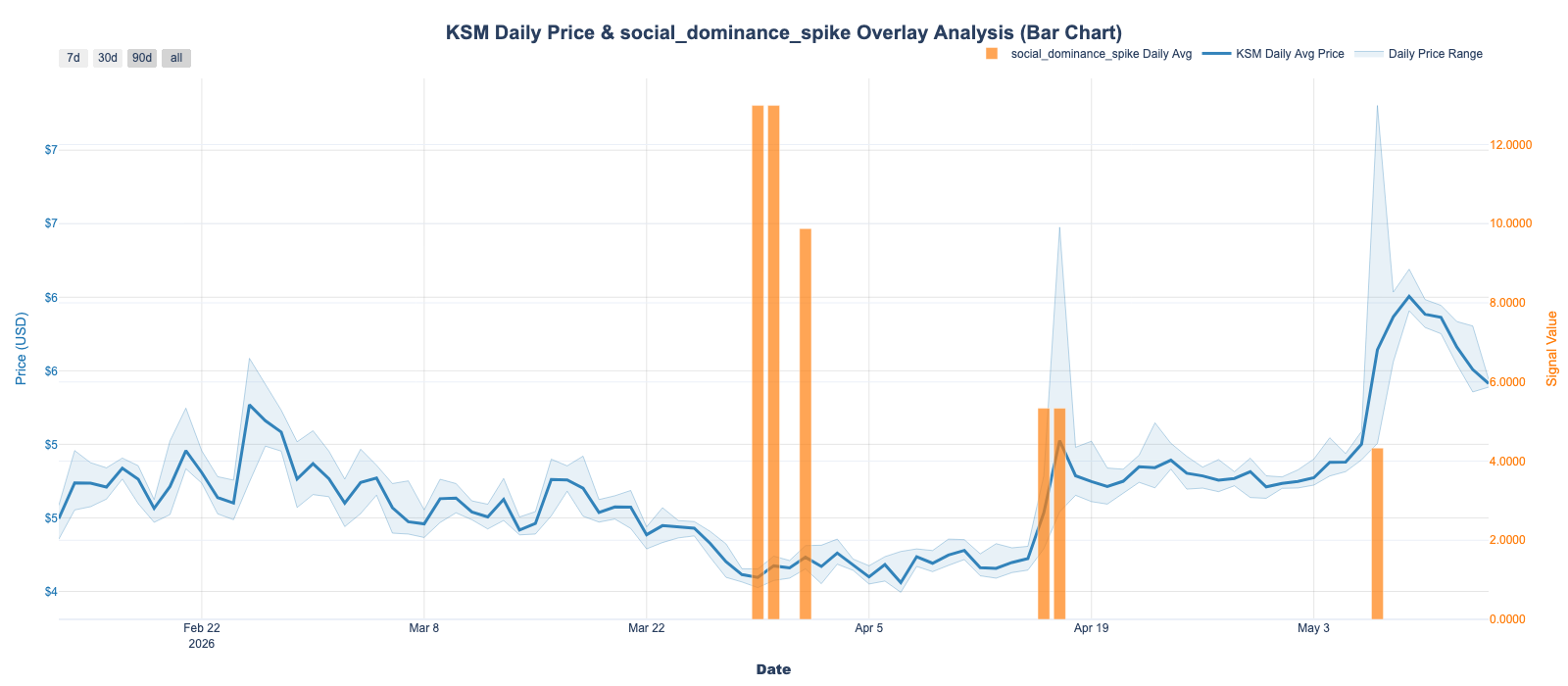
Kusama($KSM): Kusama's price hit a low of $5.00 and a high of $7.61 — a 52.2% swing in 24 hours — with trading volume surging over 700% to $57.31 million. The runtime 4200 upgrade triggered renewed interest in KSM as a speculative high-beta asset in the Polkadot ecosystem but the persistent negative sentiment is consistent with the broader negative sentiment around Polkadot being a dead chain. Kusama is Polkadot's canary network. Whatever sentiment cloud hangs over DOT falls directly on KSM, often amplified because KSM is smaller and more illiquid. Beyond inheriting DOT's baggage, KSM has a unique threat to its own existence. An unverified but widely circulated rumor suggested Kusama may fully merge into Polkadot via a 1:100 KSM-to-DOT conversion. This is a uniquely corrosive sentiment driver. Even if the rumor isn't acted upon, it plants the question: why hold KSM if it might just become a fraction of a DOT? Every technical catalyst — like the Runtime 4200 upgrade — gets immediately discounted by "but is this chain even going to exist in 12 months?"
Overall pattern to note: Three of four assets showed negative sentiment at the latest reading, which is consistent with this being a late-cycle altcoin rotation— attention was driven more by FOMO and speculative repositioning than by conviction, and sentiment quickly faded. Apecoin is the outlier and may warrant deeper research.
Project in Trends Beyond BTC and ETH
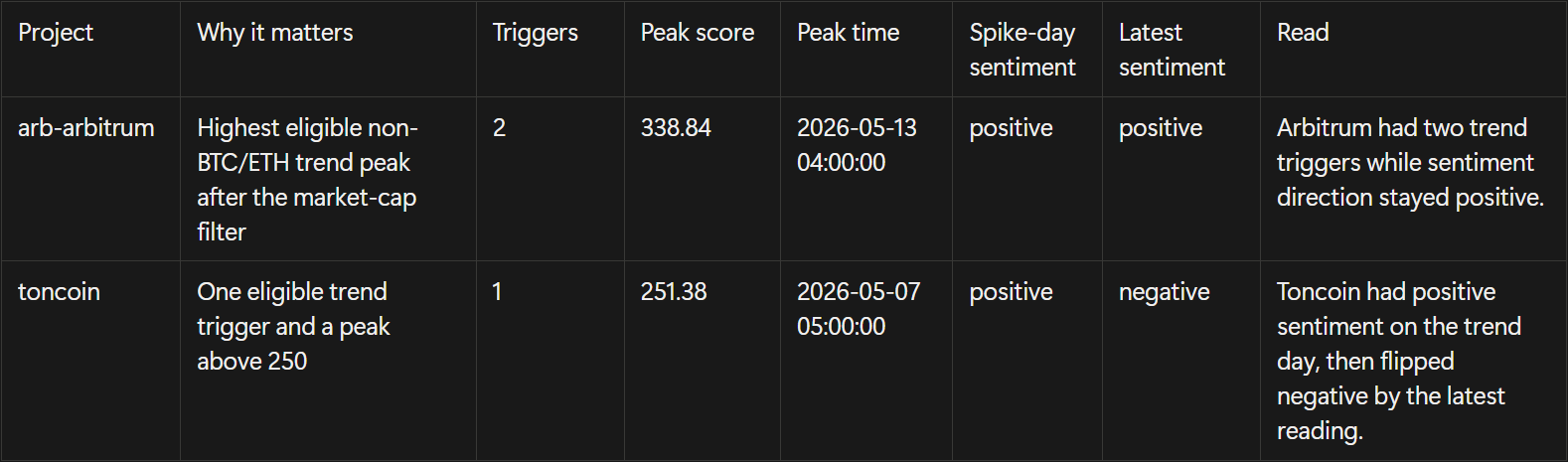
Raw project_in_trends activity was led by ufo-gaming(less than 1m marketcap), with 3 triggers and a peak score of 713.08 at 2026-05-09 06:00:00, but it did not pass the $50M market-cap filter. The remaining eligible projects were Arbitrum and Toncoin.
Arbitrum ($ARB)
Primary Catalysts: Court-Approved $71M ETH Recovery + 92.65M Token Unlock Anxiety
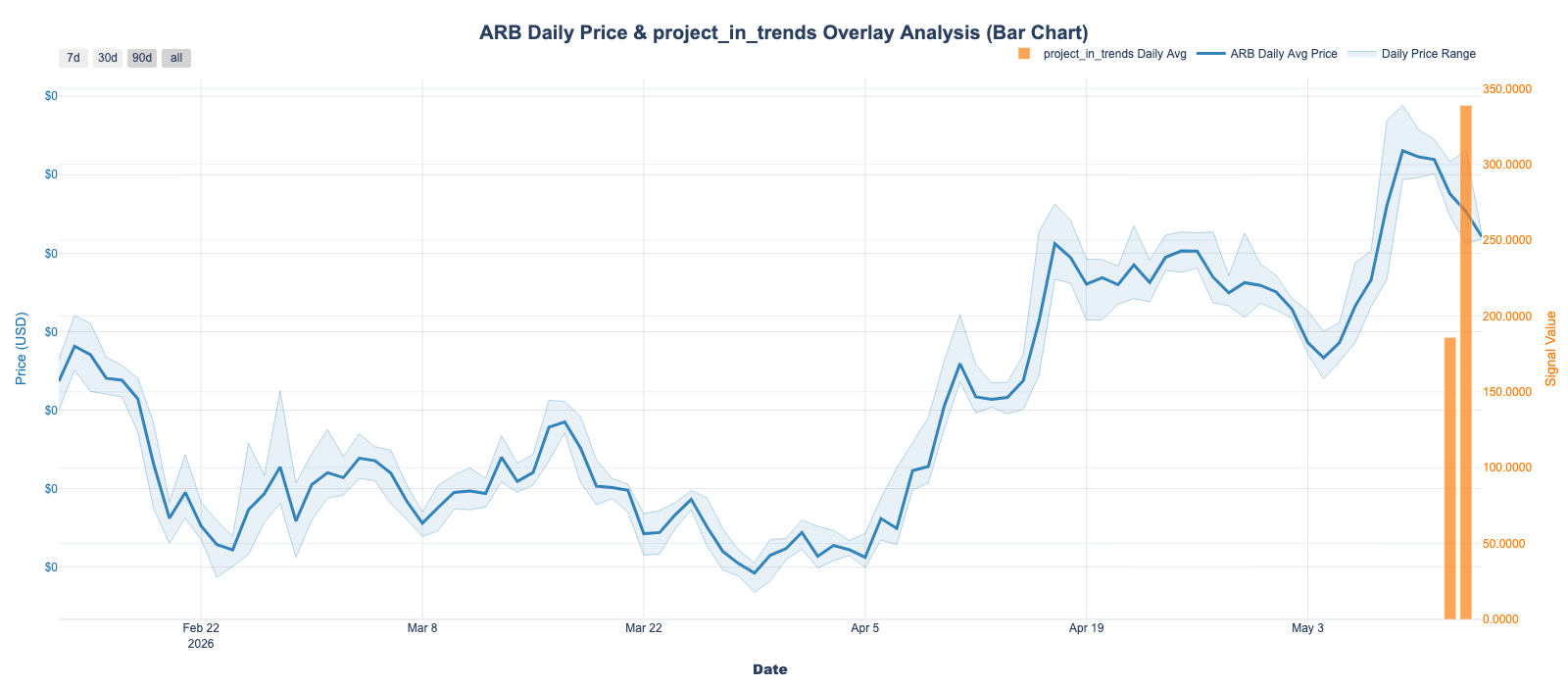
Arbitrum's peak score of 338.84 was triggered by a governance resolution landing in the same week as a supply event that had traders nervously watching. The two triggers map directly to two distinct conversation waves.
Trigger 1 — Court Approves $71M ETH Transfer (May 11): A Manhattan federal judge approved the Arbitrum DAO's plan to transfer 30,766 ETH (worth ~$71 million) to an Aave-controlled wallet. These funds had been frozen by Arbitrum's Security Council following the April 2026 KelpDAO rsETH bridge exploit. This was the resolution of a weeks-long saga: a US law firm had served a restraining notice on Arbitrum DAO attempting to claim the funds as North Korean property to satisfy terrorism judgments, injecting serious legal uncertainty into the ecosystem. The court ruling cleared that up — the DAO proposal received more than 90% yes votes (~173.9 million ARB), with the coordinated response from Aave Labs, Kelp DAO, LayerZero, EtherFi, and Compound framed as proof of DeFi's ability to self-organize under pressure.
Trigger 2 — 92.65M Token Unlock (approaching May 16): On Santiment's own trending coins dashboard, Arbitrum appeared at the top of the discussion list ahead of names like Solana, Chainlink, and Ethereum — with the main reason being the upcoming ARB token unlock, with crypto news posts flagging about $13.12M worth of unlocks for the May 11–17 week. Community conversations centered on possible airdrop mechanics, claimability checks, and ARB-related tools such as airdrop calculators.
The interplay between these two forces is what produced such a high peak score. ARB had rallied 24% over the prior 30 days from a support level, with a bull flag structure forming — but the 92.65 million token unlock is the variable the technical setup may not account for, with team/advisor allocations of 56.13M ARB and early investor unlocks of 36.52M ARB historically flowing to centralized exchanges and creating structural sell pressure.
The sustained positive sentiment on both spike-day and latest readings is the standout signal here. Unlike most of the assets in earlier tables where attention came with skepticism, ARB's X conversation was genuinely constructive — the legal overhang had been lifted, governance had demonstrated real coordination capability, and the Robinhood Chain narrative (building on Arbitrum's tech stack) continued providing institutional tailwind. Traders are cautious about the unlocks, but the governance story was strong enough to hold sentiment positive.
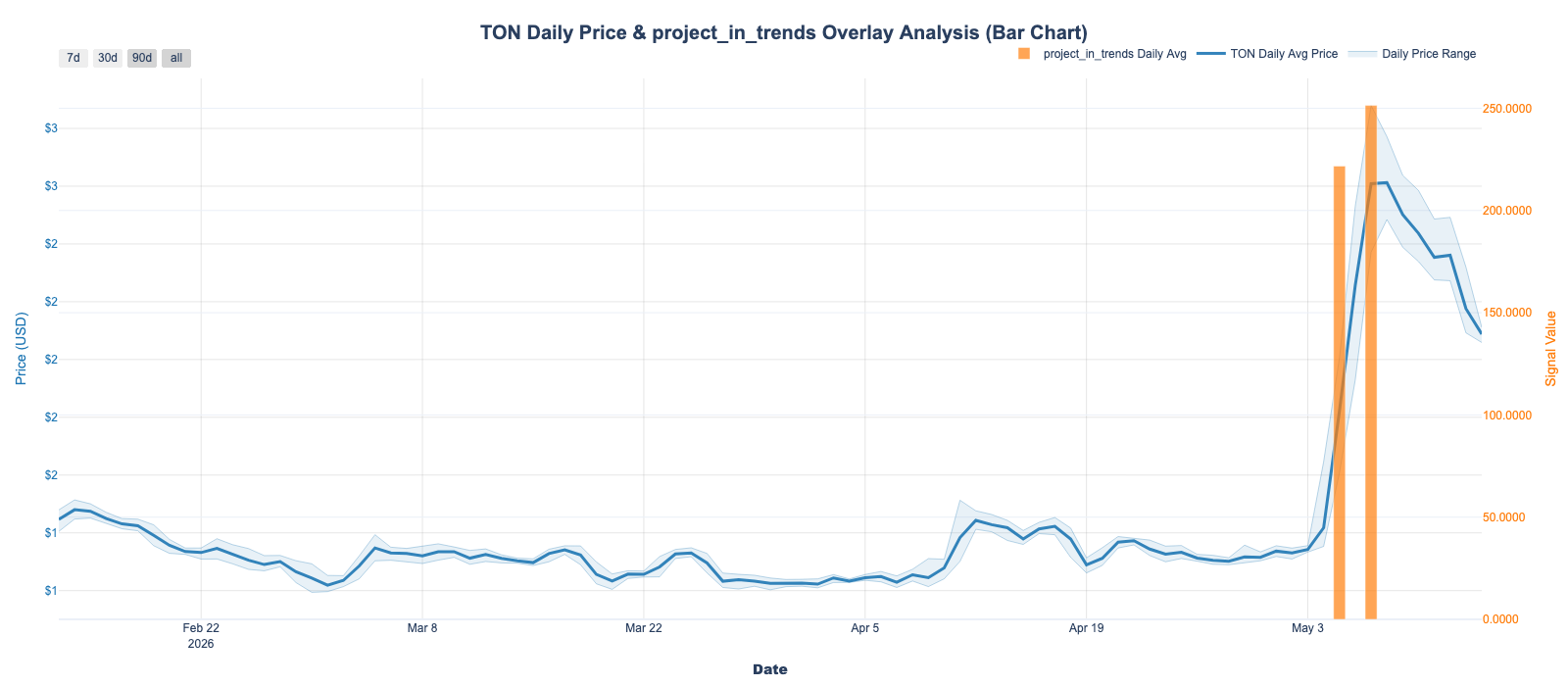
Toncoin ($TON)
Primary Catalyst: Pavel Durov's MTONGA Step 3 — Telegram Replaces TON Foundation as Largest Validator
Fees on the TON network fell by six times and Telegram announced it was stepping in to replace the TON Foundation, becoming the network's largest validator. Durov posted directly on X: "The focus shifts to tech superiority. New ton.org, new dev tools, new performance upgrades."
The peak score of 251.38 on May 7 at 05:00 UTC reflects the second wave — the delayed international amplification of the May 5 announcement, as Asian and European audiences digested the news during their active hours and price continued climbing past 30% gains.
The sentiment flip from positive (spike-day) to negative (latest) is consistent with what was noted previously: the story was structurally bullish at announcement but quickly attracted bearish counterarguments on X around centralization risk (Telegram controlling the largest validator stake) and the overbought RSI reading.
Price-Network Activity Divergence Top 3
These are the top price_network_activity_divergence rows ranked by weekly peak value after applying the $50M market-cap filter.
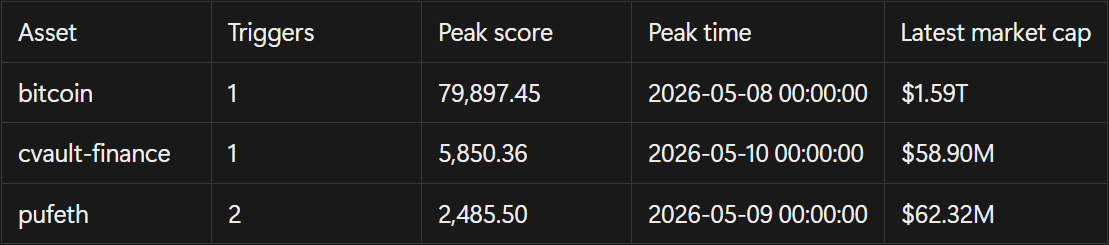
This signal identifies anomalous price surges that are not accompanied by a corresponding rise in network activity (growth). It flags potentially unsustainable or speculative price increases that are not backed by healthy user adoption or blockchain usage.
What Else Happened
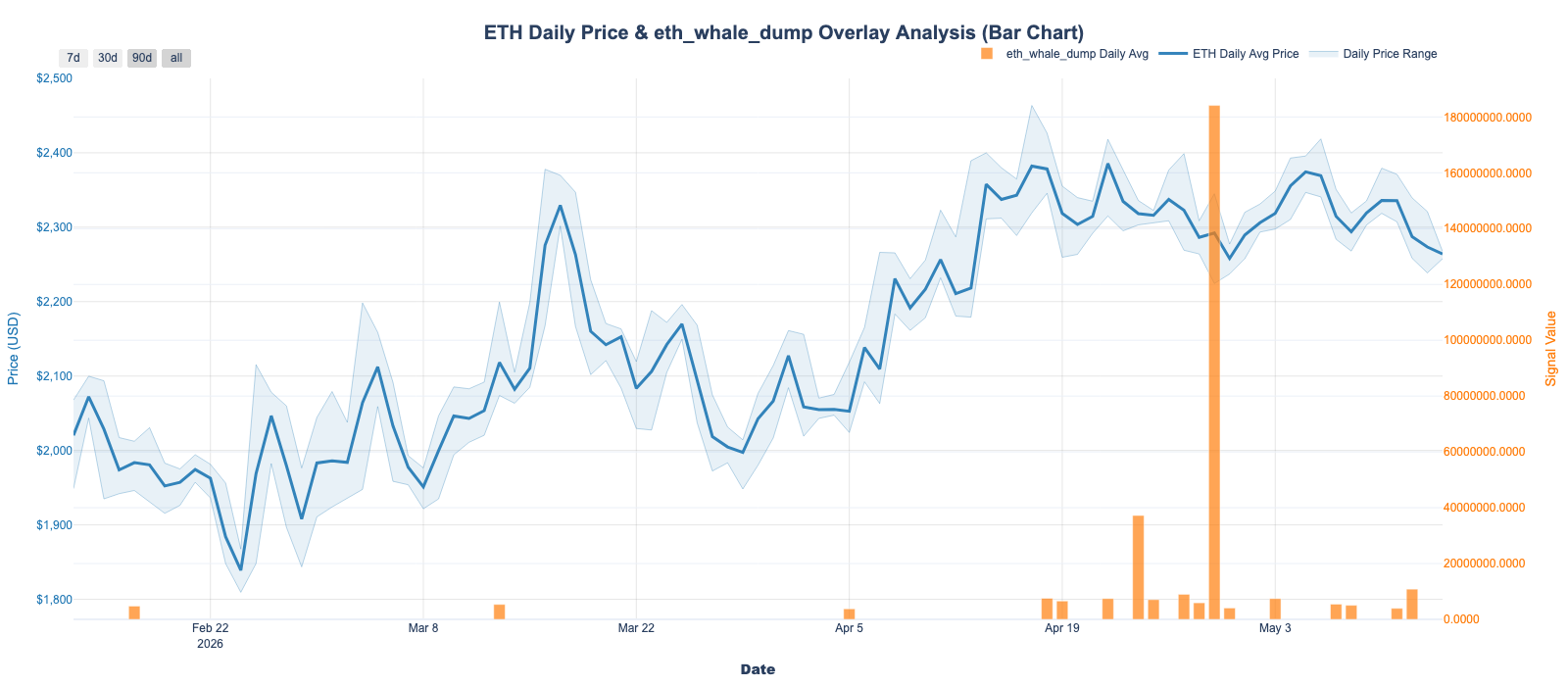
eth_whale_dump v2 remained the most persistent asset-level anomaly in the package. This signal is ETH-only by definition, so the useful facts are the timing and size of the ETH sequence. It triggered 9 times on ethereum, with an average value of 6,301,239.78 and a weekly peak of 17,079,108.00 at 2026-05-12 10:50:47. The signal stayed active from 2026-05-07 07:28:23 through 2026-05-12 10:50:47.
large_usdc_usdt_mint triggered once. The weekly event was $1.21B at 2026-05-11 00:00:00. Because this signal is global and has no asset row, it should be read as a market-liquidity event rather than an asset-specific anomaly.
Worth Watching
apecoin: a social attention spike outlier that concluded the week with a positive sentiment while all others were negative.arb-arbitrum: repeat project-trend triggers with positive sentiment direction.pufeth: repeat price-network divergence triggers, though close to the market-cap threshold.jasmy: strongest social-dominance peak and highest repeat count in the eligible social basket.
About the Anomalies We Track
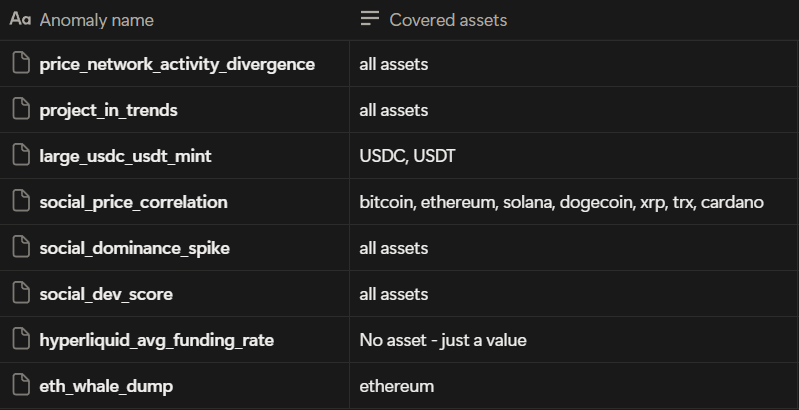
Covered anomalies and assets per anomaly type
- Network Activity & Price Divergence Anomaly - detects price surges that are not accompanied by a corresponding rise in network activity (real growth). Triggered only if the price growth exceeds 3% on the same day, ensuring the alert is relevant for significant bullish moves.
- Project in Trends Anomaly - detects when a specific crypto token gains significant traction in online discussions, placing it among the top 10 most-mentioned words in crypto-related conversations.
- Large USDC-USDT Mint Anomaly - detects daily combined $1 billion or larger minting events of USDC and USDT stablecoins on the Ethereum blockchain.
- Social Price Correlation Anomaly - detects whether social sentiment and price are behaving in an unusually aligned or unusually decoupled way. The current implementation runs on 1h X.com social data for bitcoin, ethereum, solana, dogecoin, xrp, trx, and cardano.
- Social Dominance Spike Anomaly - detects abnormal spikes in social dominance metrics. It alerts when values exceed a statistical significance thresholds of 3 standard deviations over 30 days.
- Social-Dev Score Anomaly - detects unusual activity compared to recent 30-day history of social media metrics and development activity, the score itself is weighted at 60/40 for social and dev activity.
- Hyperliquid Average Funding Rates Anomaly - detects when rates exceed predefined high/low thresholds of +40% and -20%, measured hourly.
- ETH Whale Dump Anomaly - detects potential large-scale ETH dumps by monitoring whale wallet behaviors, threshold of 500 ETH and uses a 30-day holding period as a key parameter to distinguish between normal trading activity and potential dump scenarios.
Disclaimer: The opinions expressed in the post are for general informational purposes only and are not intended to provide specific advice or recommendations for any individual or on any specific security or investment product.