The Silent Pump: How RUNE Climbed 18% While Social Media Slept

Based on Santiment MCP data
---
TL;DR
- RUNE ripped +18% in 48 hours and broke out of a 10-week consolidation range ($0.38–$0.46), closing at $0.491 — its highest level since mid-January.
- Hourly trading volume went 54× above baseline, climbing from ~$12M/hr to a peak of $675M/hr in less than a day.
- Social volume remained unusually muted relative to the price and volume expansion. While ARB saw social mentions spike 10× over the Arbitrum freeze debate, RUNE's mentions peaked at just 7/hr against a baseline of 0–3 — a relatively low-attention move compared to typical breakout conditions.
- Funding rates flipped from +0.0000848 to -0.0000664 within 15 hours. The same traders who bought the breakout rotated into shorts while the price was still rising — a pattern consistent with early long positioning followed by de-risking and short-side positioning..
- The divergence itself is the signal. Loud social + flat price (ARB) meant the news was priced. Quiet social + rising price (RUNE) suggested the move still had room to develop before the crowd noticed.
---
Every once in a while, the market gives us a textbook example of what "smart money moves quietly" actually looks like on-chain. This week, THORChain (RUNE) served up one of the cleanest examples we've seen all year.
While the entire crypto commentariat was busy yelling about Arbitrum's emergency intervention and whether L2s are "really decentralized," another token was ripping upward 18% with barely a tweet to accompany it. The divergence between what the crowd talked about and where the money actually moved is the kind of signal Santiment was built to catch.
Let's walk through it.
The setup
On April 21, Arbitrum's Security Council executed an emergency on-chain upgrade to freeze 30,766 ETH tied to the KelpDAO exploit. That's roughly $71M of stolen collateral yanked out of the attacker's hands via an inbox contract revert.
Great for the victims. Great for the headlines. Not so great for the attacker — who then reportedly routed roughly $175M of remaining funds through THORChain, the permissionless cross-chain swap protocol, to keep laundering what they could.
And that's where our story actually begins. Because THORChain's token, RUNE, sits at the center of that protocol — and every swap that runs through THORChain generates fees for nodes, which can translate into incremental demand for the network's native asset. The attacker's desperate exit, in other words, may have acted as a tailwind for THORChain activity and, indirectly, RUNE.
Chart 1: RUNE broke out of its 10-week range on one day's activity
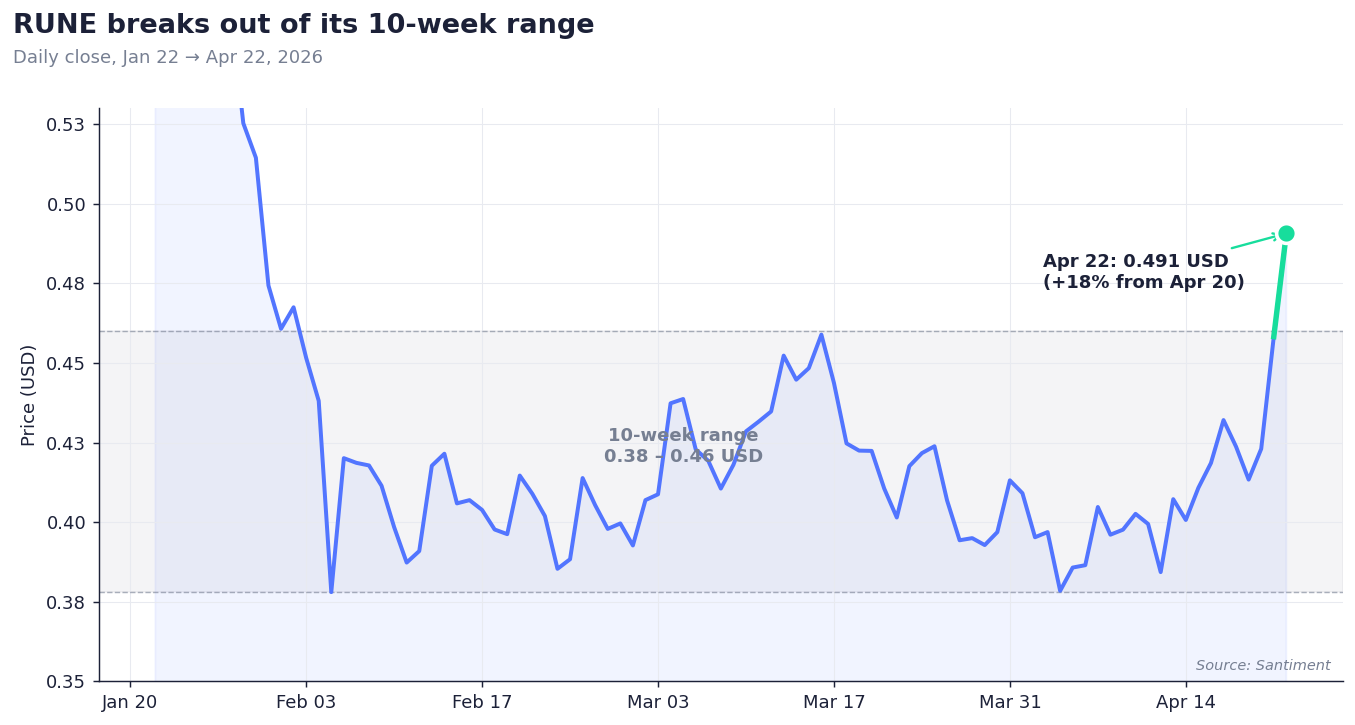
For 71 days straight, RUNE was pinned between $0.38 and $0.46 — the kind of chop that bores traders to death. Then on April 21, the daily candle printed at $0.458, right at the top of the range. By April 22, the token closed at $0.491, its highest level since mid-January.
That's +18% in 48 hours on a token that had done essentially nothing for two and a half months. Breakouts like this rarely happen on random Tuesdays. Something was driving it, and it likely wasn't purely organic demand for cross-chain swaps.
Chart 2: The volume went properly exponential
If you want to know whether a move is real, look at the volume. And here, the volume told a very loud story.
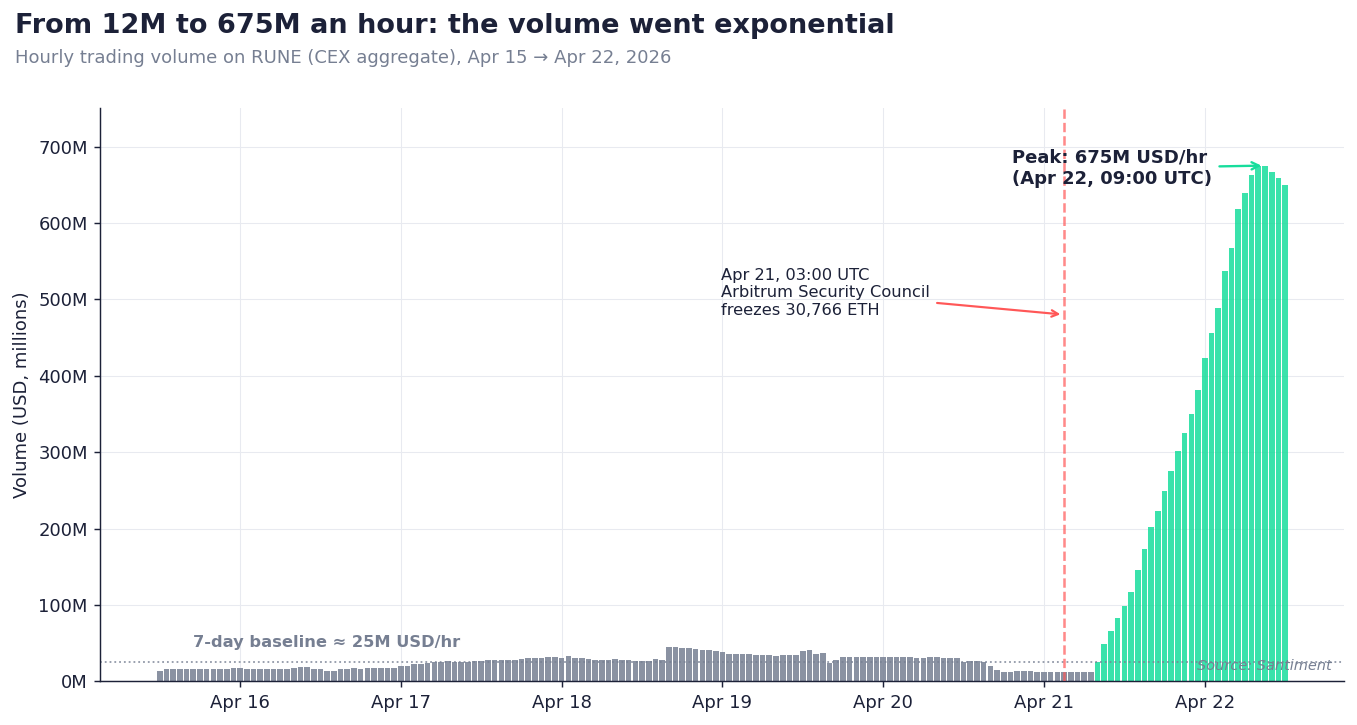
The 7-day baseline on RUNE sat around $25M per hour in aggregate CEX volume. Nothing exciting. Then at 08:00 UTC on April 21 — about five hours after the Arbitrum freeze announcement — the hourly volume went vertical.
That's a 54× jump from the baseline, reached in about 24 hours. And notice the shape: it's not a single spike that fades. It's an exponential curve that keeps compounding hour over hour. That shape is consistent with programmatic flow — market makers and algos reacting quickly — rather than a typical retail-driven FOMO wave, though we can't isolate participants with certainty.
Chart 3: The crowd was watching the wrong token
This is the chart that made us stop and stare.
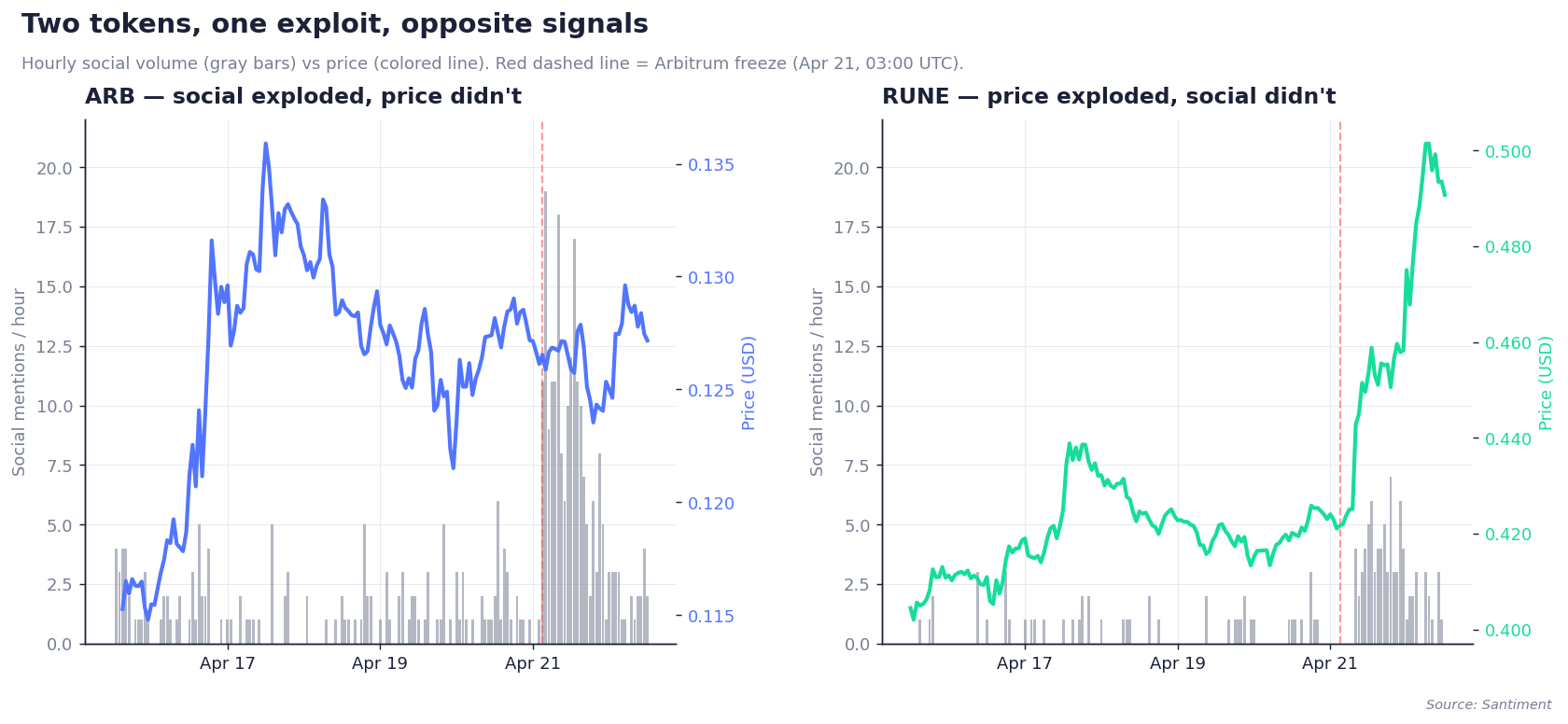
On the left, you have ARB. Social volume went absolutely vertical on April 21, hitting 19 mentions per hour against a baseline of 1–5. The entire crypto Twitter discourse spent a full day arguing about whether the Arbitrum Security Council just "centralized" the network. And ARB's price? Basically flat. The token was $0.131 at the April 17 peak and $0.127 on April 22 — a fraction of a percent lower.
On the right, you have RUNE. The social volume barely budged. Peak of 7 mentions per hour against a baseline of 0–3 — hardly a blip. Almost no one was talking about it. And yet the price did this ↗
Two tokens, one exploit, perfect mirror-image signals. The crowd spent its energy debating the philosophical implications on a token that didn't move. The price action, meanwhile, happened on a token the crowd mostly ignored.
This is the clearest case we've seen all year for why price-only analysis isn't enough, and why social-only analysis isn't enough either. You need both, and you need to watch for the gap between them.
Chart 4: Longs bought the top, then flipped short
Here's where it gets even more interesting. If retail wasn't visibly driving this move on social, what kind of flow was behind it? The derivatives data tells us.
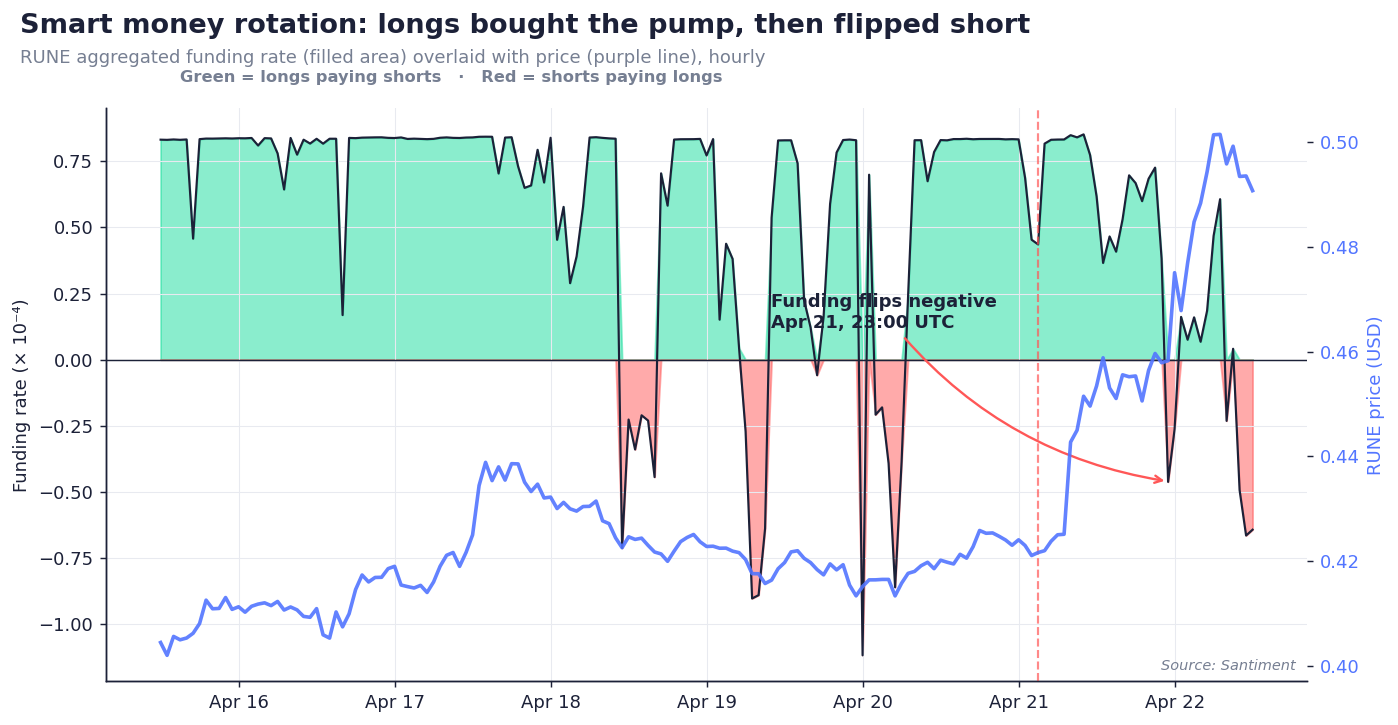
Look at the funding rate throughout the week. For most of April 15–20, the rate hovered near +0.00008 — a steady positive baseline where longs were paying shorts, classic complacent uptrend.
When the pump kicked off on the morning of April 21, funding went even higher — +0.0000848, one of the peaks of the week. Longs chased in aggressively. Smart, opportunistic, momentum-following flow.
But then, starting around 13:00 UTC, funding started decaying. And at 23:00 UTC on April 21 — right as RUNE was closing in on its local highs — funding flipped negative. Within 12 hours it was deeply red: -0.0000664 by the morning of April 22.
Translation: early long positioning appears to have been reduced, with increasing short-side pressure emerging, while the price was still rising. This doesn’t look like pure capitulation, but rather a shift in positioning during strength. This suggests some participants viewed the move as increasingly priced in and started positioning for mean reversion — before retail ever showed up to the party.
By the time anyone on Twitter noticed, the trade was already being unwound underneath them.
What this actually means
A few takeaways worth sitting with:
1. Permissionless infrastructure doesn't get to choose its demand. THORChain's design is neutral — it routes swaps, it charges fees, and it doesn't care about intent. When an attacker needs volume, THORChain gets volume. When legitimate cross-chain traders need liquidity, THORChain gets that too. The protocol (and its token) benefits either way. That's the architecture, stated plainly.
2. Lower-attention moves often carry different signal characteristics than highly crowded ones. The loud trades on social media are usually the ones getting sold into. The quieter ones — where price, volume, and funding all move together while social barely registers — can indicate capital deployment before broader crowd participation. This week's RUNE pump was as textbook as it gets.
3. Divergence is a feature, not a bug. Every time you see social volume and price move in opposite directions, that's a trade-worthy signal in its own right. In ARB's case, a flat price under a massive social spike suggested the news was already priced. In RUNE's case, a rising price under near-zero social attention suggested the opposite — the move had room to run because the crowd wasn't in it yet.
4. The funding flip is now the most interesting part. With longs actively rotating into shorts at the highs, the question for next week becomes: does the laundering flow dry up fast enough to validate the short thesis, or does sustained THORChain volume keep RUNE bid above $0.48? That's the setup to watch.
Zooming out
This is the second time in three years that a major exploit has triggered a visible volume surge on THORChain — the first being the Ronin/Lazarus laundering of 2022. If that starts becoming a pattern, THORChain volume spikes may be worth monitoring as a potential early signal following major exploits, though it's too early to treat this as a repeatable pattern, which would be one of the more unusual on-chain signals in crypto.
We'll be watching. And for what it's worth, so will the funding rate.
-----
Data and charts sourced from Santiment MCP connector. Explore the metrics used in this piece — RUNE trading volume, social volume, and aggregated funding rates — on Sanbase.
-----
Disclaimer: The opinions expressed in the post are for general informational purposes only and are not intended to provide specific advice or recommendations for any individual or on any specific security or investment product.