The Weekly Anomaly Report: October 7th – 14th


A token suddenly dominating crypto Twitter, whales dumping ETH, price spiking while network usage flatlines — you get the gist. We call these anomalies, and they often lead to trading opportunities.
If you’re new here, we spot trading setups potentially worth acting on, give you the market backdrop they sit against, and grade how last week’s predictions actually played out.
Let’s dig in!
This Week in Brief
- Starknet, STRK: more than doubled on plans to become its own blockchain, then fell 31% the day after its crowd, active addresses, and new wallets all peaked together.
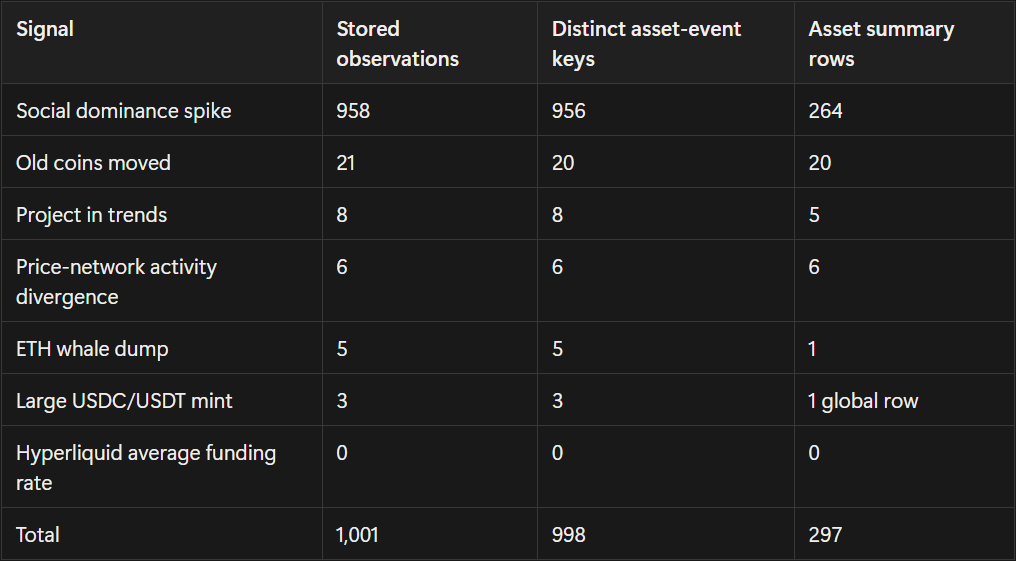
- 'old_coins_moved' fired 21 times across 20 distinct events this week.
Market Backdrop
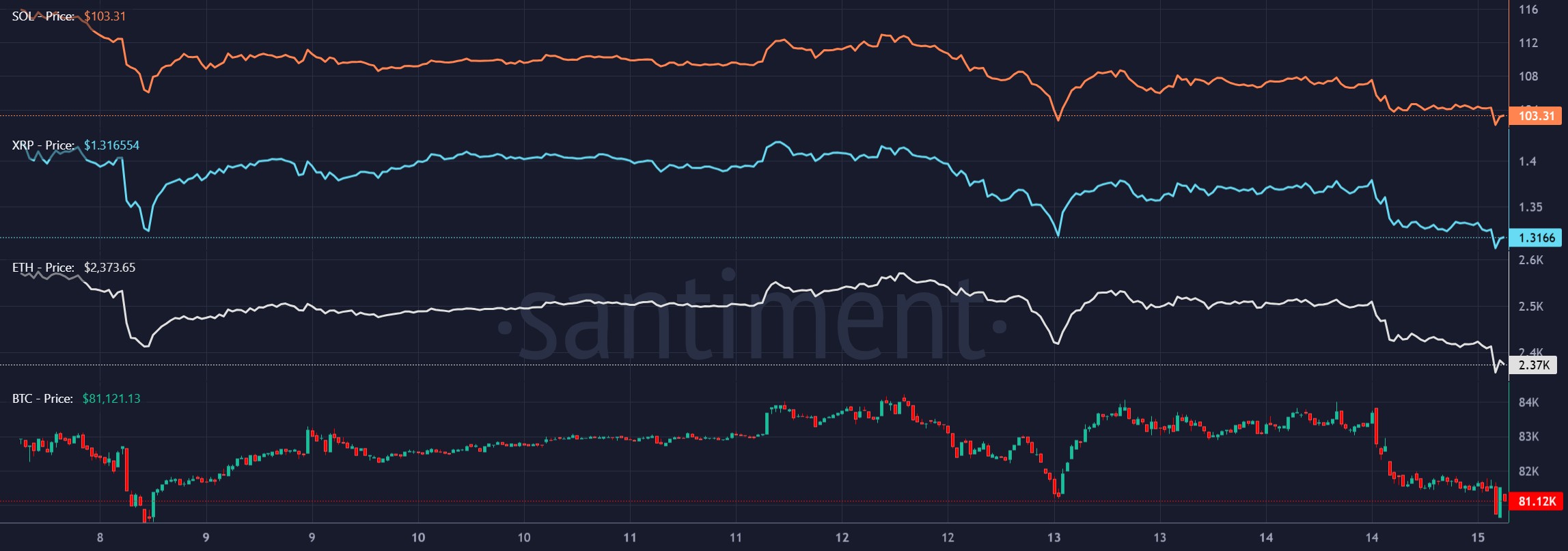
The majors went sideways. Bitcoin dipped from $83.3K on October 7 to $81.7K on October 8, recovered to $83.7K on October 11, and closed October 13 at $83.1K — essentially flat. Ether was weaker, from $2,574 to $2,497, about -3.0%.
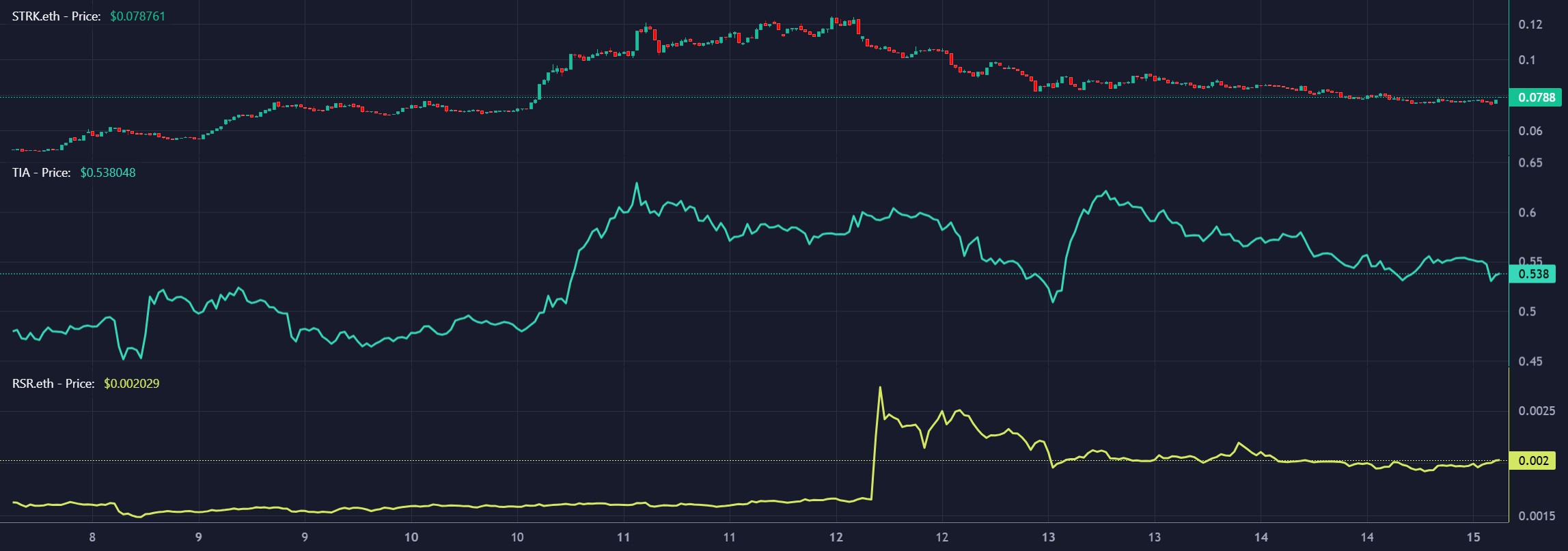
The action happened in smaller names. Starknet more than doubled in four days, while Celestia rose 27.9% in a single day and Reserve Rights 32.7% in another, each on its own news while Bitcoin barely moved.
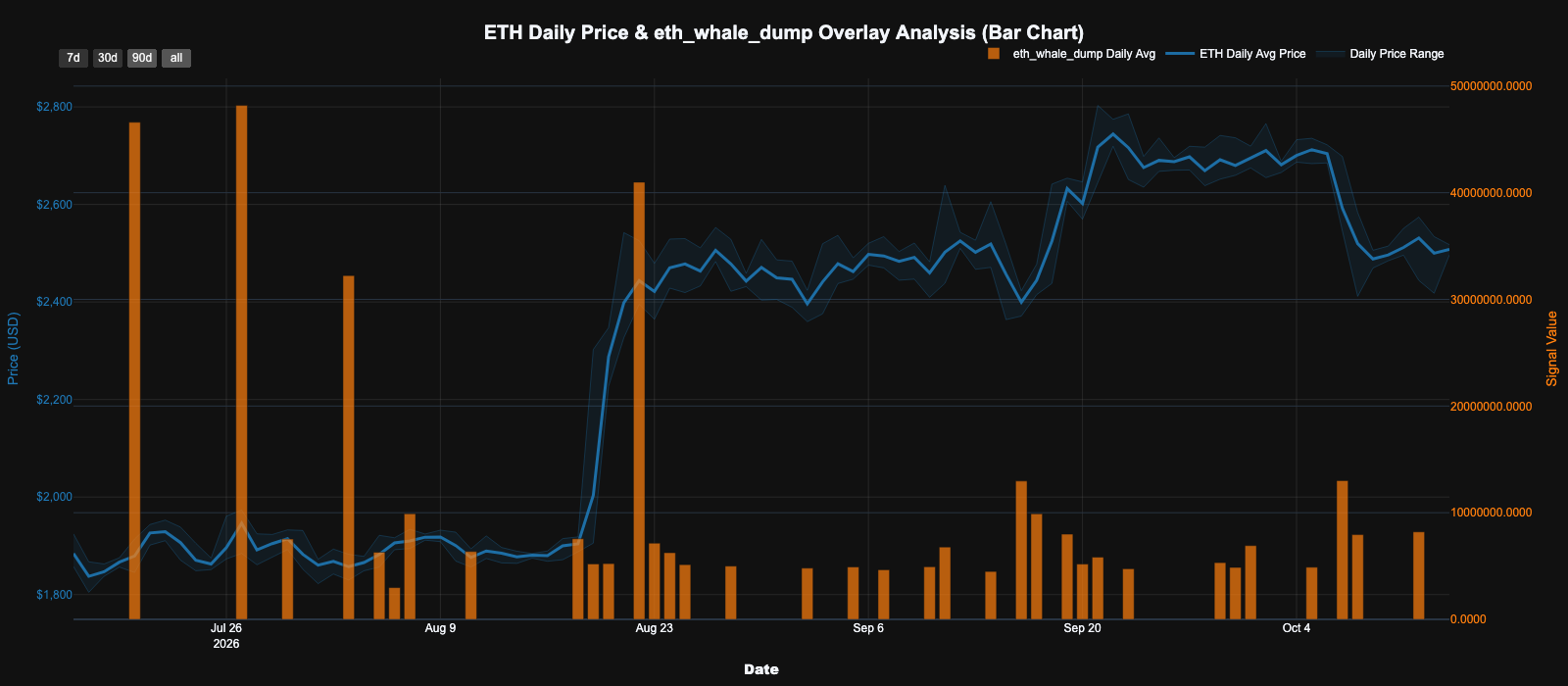
'hyperliquid_avg_funding_rate' produced no triggers for a second straight week. 'eth_whale_dump' fired five times, and all five were deposits to OKX. Its highest reading, $20.52M on October 7, is the same transaction we reported last week, since the two report windows overlap.
September’s consumer price index, released October 14, came in hotter than expected on both measures. Headline prices rose 3.7% over the year against a 3.6% forecast, up from 3.4% in August. Core inflation, which strips out food and energy, rose to 2.6% from a five-year low of 2.4%, also above its 2.5% forecast. Gasoline, up 9.1% in the month, drove more than half the monthly increase.
The Fed raised rates in September, and this CPI result keeps another hike likely for the October 28 decision. No crypto-specific legislation is moving — the CLARITY Act has been stalled since failing a Senate vote last month. The U.S. midterms are in early November. From a macro and political point of view, the atmosphere for crypto assets seems quite calm this week.
Test your trading skills, build a track record, win capital allocation from Santiment on our new platform, Score Arena — Apply for early access!
This Week’s Trading Setups
Only one strong setup this week based on the anomalies.
1. Starknet (STRK)
Signal: social_dominance_spike + price_network_activity_divergence · Lean: Mean-reversion, low conviction
What’s anomalous: 'social_dominance_spike' fired nine times, peaking at 8.95 on October 8, and 'price_network_activity_divergence' hit on October 12. Market cap is about $635M.
Neither is a surprise on a move this size. STRK rose 122% from October 8 to its October 11 close of $0.1232. I note that the token climbed roughly 330% in four weeks.
Take a look at when the crowd showed up, and how it felt. On October 8, the day attention spiked, sentiment balance was slightly negative at -0.51. By October 11 it read +12.44, its highest day of the rally, and the week starting October 8 reads 38.46 so far — more than double any full week in the previous six months. Everything peaked together on October 11: price, active addresses at 2,823, and 1,166 new wallets, about 13 times the recent average. By October 13, active addresses were down 63% and new wallets 81%, while price was down about 30%.
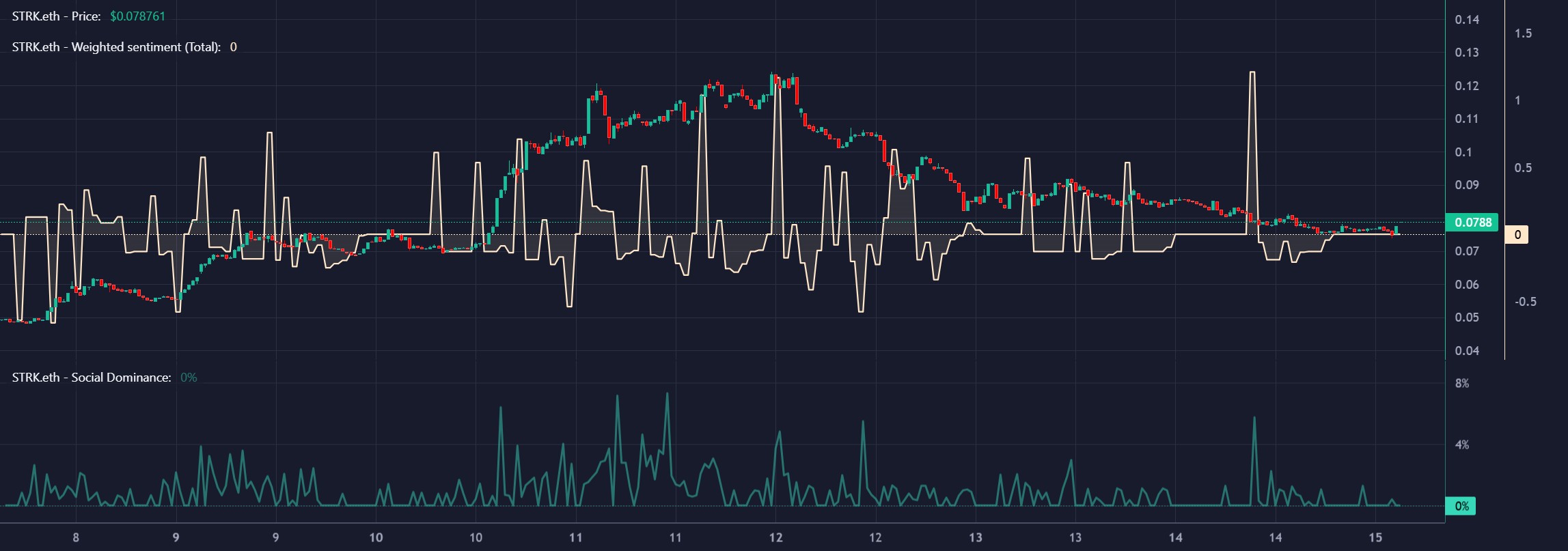
Why: Maybe it was due to a shift in the roadmap and narrative? On October 8, Starknet said it was “actively considering becoming an L1,” leaving its role as an Ethereum layer 2, which it said would make it the first fully quantum-resistant network, targeting 2027. StarkWare CEO Eli Ben-Sasson then warned that “the quantum threat may be much closer than we think,” and the rally extended into October 11.
This is a plan rather than a shipped change, and the move to an L1 remains unconfirmed. One other bit of context: Santiment found the 10 largest STRK addresses hold about 7.09B tokens, their highest combined balance since April.
What to watch: The crowd’s mood heading into the unlock. About 127 million STRK, roughly 1.7% of circulating supply, unlocks on October 15. Sentiment turning negative as active addresses keep falling would confirm a local top, while a second wave of new wallets would mean the crowd is coming back.
The takeaway: The crowd arrived on a narrative, peaked in euphoria on the same day as price, and has now slowed down. We lean toward a further pullback, though the largest holders still growing their positions is a reason not to expect the whole move to unwind.
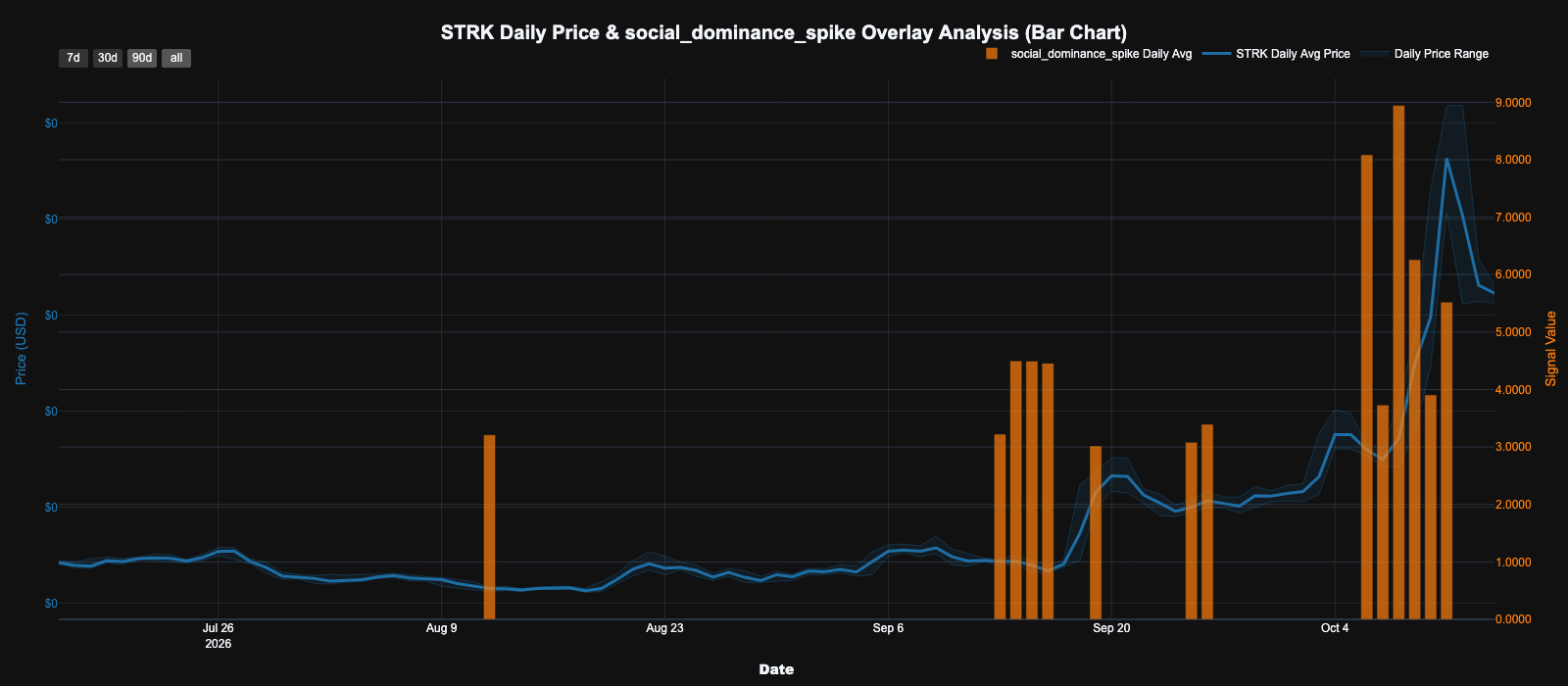
Trader tip: when sentiment, active addresses, and new wallets all peak on the same day as price, treat it as a likely top rather than a breakout — STRK’s did on October 11, and it fell 31% the next day.
Last Week’s Scorecard
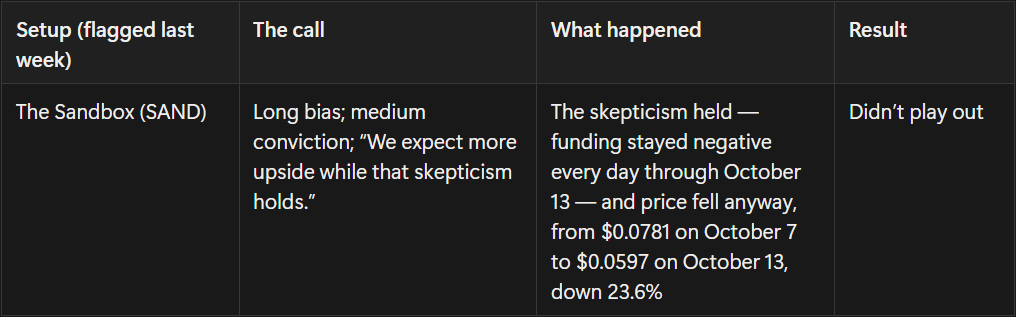
Scorecard read: Just one prediction, and it didn’t happen (yet?) The condition we set held: traders kept betting against SAND every day of the week. Price fell 24% regardless. The traders betting against it were right. The catalyst was a one-time restoration of exchange access, and a one-time event gives buyers no reason to keep coming.
A skeptical crowd is only fuel when there is a reason for buying to continue. This week Reserve Rights got the same kind of catalyst, an Upbit listing on October 12, rose 32.7% that day, and slipped 5.8% the next.
What Else Triggered
'old_coins_moved' fired 21 times across 20 distinct events this week. Among the strongest readings:
- Reserve Rights, RSR: 61.15 times its trigger level, the week’s highest multiple, on October 12 — the day Upbit listed it and price rose 32.7%. It slipped 5.8% the next day.
- Chainlink, LINK: 23.82 times, about 14.4% of supply, dormant 274 days, on October 9. Price is up 0.5% since.
- Telcoin, TEL: 2.58 times, about 0.76% of supply, dormant 513 days, on October 7 — a local high, and its fourth trigger since September 9. Down 11.6% since.
- Render, RENDER: 3.28 times, about 0.13% of supply, dormant 534 days, on October 12 — its highest close of the week, and its second trigger in two weeks. Down 3.8% the next day.
Celestia, TIA drew eight 'social_dominance_spike' triggers, peaking at 9.28 on October 11, but that peak came the day after TIA rose 27.9%, so the attention followed the move. The team pointed to its Fibre data layer reaching 3.07 Tb/s and a proposal to change the network’s economics.
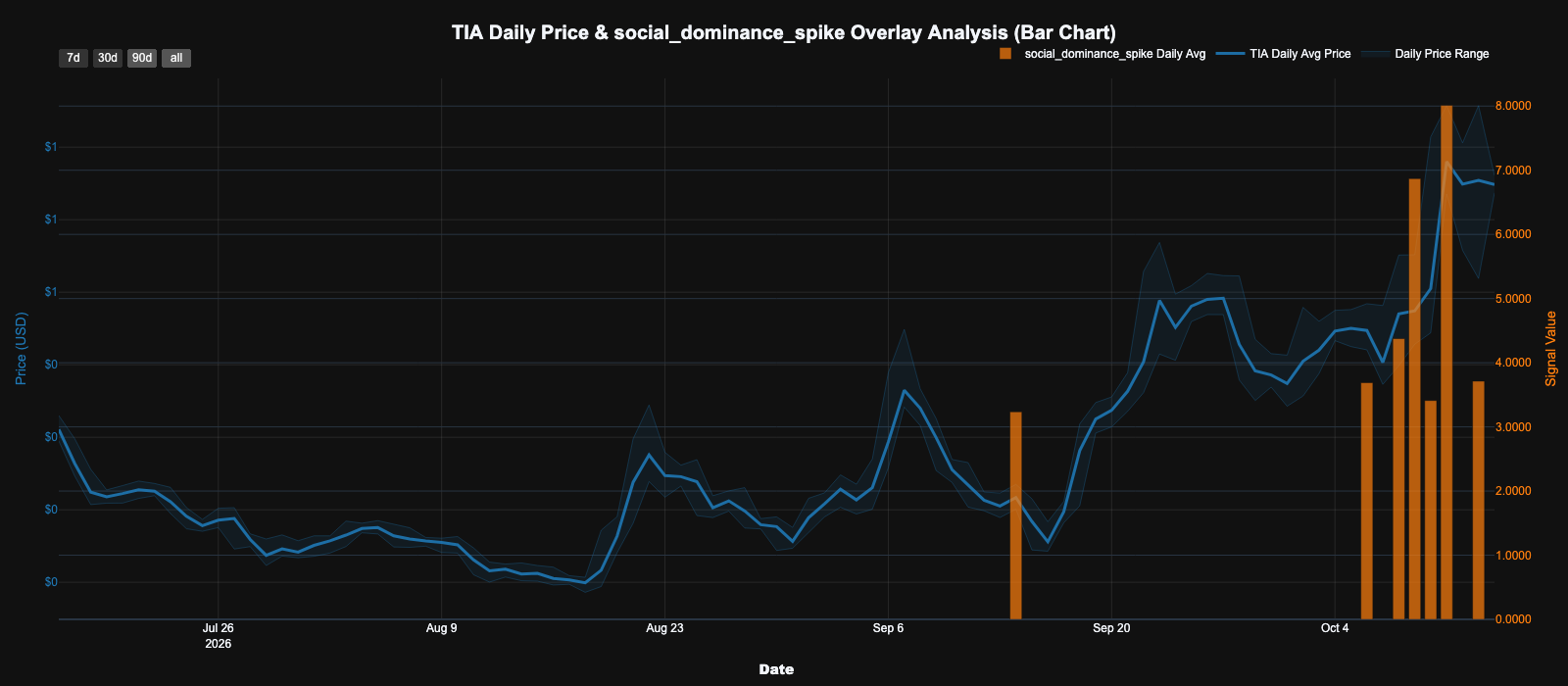
No-shows this week: 'hyperliquid_avg_funding_rate', 'social_price_correlation', and 'social_dev_score' produced no eligible events.
Worth Watching
- Starknet, STRK: whether active addresses keep falling into the October 15 unlock.
- Reserve Rights, RSR: whether it keeps fading after its Upbit listing.
- Telcoin, TEL: whether a fifth dormant-coin trigger lands near a high.
Full Trigger Table
Between 2026-10-07 08:00 and 2026-10-14 05:00 UTC, 1,001 trigger observations fired across six active signals.
Market-cap filter: latest_marketcap_usd > $50M.
Anomalies We Track
- Network Activity & Price Divergence Anomaly — detects price surges that are not accompanied by a corresponding rise in network activity (real growth). Triggered only if price growth exceeds 3% on the same day, ensuring the alert is relevant for significant bullish moves.
- Project in Trends Anomaly — detects when a specific crypto token gains significant traction in online discussions, placing it among the top 10 most-mentioned words in crypto-related conversations.
- Old Coins Moved Anomaly — detects unusually large amount of long-dormant supply moving, measured against each asset’s own recent history. Triggers above 1.5 times that baseline. A trigger shows old coins moved, not that anyone sold them.
- Large USDC-USDT Mint Anomaly — detects daily combined $1 billion or larger minting events of USDC and USDT stablecoins on the Ethereum blockchain.
- Social Price Correlation Anomaly — detects whether social sentiment and price are behaving in an unusually aligned or unusually decoupled way. Currently runs on 1h X.com social data for bitcoin, ethereum, solana, dogecoin, xrp, trx, and cardano.
- Social Dominance Spike Anomaly — detects abnormal spikes in social dominance. Alerts when values exceed a statistical significance threshold of 3 standard deviations over 30 days.
- Social-Dev Score Anomaly — detects unusual activity compared to the recent 30-day history of social media metrics and development activity. The score is weighted 60/40 for social and dev activity.
- Hyperliquid Average Funding Rates Anomaly — detects when rates exceed predefined high/low thresholds of +40% and -20%, measured hourly.
- ETH Whale Dump Anomaly — detects potential large-scale ETH dumps by monitoring whale wallet behaviors. Uses a 500 ETH threshold and a 30-day holding period to distinguish normal trading from potential dump scenarios.
Thanks for reading this week’s Santiment Anomaly Report. For real-time anomaly alerts and the underlying data, head to Sanbase.
See you next week.
Anomalously yours,
Santiment
Disclaimer: Parts of this report were generated with AI and then quality checked and copy-edited by humans. It is for reference purposes only and is not intended as financial or investment advice. Always DYOR.