The Weekly Anomaly Report: October 14th – 21st


A token suddenly dominating crypto Twitter, whales dumping ETH, price spiking while network usage flatlines — you get the gist. We call these anomalies, and they often lead to trading opportunities.
If you’re new here, we spot trading setups potentially worth acting on, give you the market backdrop they sit against, and grade how last week’s predictions actually played out.
Let’s dig in!
This Week in Brief
- Basic Attention Token, BAT: more than doubled with no catalyst, and its active addresses peaked two days before price did.
- Celestia, TIA: for the second week running, its crowd arrived the day after a news-driven jump, and price gave back about 13%.
Market Backdrop
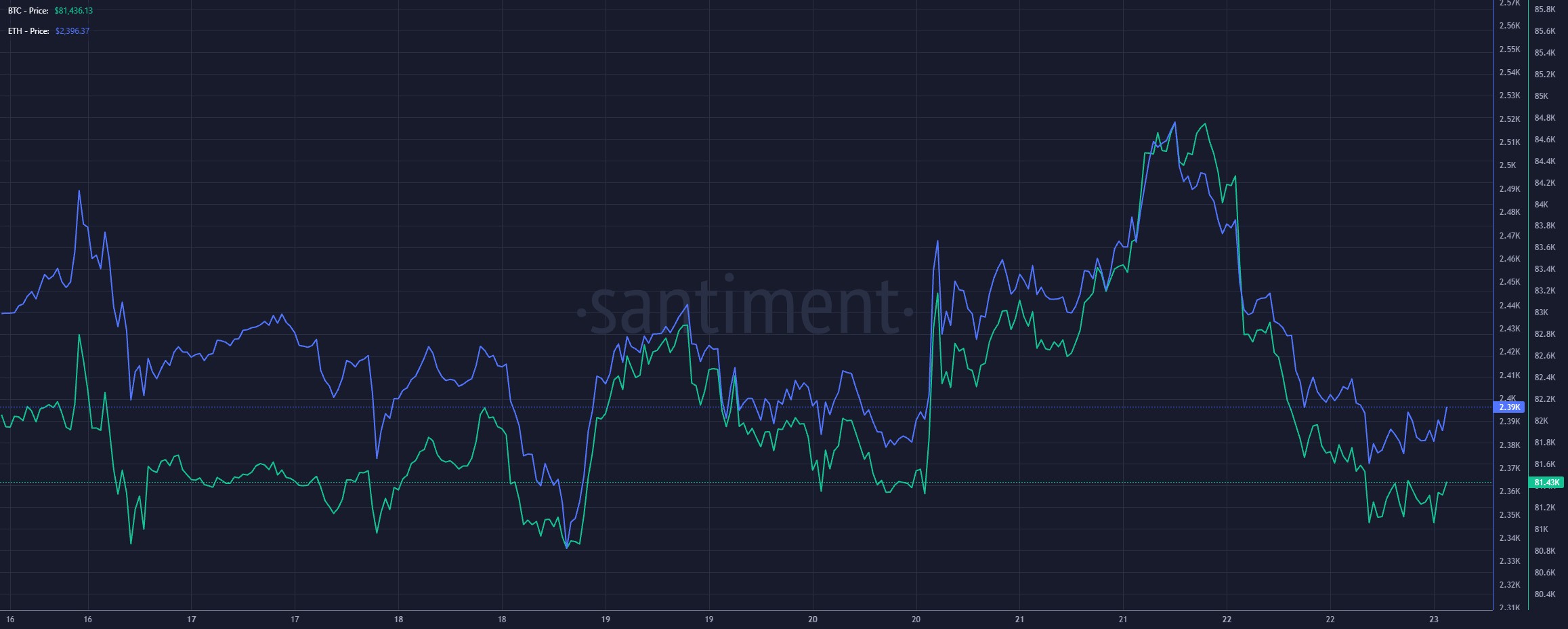
The majors stayed flat. Bitcoin traded between $81.4K and $82.9K from October 14 to 20, closing at $82.9K, about +1.7%. Ether moved from $2,418 to $2,447, roughly +1.2%.
Smaller names did the moving. Basic Attention Token, BAT, more than doubled in the week to October 15, and Celestia, TIA, jumped 16.7% on October 16, each while Bitcoin barely moved.
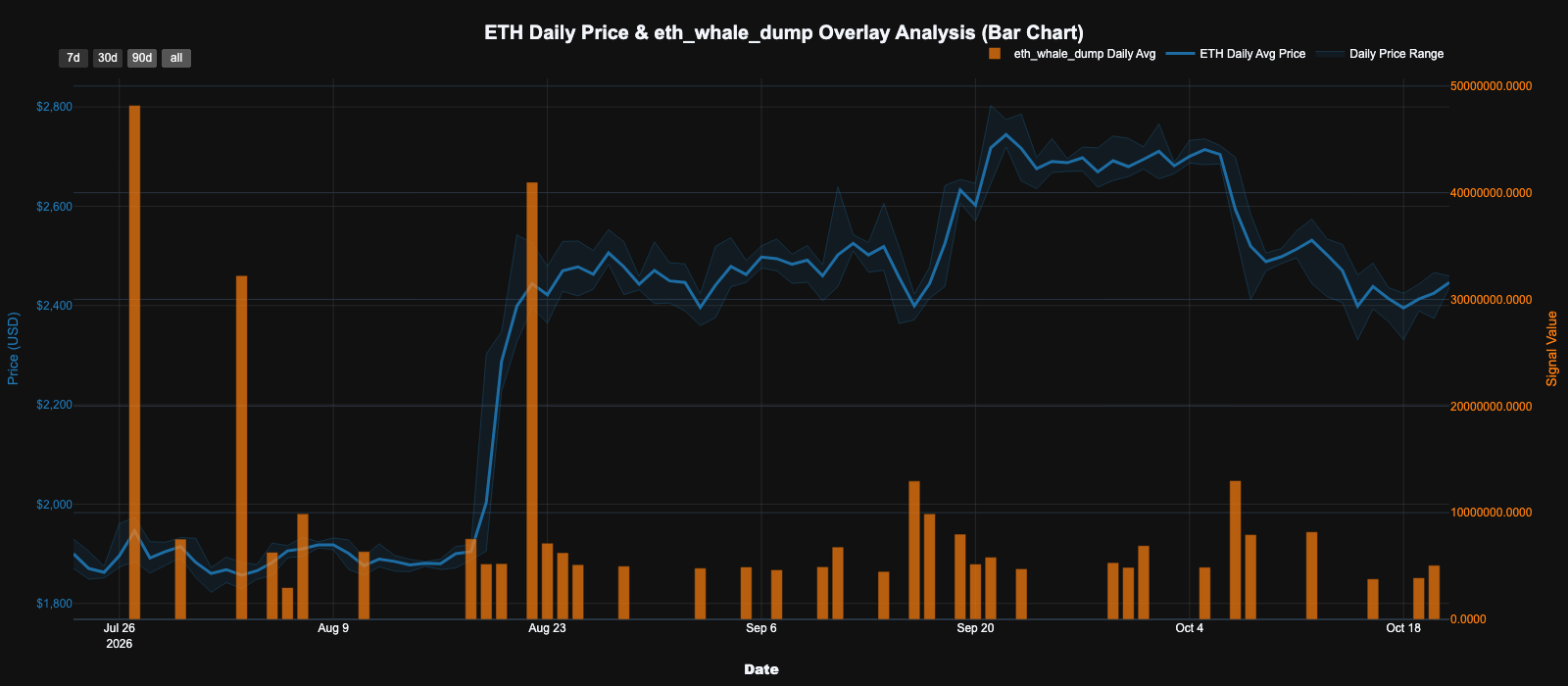
'hyperliquid_avg_funding_rate' produced no triggers for a third straight week. 'eth_whale_dump' fired three times, on transfers to OKX, KuCoin, and Bybit, peaking at $5.07M on October 20.
The Fed announces its next interest-rate decision on October 28, inside the coming week. It raised rates in September, and Fed Chair Kevin Warsh has declined to say whether it will raise them again, even after September’s inflation report came in hotter than expected.
Nothing crypto-specific is moving in Washington. The CLARITY Act remains stalled, and the U.S. midterms are on November 3.
Test your trading skills, build a track record, win capital allocation from Santiment on our new platform, Score Arena — Apply for early access!
This Week’s Trading Setups
1. Basic Attention Token (BAT)
Signal: price_network_activity_divergence + old_coins_moved · Lean: Mean-reversion, low conviction
What’s anomalous: 'price_network_activity_divergence' fired on October 15, and 'old_coins_moved' fired on October 14 at 1.62 times its trigger level. Market cap is about $291M.
Both are unsurprising on a move this size. BAT more than doubled in a week, from $0.1026 on October 8 to $0.2157 on October 15. Take a look at what drove it. Daily active addresses rose from 333 to 1,172 between October 8 and 13, up 252% — faster than price — then peaked on October 13, two days before price did. By October 20, active addresses were down 46% from that peak, while price was down 10% from its own.
Traders bet against the rally once, hard: aggregated funding hit -0.00331 on October 13, about 50 times its typical size that month, then settled back around zero. The crowd’s mood didn’t track the price. Sentiment balance read 30.92 in the week of the rally and 30.24 the week after, close to BAT’s six-month median of about 28 and well below its high of 49.11. The old-coins reading came on a day when nearly 200M BAT, about 13% of supply, changed hands, so the coins moving were mostly active ones rather than long-idle holdings.
Why: No clear catalyst — flagging on data alone. Nothing from Brave or the BAT project explains the timing, and Brave’s blog had published nothing since September 3. The background is general: Brave reported 128 million monthly users in September, its Rewards Card has a waitlist, and a potential proposal could bring BAT to Internet Computer.
What to watch: Whether active addresses keep falling. Active addresses led this rally and topped first, so a further drop would point to price following them down. A second surge in addresses could mean genuine adoption and that the crowd is coming back.
The takeaway: BAT doubled with no catalyst, on a crowd that peaked two days before price and has since thinned by almost half. We lean toward a further pullback, at low conviction, since the crowd never got euphoric enough to mark a clear top.
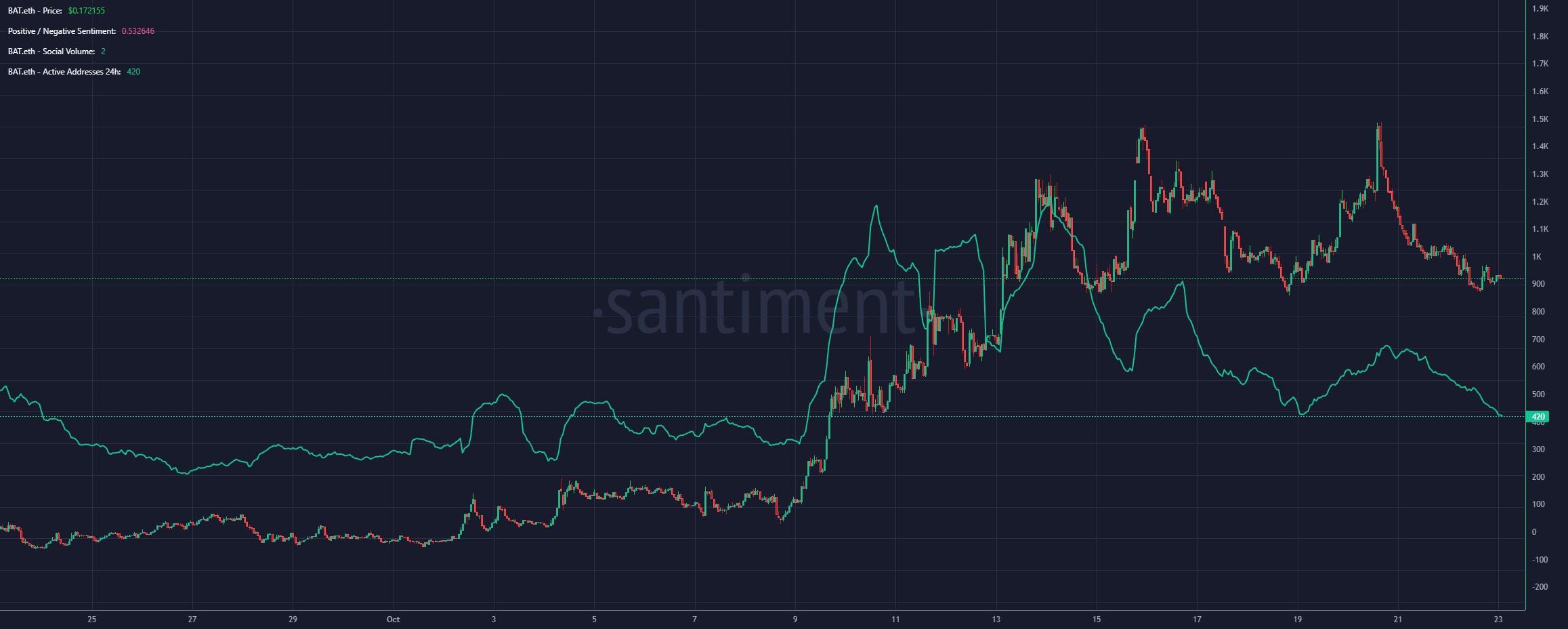
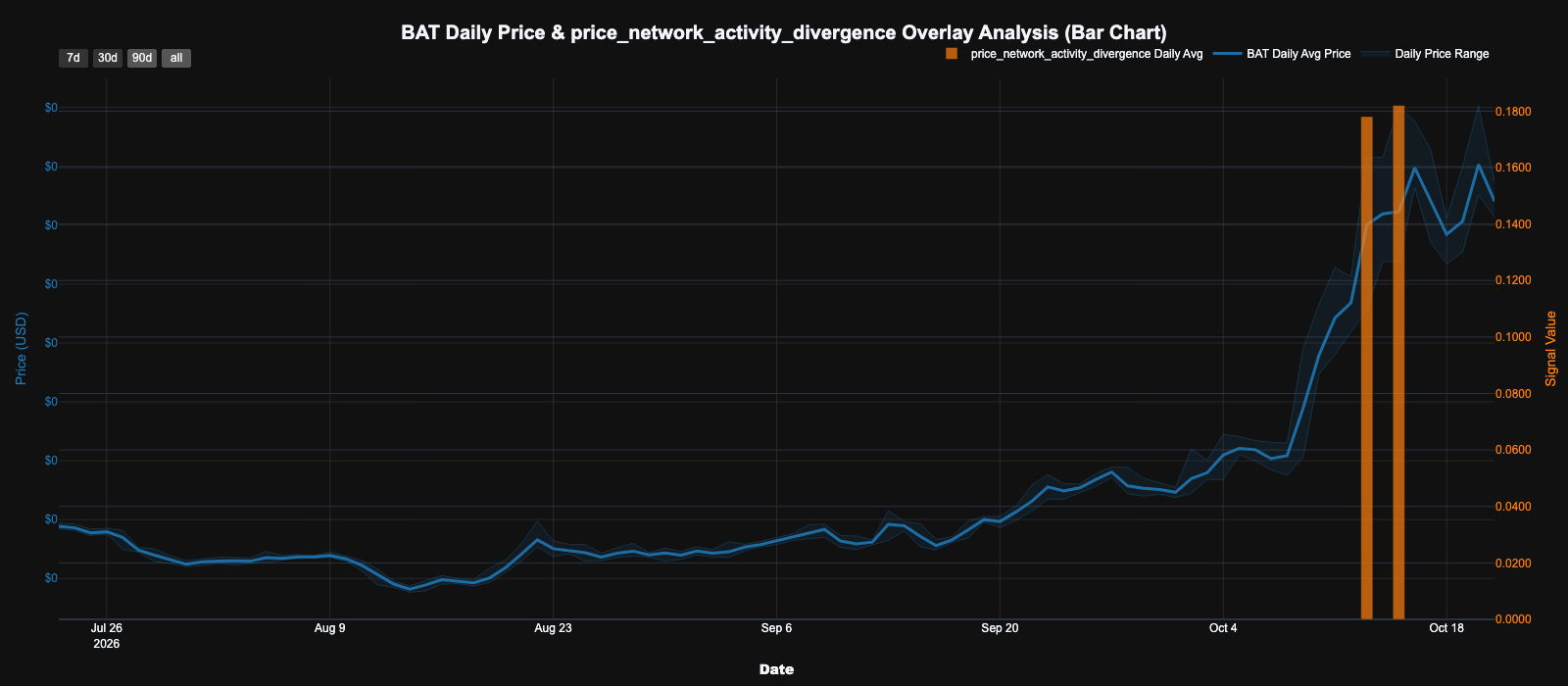
Trader tip: watch whether active addresses peak before price does — BAT’s topped on October 13, two days before its price high.
2. Celestia (TIA)
Signal: social_dominance_spike · Lean: Mean-reversion, low conviction
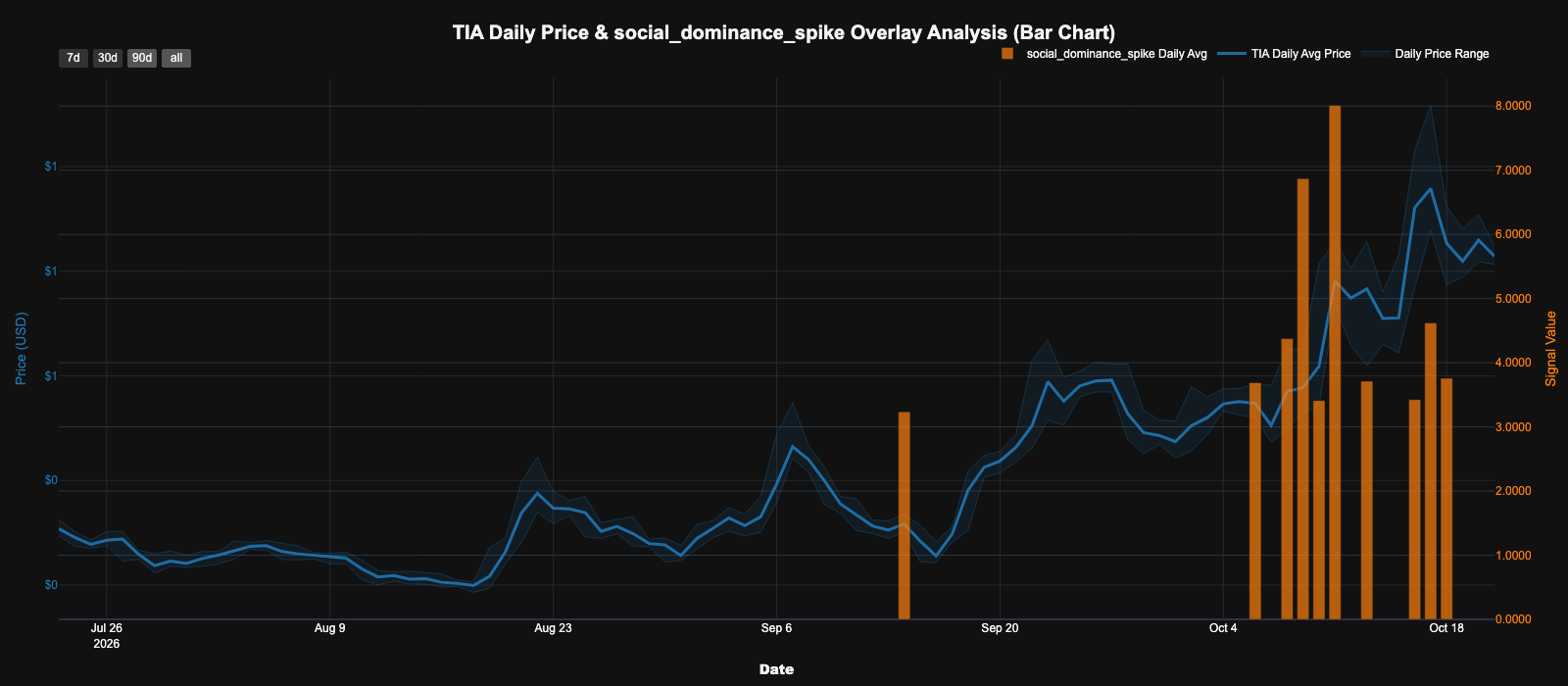
What’s anomalous: 'social_dominance_spike' fired four times, peaking at 4.84 on October 17. Market cap is about $574M.
Take a look at the timing. TIA jumped 16.7% on October 16, and the attention peak came the next day. It is the second week running: last week TIA rose 27.9% on October 10, and its attention peaked on October 11. Both times, price then fell — 12.5% by October 12, and 13.0% by October 21. Over the week, TIA still finished 13.0% higher.
Why: Two pieces of news, a week apart. On October 16, Celestia introduced Eden, an EVM chain that uses Celestia for data and TIA as its gas token, built as a test environment for AI agents to trade and pay for services on-chain. The week before, the team pointed to a Fibre benchmark of 3.07 terabits per second and a proposal to change the network’s economics.
What to watch: The next spike in attention. Twice now the crowd has arrived the day after a news-driven jump, and price has given back about 13% within days. A third instance would make this a pattern worth trading against.
The takeaway: Celestia was up 40% from October 2 to October 20, but its crowd keeps arriving a day late. We lean toward fading the next news-driven spike rather than chasing it.
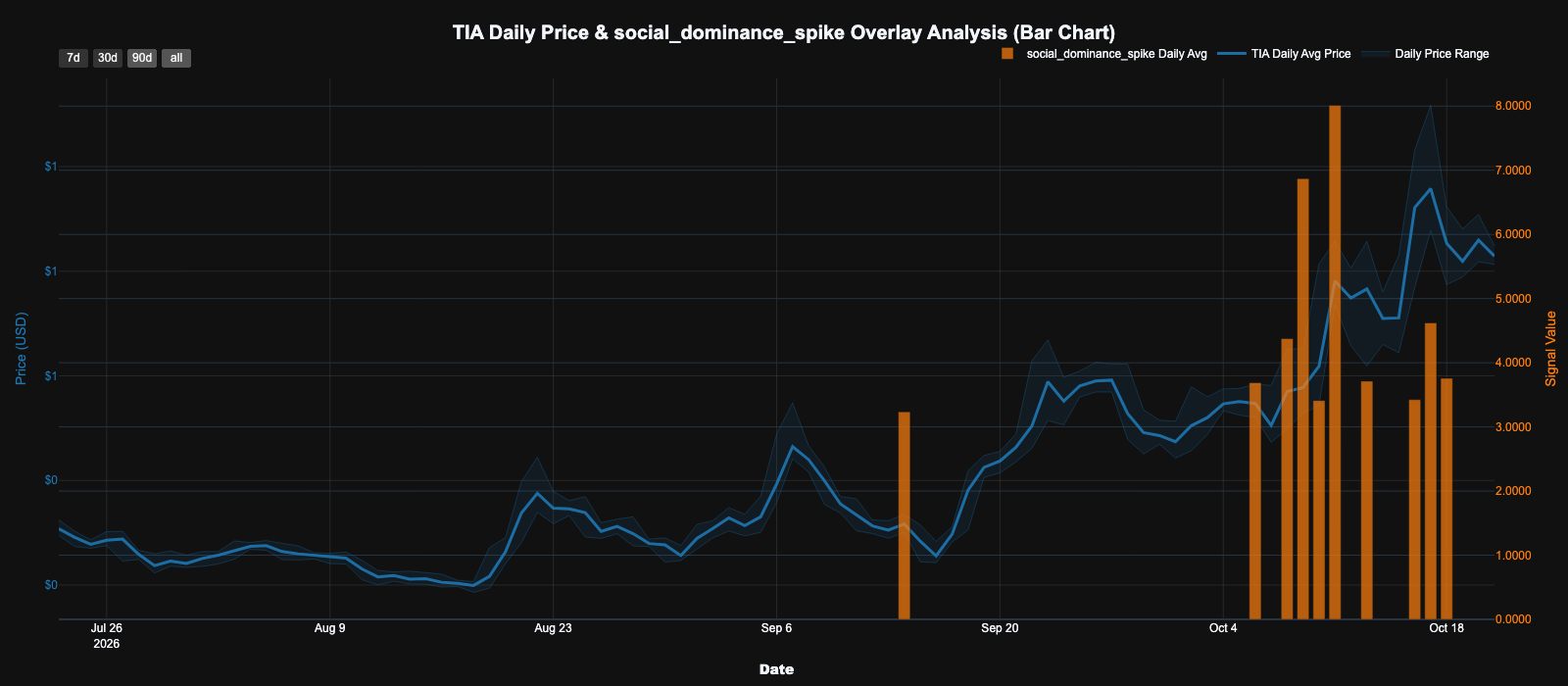
Trader tip: don’t buy the day after a news-driven jump — Celestia’s crowd arrived then twice, and both times price gave back about 13%.
Last Week’s Scorecard
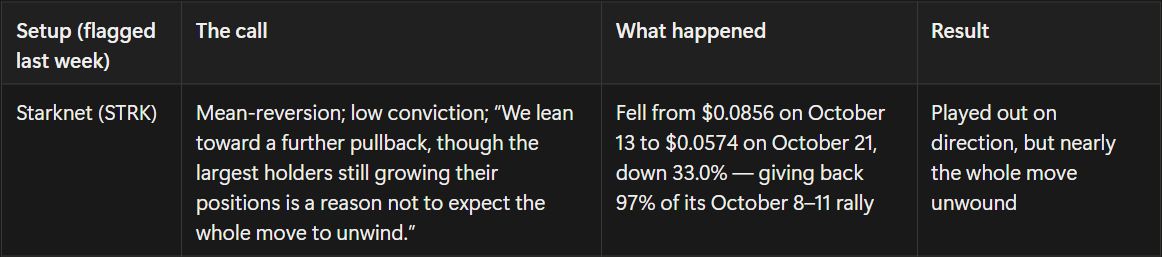
Scorecard read: One call, and the direction landed: Starknet fell 33%.
The lesson is about which data did the predicting. The euphoria reading — sentiment, active addresses, and new wallets all peaking on the same day as price, signaling the drop.
What Else Triggered
HEX and PulseX hit their social-dominance highs an hour apart on October 15, at 7.90 and 6.99 — above Mantle’s 6.57 and Celestia’s 4.84. Both are projects of Richard Heart, who was arrested in Istanbul on October 14 on a Finnish Interpol Red Notice over alleged tax fraud and assault. HEX’s dormant coins moved on the day of the arrest, at 3.68 times their trigger level.
'old_coins_moved' fired 40 times across 36 distinct events this week. Among the strongest readings:
- Bitget Token, BGB: 13.64 times, about 0.45% of supply, dormant 398 days, on October 19. Up 2.1% by October 21.
- Ethereum Name Service, ENS: 7.24 times, about 8.65% of supply, dormant 305 days, on October 20. Up 2.9% the next day.
Holo, HOT was the only project besides Bitcoin and Ether to reach 'project_in_trends', at 149.33 on October 15. Its price was 2.7% lower by October 20, and its active addresses stayed between 204 and 290 a day.
Two of last week’s watch items resolved. Reserve Rights kept declining after its Upbit listing, down 13.4% from October 12 to October 21. Telcoin produced no fifth dormant-coin trigger, and by October 21 it was down 28.6% from its fourth, on October 7.
No-shows this week: 'hyperliquid_avg_funding_rate', 'social_price_correlation', and 'social_dev_score' produced no eligible events.
Worth Watching
- Basic Attention Token, BAT: whether active addresses keep falling.
- Celestia, TIA: whether its next spike in attention again comes the day after a jump.
- Ethereum Name Service, ENS: whether a second dormant-coin trigger follows its October 20 move.
Full Trigger Table
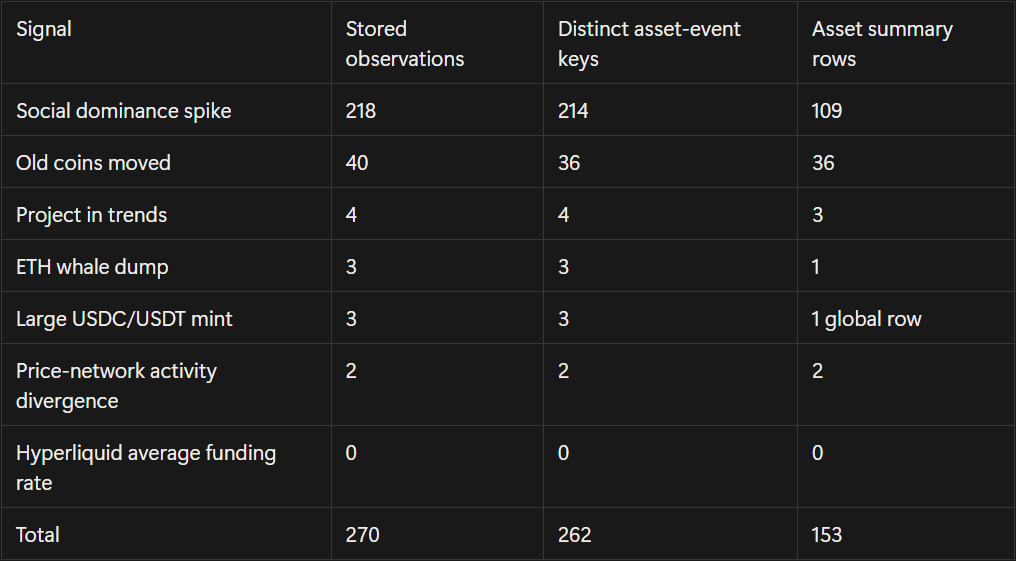
Between 2026-10-14 09:00 and 2026-10-21 06:00 UTC, 270 trigger observations fired across six active signals.
Market-cap filter: latest_marketcap_usd > $50M.
Anomalies We Track
- Network Activity & Price Divergence Anomaly — detects price surges that are not accompanied by a corresponding rise in network activity (real growth). Triggered only if price growth exceeds 3% on the same day, ensuring the alert is relevant for significant bullish moves.
- Project in Trends Anomaly — detects when a specific crypto token gains significant traction in online discussions, placing it among the top 10 most-mentioned words in crypto-related conversations.
- Old Coins Moved Anomaly — detects unusually large amount of long-dormant supply moving, measured against each asset’s own recent history. Triggers above 1.5 times that baseline. A trigger shows old coins moved, not that anyone sold them.
- Large USDC-USDT Mint Anomaly — detects daily combined $1 billion or larger minting events of USDC and USDT stablecoins on the Ethereum blockchain.
- Social Price Correlation Anomaly — detects whether social sentiment and price are behaving in an unusually aligned or unusually decoupled way. Currently runs on 1h X.com social data for bitcoin, ethereum, solana, dogecoin, xrp, trx, and cardano.
- Social Dominance Spike Anomaly — detects abnormal spikes in social dominance. Alerts when values exceed a statistical significance threshold of 3 standard deviations over 30 days.
- Social-Dev Score Anomaly — detects unusual activity compared to the recent 30-day history of social media metrics and development activity. The score is weighted 60/40 for social and dev activity.
- Hyperliquid Average Funding Rates Anomaly — detects when rates exceed predefined high/low thresholds of +40% and -20%, measured hourly.
- ETH Whale Dump Anomaly — detects potential large-scale ETH dumps by monitoring whale wallet behaviors. Uses a 500 ETH threshold and a 30-day holding period to distinguish normal trading from potential dump scenarios.
Thanks for reading this week’s Santiment Anomaly Report. For real-time anomaly alerts and the underlying data, head to Sanbase.
See you next week.
Anomalously yours,
Santiment
Disclaimer: Parts of this report were generated with AI and then quality checked and copy-edited by humans. It is for reference purposes only and is not intended as financial or investment advice. Always DYOR.