Deep Dive: Microcaps Getting LOUDER While the Blue Chips Take a Break

Crypto’s risk appetite has moved down the ladder. Bitcoin’s late-August surge opened the door, with BTC gaining roughly 25% during August before September brought another leg higher. Market participation also widened sharply, with 83% of the top 100 non-stablecoin assets finishing August higher. That does not guarantee a textbook “altseason,” but it created exactly the environment where traders begin looking beyond Bitcoin, then beyond large-cap alts, and eventually toward the smallest corners of the market.
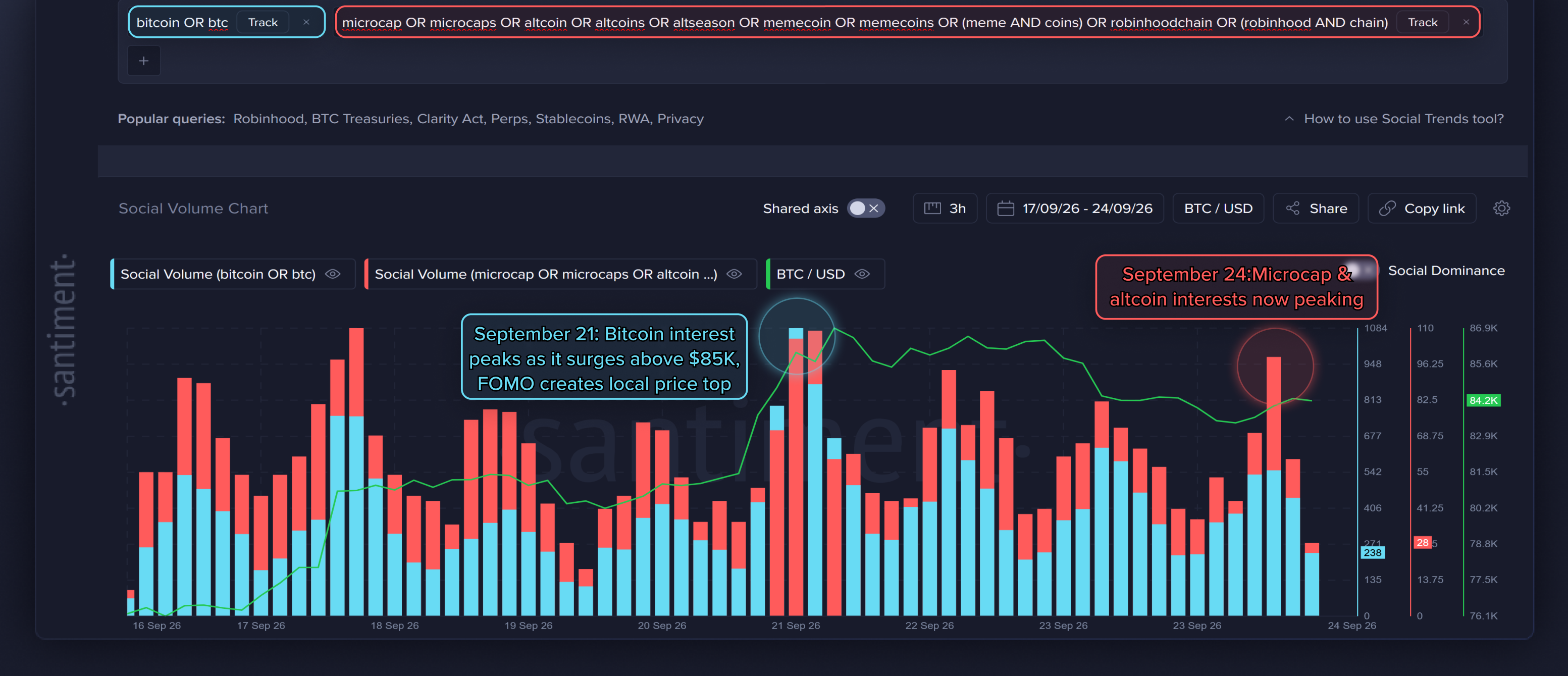
That final step now appears to be happening. Tokens such as familiars, CHUDDY and SHARTCOIN are appearing alongside clusters of small KOL buys like EMBER, MINI, and PAID, with repeated wallet entries and rapid social-media amplification. MadeOnSol’s September 24 data alone tracked 323 active KOLs making nearly 38,000 trades, with 1,768 tokens receiving buys from at least two tracked KOLs.
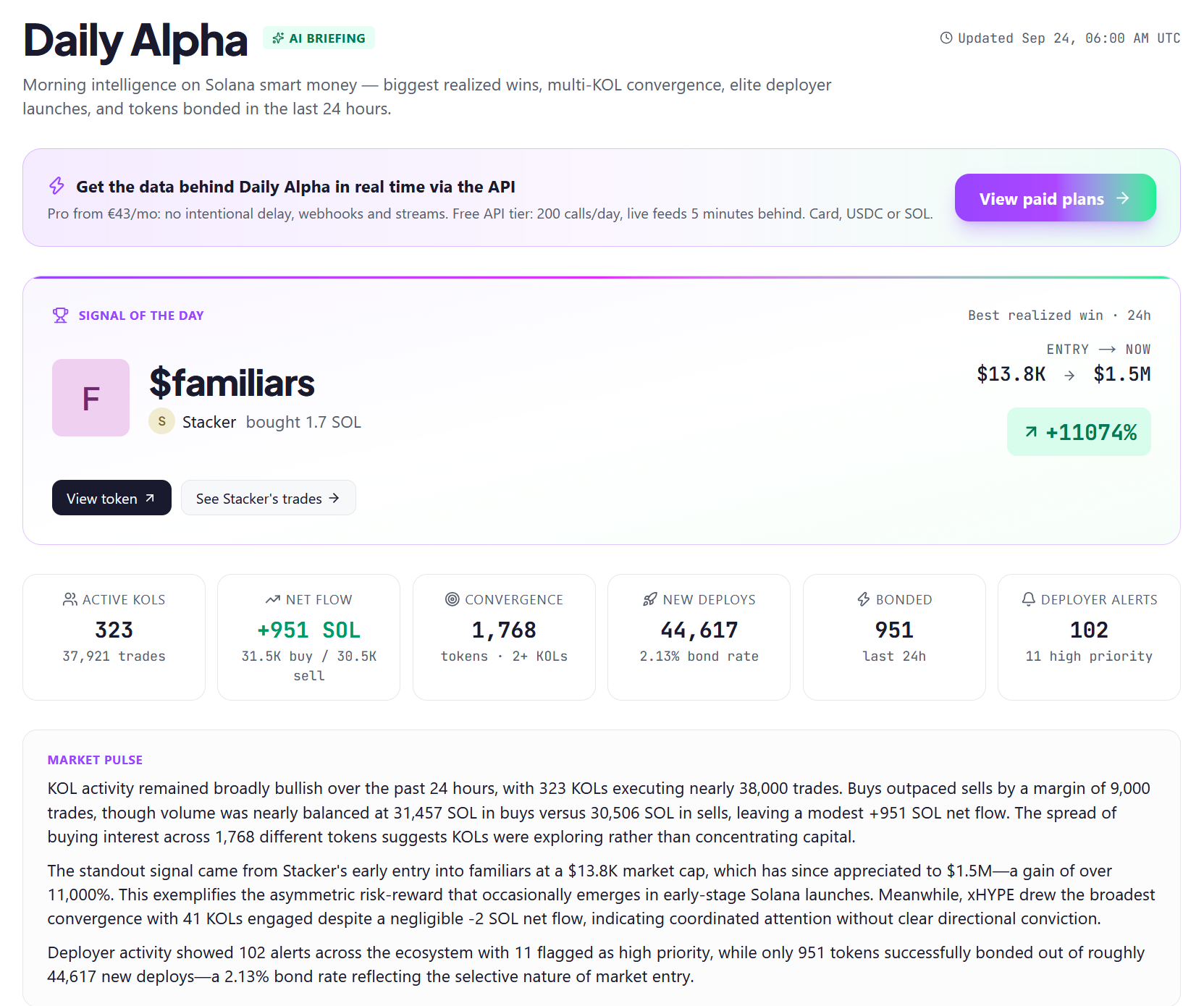
The bullish interpretation is straightforward. A relatively tiny amount of fresh capital can send an illiquid token flying. The bearish interpretation, however, is just as important. The same thin liquidity that makes a 10x possible can make a 70% collapse possible when influential wallets rotate elsewhere.
EMBER Turns a Launchpad Into a Microcap Narrative
EMBER is a good example of why the current rotation cannot simply be called “memecoin season.” Embercurve is an actual Solana launchpad powered by Meteora infrastructure, allowing projects to pair tokens not only with SOL and USDC, but with more than 160 tokenized stocks. That gives EMBER a much stronger narrative than “funny picture goes viral.” There is a product, transaction activity and a mechanism designed to capture value from an active launch ecosystem.
Then came the KOL effect. Unipcs, better known as Bonk Guy, said he initially saw EMBER around a $3 million valuation, ignored it, then began buying aggressively from roughly $7 million through $20 million after watching the platform’s activity accelerate. In Image 1, he goes further, arguing that EMBER could “easily” reach a valuation above $100 million. Image 11 shows James Wynn making the relative-valuation argument, contrasting EMBER’s much smaller valuation with Pump.fun. Bonk Guy later reported that the platform had already produced tens of millions of dollars in trading volume within days.
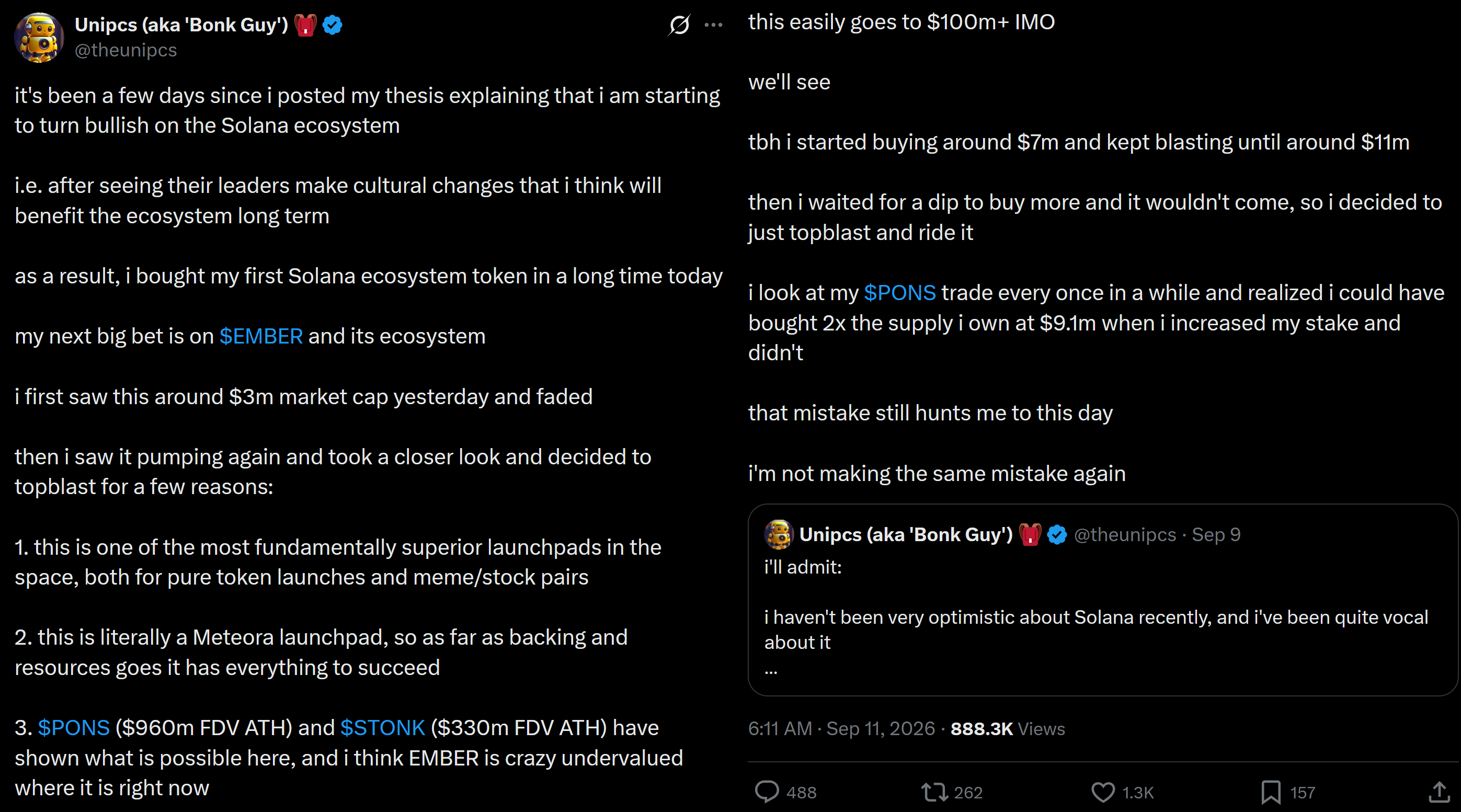
That language is also exactly where microcap traders should become more skeptical. A KOL saying something should “easily” reach $100 million is expressing a thesis, not revealing where the token is destined to trade. The larger an influencer’s existing position is, the more important that distinction becomes. A strong product can still have a bad token valuation, poor entry point or brutal drawdown.
EMBER also faced questions after Bubblemaps identified connected wallet clusters. Bubblemaps later clarified that one important cluster involved a reward distributor and specifically stressed that a cluster does not automatically mean a scam. Bonk Guy likewise disputed claims that insiders controlled more than half of the supply. That clarification removes some of the most alarming interpretations, but it also illustrates why wallet concentration needs to be investigated rather than dismissed or sensationalized.
MINI Is Getting Something More Valuable Than One Viral Tweet
MINI offers another clue about what separates current microcap speculation from a random one-day pump. The KOL buying has been repetitive. On September 16, MadeOnSol recorded slingoor buying MINI in blocks of 444 SOL, 282 SOL and 101 SOL. September 19 brought another 173 SOL purchase plus several 100-SOL transactions. On September 20, the tracker recorded a further 502 SOL purchase.
That repeated accumulation is more notable than a single influencer buying once and immediately posting about it. It does not mean the buyer knows where price is going. It does suggest the thesis survived beyond the first entry.
Image 10 highlights the argument attracting attention. MiniRouter offers a single API for accessing many AI models, and its service now accepts MINI as payment. On September 23, MiniRouter increased the incentive by crediting qualifying MINI payments at 105% of their value while its allowance is available. The platform also accepts SOL and USDC, so MINI is not required to use it, but the token at least connects to a functioning service instead of depending entirely on social identity.
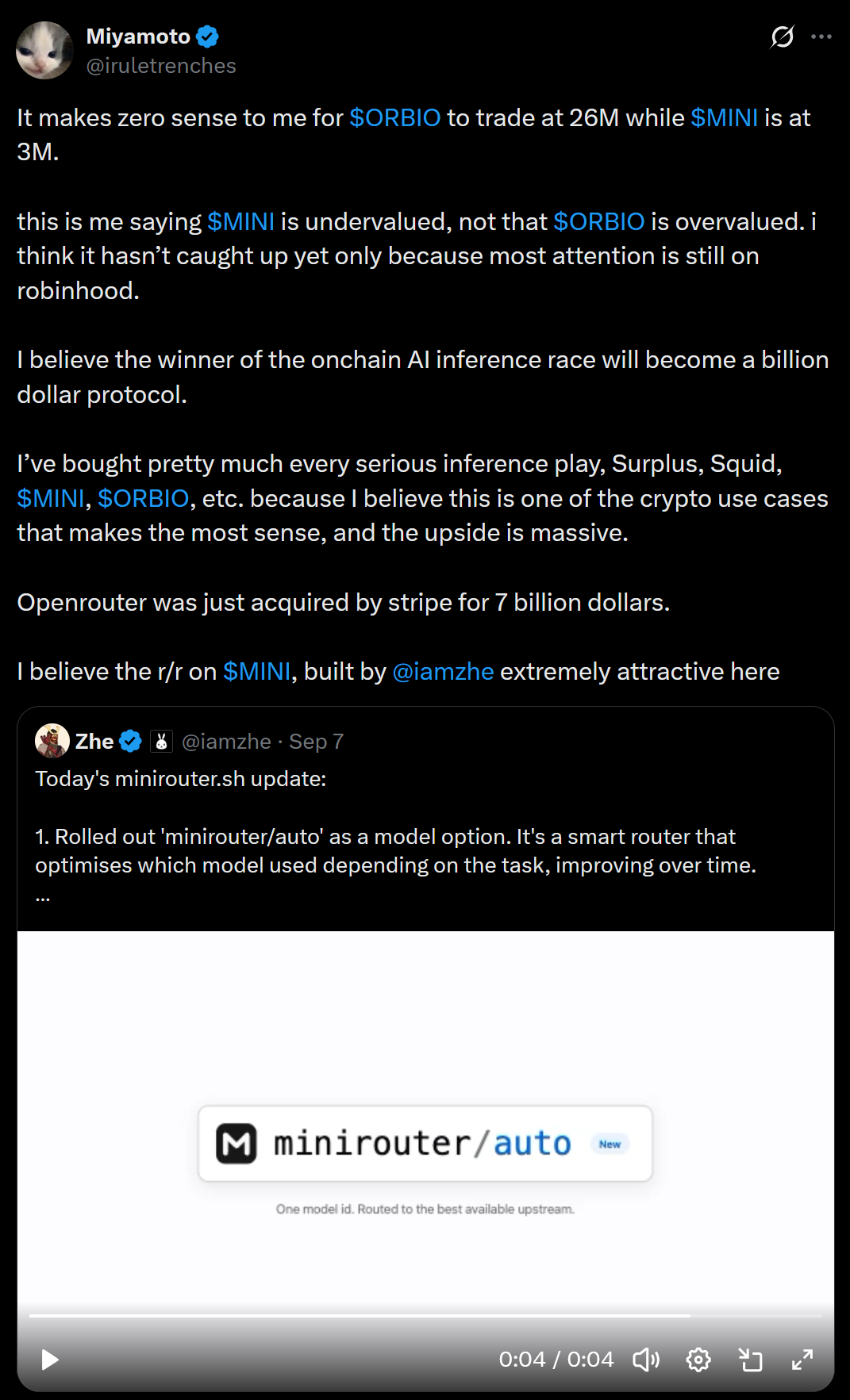
That distinction could become increasingly valuable if the microcap market cools. Narratives with actual usage have something for traders to measure after KOL attention fades. MINI’s test will be whether token-denominated payments create recurring demand or simply provide a compelling marketing wrapper during an AI-heavy trading cycle.
For now, the bullish case is the combination of a working product, a timely AI narrative and repeated large wallet purchases. The bearish case is familiar. When one visible KOL repeatedly becomes one of the largest buyers, the market can become unusually sensitive to what that same wallet eventually does on the sell side.
PAID Turns Crypto Attention Into an X-Native Business Model
PAID may be the cleanest example of KOL convergence in this group. On September 16, MadeOnSol tracked 50 KOLs interacting with PAID, with net accumulation around 161 SOL. slingoor accounted for a 370 SOL purchase, kyro for 106 SOL, while Ethan Prosper’s tracked entry began around an $18,200 valuation before the token later reached roughly $7.8 million in that reporting window.
The narrative almost feels engineered for Crypto Twitter. UsePaid lets token creator fees be directed toward an X account, converts the recipient’s share into dollars and sends it through X Money. Its current documentation says 80% goes to the designated recipient while the remaining 20% is used for open-market PAID purchases and burns. Importantly, UsePaid explicitly says it is independent from X, X Money, Robinhood, pump.fun and the launchpads it supports.
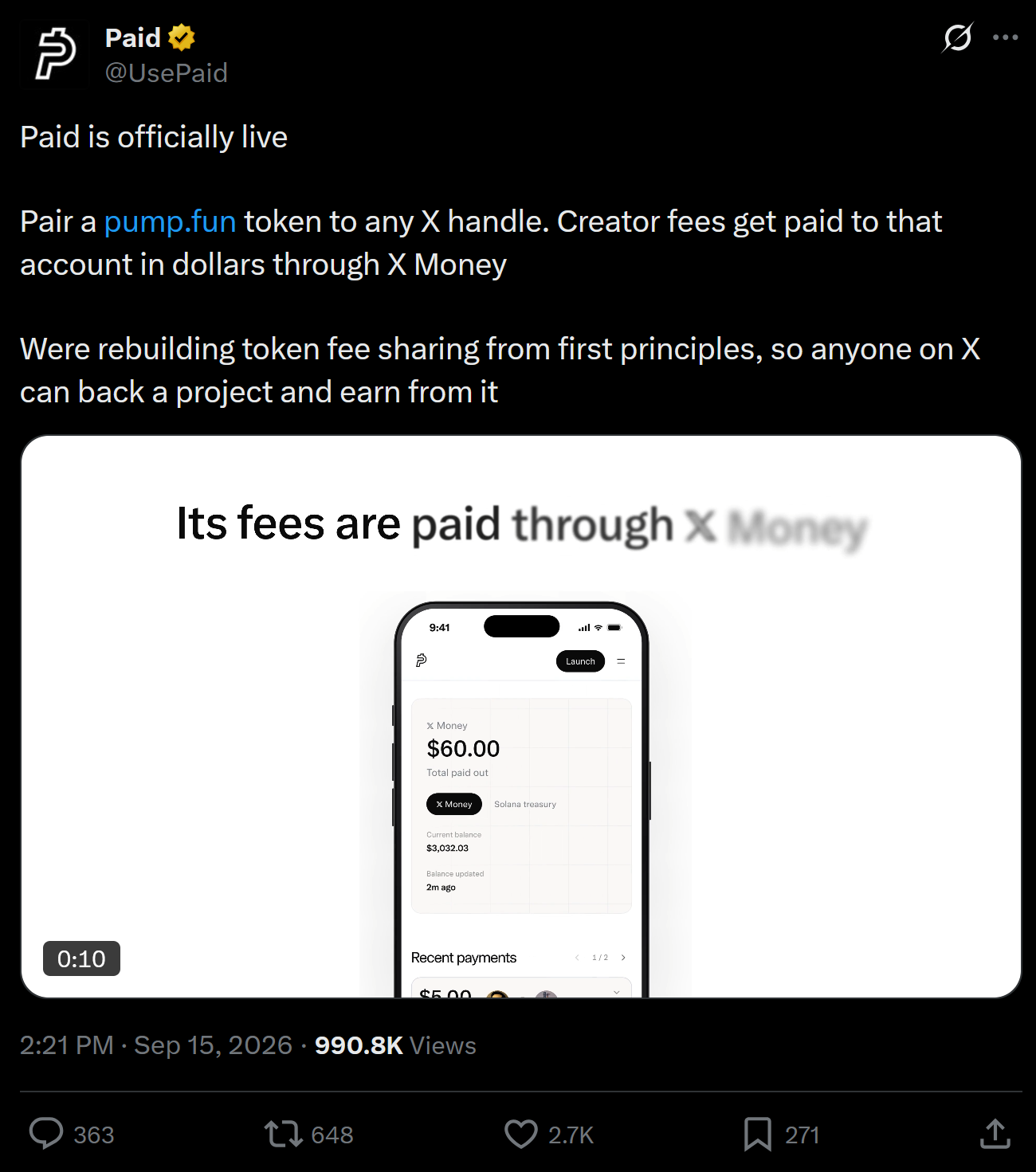
The pitch is simple: connect a token to an X handle and turn trading fees into dollar payments. And then the next stage has token launches on Pons and fees from Robinhood Chain feeding the same system. That convergence of creator fees, social media, memecoins and X Money is unusually well suited to the way crypto attention already works.
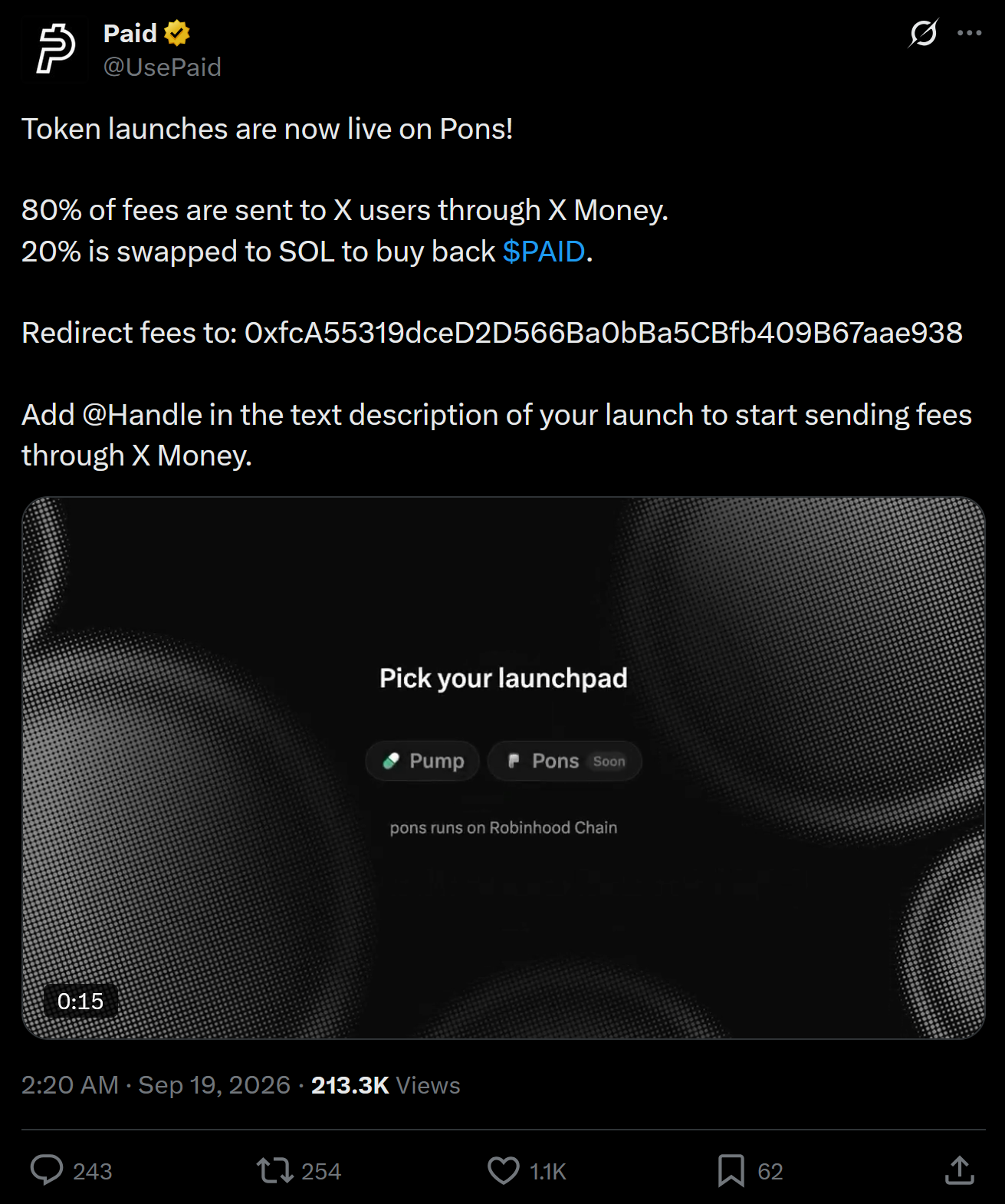
There is also a useful lesson here about microcap narratives. PAID does not have to become an enormous protocol to attract speculation. It only needs enough traders to believe that every new token, creator and chain integration can generate another fee stream. That can create a powerful reflexive loop. More attention creates launches, launches create fees, fees create buybacks, and those buybacks create more attention.
Reflexivity works both ways. If launches slow or traders lose interest, the same narrative can unravel quickly. Even UsePaid’s own disclosures stress that PAID ownership provides no governance rights, fee entitlement or access privileges.
JEANPHIL Shows That Sometimes Attention Is the Product
Then there is JEANPHIL, where pretending the story is fundamentally driven would miss the entire point. The blond-fringe Jean Phil character already had attention outside crypto. Traders packaged that cultural recognition into a Solana token, turning a social meme into a speculative market.
MadeOnSol tracked Megga buying 6.2 SOL worth when the token was around a $41,600 valuation. By its September 20 snapshot, JEANPHIL had reached roughly $2.8 million. Three days later, MEXC added the token to its Meme+ trading zone, giving the trend another distribution channel.
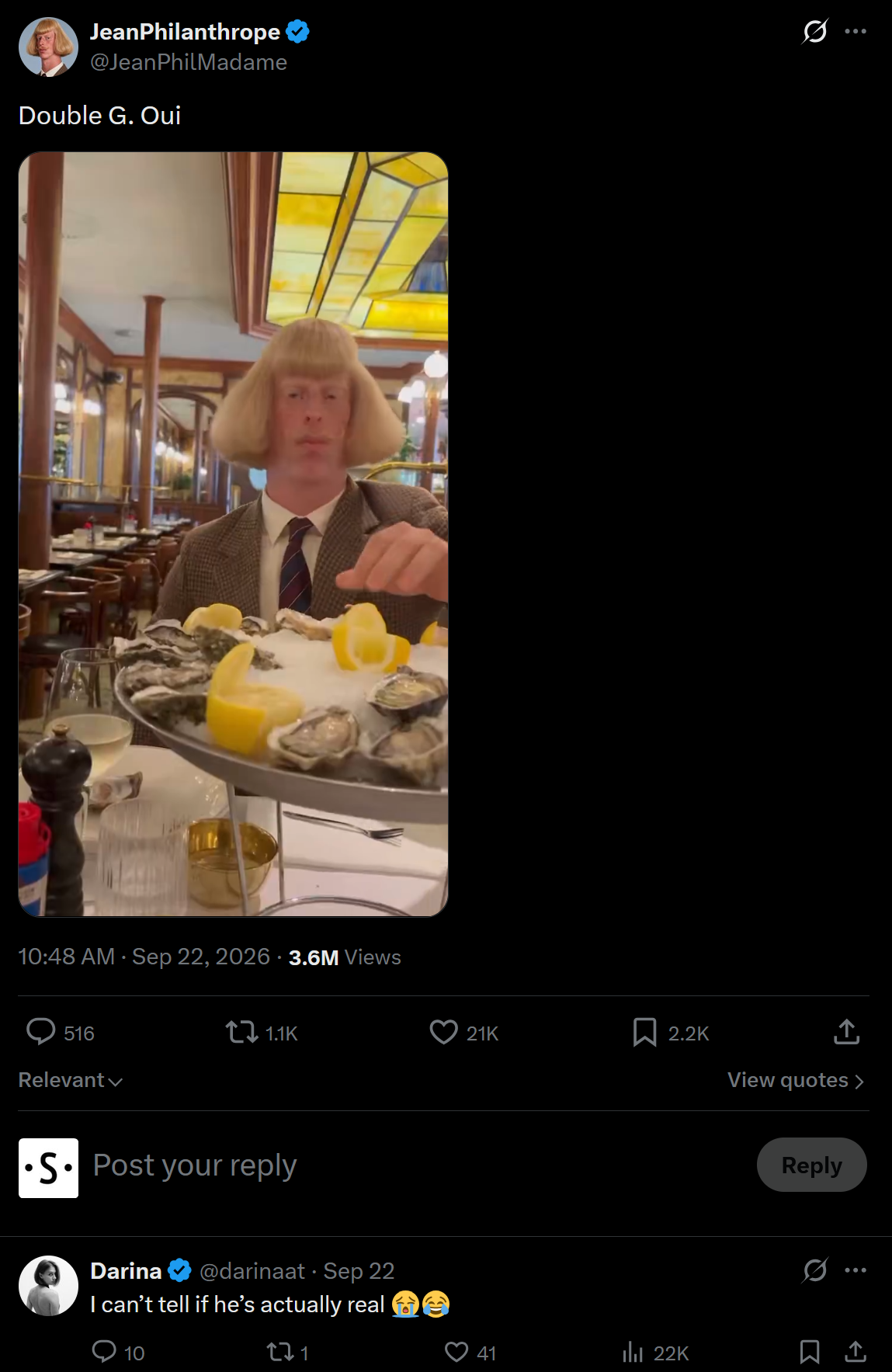
This is almost a perfect illustration of the thesis because it barely looks like crypto at all. It is simply Jean Phil being Jean Phil, with millions of views. That is precisely why traders care. An existing meme does not need Crypto Twitter to invent its identity. Crypto only has to financialize an identity that already travels.
This is the purest version of attention trading in the article. There is little need to debate revenue multiples or protocol architecture. The bullish argument is that an instantly recognizable meme can spread much farther than a token created solely for crypto insiders. The bearish argument is that attention can vanish just as quickly, leaving late buyers holding an asset whose principal fundamental was the virality they arrived too late to capture.
STAMP Shows Why Contract Verification Matters More Than a Ticker
STAMP initially looks like one of the more utility-focused names. MadeOnSol recorded an early Cope position at roughly a $13,100 valuation before a token under the Stamp name reached about $3.9 million, and its September 21 report also recorded andy8052 buying roughly 62 SOL worth.
Purchases of a token called “Stamp” should not automatically be interpreted as proof that those wallets bought the official future token advertised by Stamp. Tickers are cheap to duplicate. Contract addresses are what matter.
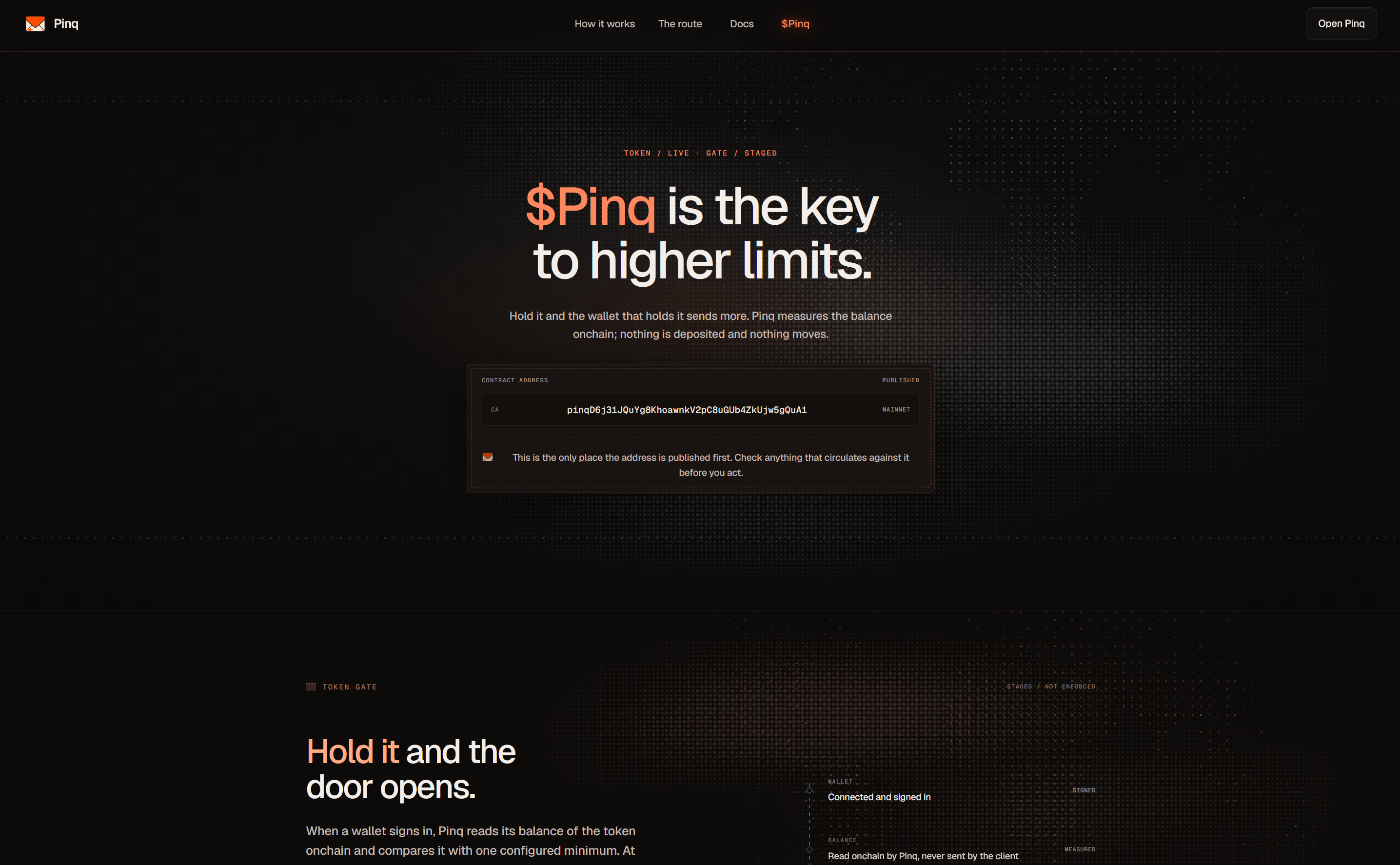
That caveat is especially relevant during a microcap frenzy. A recognizable project name, KOL purchase and rapidly rising chart can make three independent facts feel like one coherent story even when the links between them have not been established. Of all the tokens here, STAMP is the clearest example of why traders need to verify the contract directly through a project’s official channel before treating KOL-wallet activity as an endorsement of a particular project.
Robinhood Chain Is Becoming Its Own Speculative Hunting Ground
One of the strongest themes connecting these trades is not Solana at all. It is Robinhood Chain.
The network is increasingly being treated like fresh territory where traders can attempt to identify the first important launchpads, liquidity protocols, RWA experiments and community tokens before their roles become obvious. That “new chain” dynamic is especially attractive to microcap hunters because valuations are often tiny and category leaders have not yet been established. It is also why PONS, SHROOM and RKST increasingly appear together in social discussions.
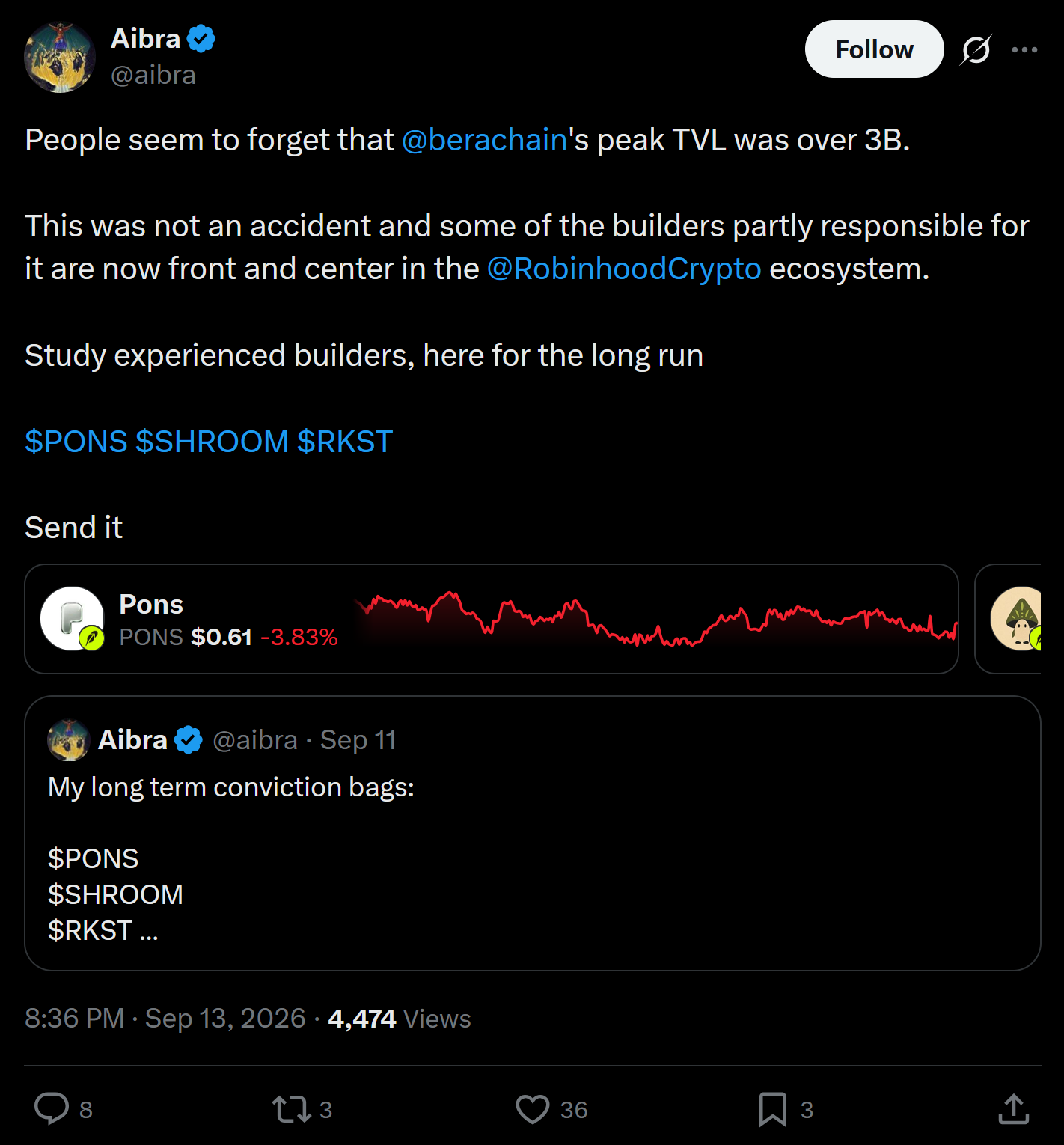
Aibra grouped PONS, SHROOM and RKST together while arguing that experienced builders were migrating toward the Robinhood ecosystem. That is a thesis rather than proof that those tokens will become winners, but it shows how KOLs are beginning to package Robinhood Chain itself as a trade.
SHROOM gives that thesis a DeFi/RWA angle. Its project describes itself as liquidity infrastructure for stock tokens on Robinhood Chain. The plan is to pair SHROOM against major stock tokens, capture fees produced by those pools and use fees earned by protocol-owned liquidity to buy back and burn SHROOM. Eligible holders can also receive MU rewards through its canonical liquidity pool.
That is significantly more structured than a traditional meme coin, but it remains an experiment. The bullish thesis depends on tokenized-stock activity actually growing and routing meaningful volume through those pools. If Robinhood Chain becomes a major tokenized-equities venue, early liquidity infrastructure could benefit. If traders move on to the next chain before that usage arrives, a compelling mechanism alone will not rescue an overextended microcap.
RKST Takes the Microcap Narrative All the Way to Space
Microcaps are often lazily grouped together as memecoins. RKST demonstrates why that definition is becoming less useful.
Rocket Strategy says it intends to finance exposure to an actual reusable suborbital rocket. Image 5 shows the project’s BLK3 concept, which it says is being built by Exos Aerospace and designed to carry payloads toward the edge of space. The team has described a model in which customers eventually pay for payload capacity and 80% of certain resulting proceeds are directed toward RKST buybacks. Those figures are project claims, not independently verified operating results.
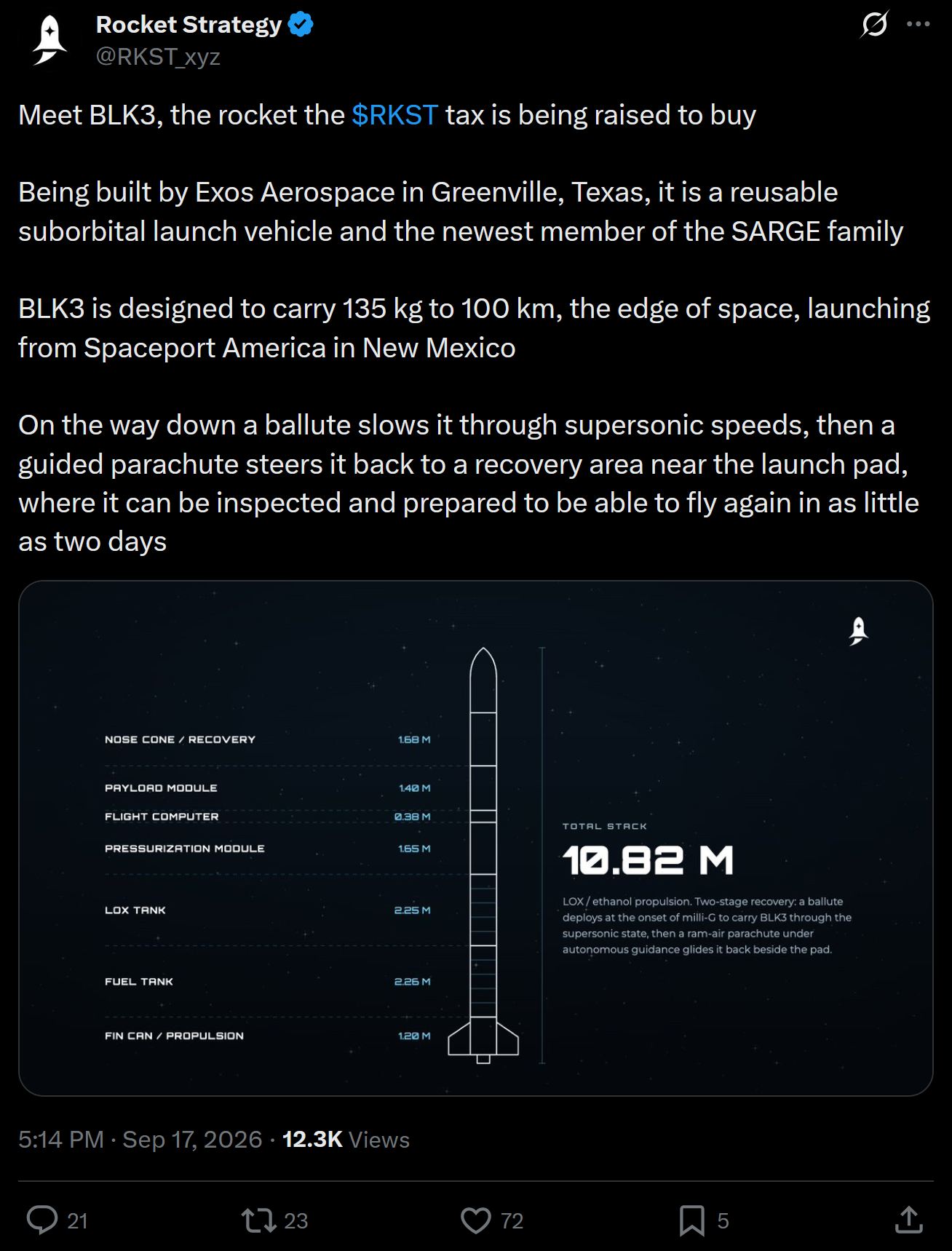
The concept sounds almost absurd when placed beside tokens built around frogs and hairstyles, but that is part of the marketing power. A microcap promising to buy a rocket is far more memorable than another token claiming it will become “the future of DeFi.”
The project reported on September 24 that legal due diligence on the rocket transaction had advanced, a Cayman entity had been registered and financing discussions were continuing. Again, these are statements from Rocket Strategy itself rather than confirmation that the acquisition has closed.
That distinction needs to remain visible. RKST’s bullish case is an unusually differentiated RWA narrative attached to Robinhood Chain. Its bearish case is that investors are pricing a complex real-world aerospace business before the underlying acquisition, financing and revenue machine have been demonstrated. In microcaps, a great story can appreciate much faster than the business the story describes.
LONG Shows the Dangerous Side of the New-Chain Gold Rush
LONG may be the best cautionary example in the entire group.
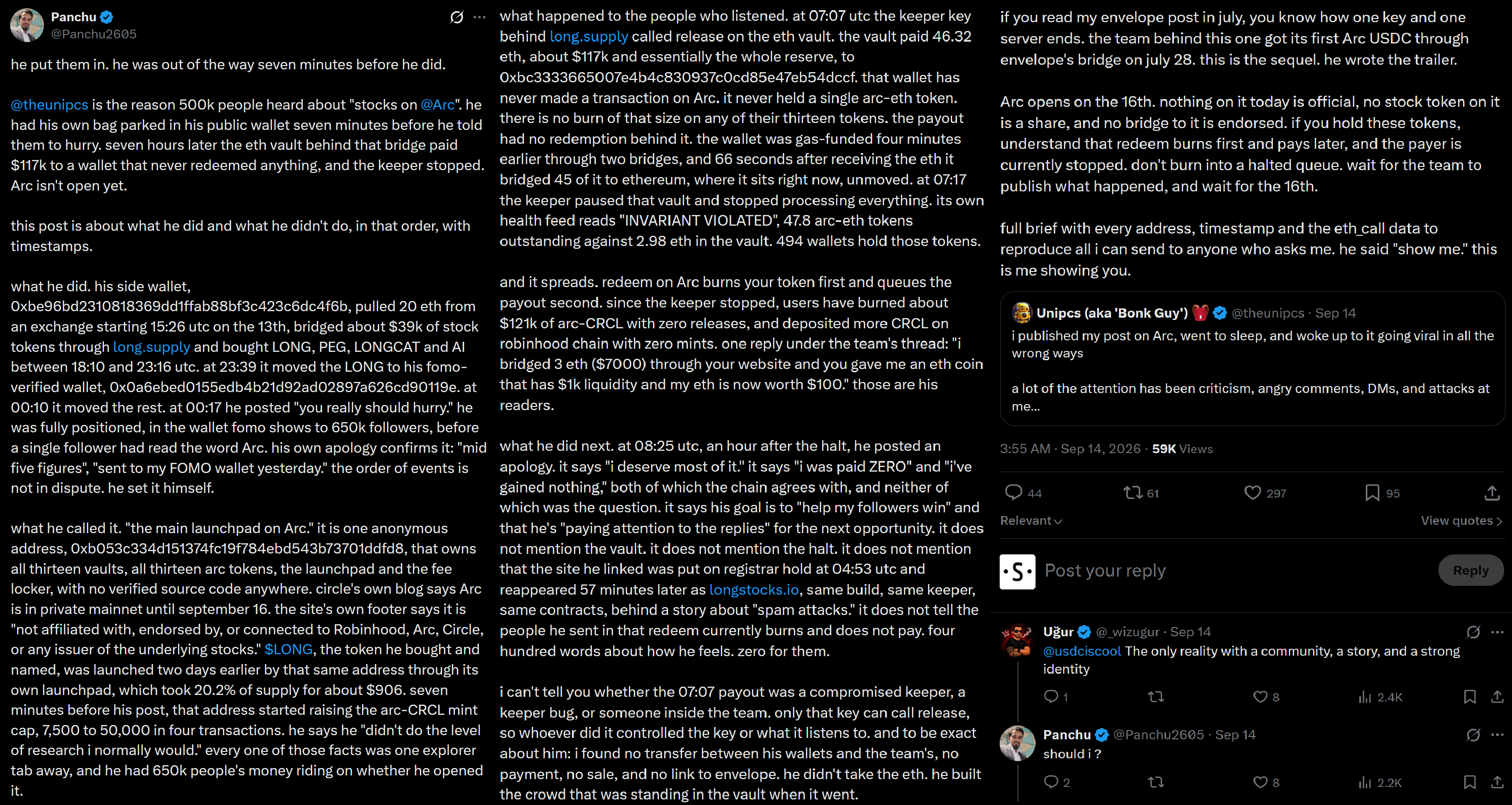
Bonk Guy disclosed buying LONG and several Arc-related tokens while presenting Arc as a short-term, high-risk speculative opportunity rather than a long-term conviction play. Reports following the promotion said LONG’s market capitalization briefly expanded by roughly 27 times. But almost immediately, researchers and other KOLs began challenging the infrastructure surrounding the launchpad and bridge.
Panchu’s lengthy thread questioned the permissions, bridge mechanics and reserve behavior around long.supply, including a disputed vault payout and halted redemption process. Those claims should be treated as the researcher’s allegations and on-chain interpretation, not as a proven finding of intentional wrongdoing. Bonk Guy’s own follow-up, visible in the thread, acknowledged that his Arc post had gone viral “in all the wrong ways.”
What makes the controversy particularly instructive is the chronology alleged in the thread. Panchu argued that Bonk Guy already held positions before directing hundreds of thousands of followers toward the opportunity, while also raising questions about a bridge that had not been officially endorsed by Arc. Separate reporting likewise documented concerns about token permissions and the custom bridge architecture.
A KOL buying before talking about a token does not itself demonstrate misconduct. In many cases, publicly disclosing a position is exactly what traders expect. But it creates an unavoidable incentive conflict: the audience arriving after the post is providing new liquidity to a market in which the influencer is already positioned.
This is why the rhetoric matters. “This easily goes to $100M.” “You’re fading generational wealth.” “Only an idiot would miss this.” None of those statements improve a token’s liquidity, security, revenue or distribution. If a KOL needs to insult your intelligence for declining to buy what they already own, the insult is not evidence that the trade is good. It is evidence that persuasion has become part of the trade.
The Real Signal Is Repeat Buying, Not the Loudest Tweet
Taken together, these assets reveal several distinct narratives hiding inside the same microcap wave. MINI represents AI utility. PAID represents X-native monetization. EMBER and LONG represent launchpad speculation. SHROOM and RKST combine Robinhood Chain with tokenized real-world assets. JEANPHIL is almost pure cultural attention. STAMP illustrates both the appeal of utility and the need to verify whether a token being traded is actually associated with the project whose name it carries.
That variety is important. Microcap does not mean memecoin. What these assets share is not necessarily their purpose. It is their size, liquidity profile and susceptibility to attention. When an asset is worth only a few million dollars, one large wallet, one viral post or one KOL cluster can become a material market event.
The numbers from MadeOnSol make that environment particularly clear. On September 16, its tracker saw 331 active KOLs execute more than 37,000 trades across a universe where 1,764 tokens attracted multiple KOL buyers. By September 20, another 309 tracked traders were active across more than 35,000 transactions. These are not markets waiting patiently for quarterly earnings. Capital is rotating at extremely high speed.
That is why repeated buying is more interesting than one screenshot of one famous wallet. slingoor returned to MINI across several days and multiple purchase sizes. PAID attracted dozens of KOL wallets simultaneously. Those patterns at least suggest that interest persisted beyond one promotional moment. They still do not tell you what happens when those same wallets begin selling.
Microcap Season Can Be Bullish Without Being Safe
There is a legitimate bullish interpretation of what is happening. Bitcoin’s August surge was unusually strong, large-cap participation widened, and by September capital was visibly willing to move farther out on the risk curve. Bitcoin gained nearly 25% in August, while ETH, SOL and XRP all did even better during the month. September then brought another major BTC advance.
Historically familiar sequencing makes the microcap burst understandable. Bitcoin attracts liquidity first. Large alts catch up. Mid-caps begin outperforming. Eventually traders who feel they missed those moves start hunting assets where $10,000 or $100,000 can still move the chart dramatically. That sequence is a useful framework, not a law of markets. August’s unusually wide participation and the current KOL activity suggest that crypto is at least behaving like the late, speculative portion of that rotation.
The bearish interpretation is the mirror image. If tiny assets are surging because traders are becoming increasingly willing to chase risk, microcap mania can be a sign of abundant liquidity and a sign that speculation is becoming stretched. The same KOL convergence that sends a $50,000 project toward $5 million can produce violent exits when five influential wallets independently decide the trade is over.
The opportunity is real. So is the asymmetry. In microcaps, the person whose tweet introduces you to the trade may have purchased hours or days before you ever knew the ticker existed. Watching what influential wallets keep buying after the first spike, what they quietly sell, and whether an actual product keeps gaining users after the social campaign fades may tell traders far more than the loudest price target on X.
-----
Free two-week trials to Sanbase PRO (to access all mentioned Santiment data in this article, and plenty more) are AVAILABLE HERE!
-----
Disclaimer: The opinions expressed in the post are for general informational purposes only and are not intended to provide specific advice or recommendations for any individual or on any specific security or investment product.