Deep Dive: Fed Hikes For First Time Since 2023, Crypto Faces Its Liquidity Test

For the first time since July 2023, the Federal Reserve has raised interest rates. The FOMC voted unanimously September 16th to increase its target range by 25 basis points, from 3.50%-3.75% to 3.75%-4.00%. That ends a roughly 38-month stretch without a rate hike and formally puts monetary tightening back on the table.
For crypto, the hike itself may not be the most important development. Traders had days to prepare for it, and markets were already heavily positioned for a quarter-point increase. The bigger question is whether September represents one isolated adjustment or the beginning of another sustained tightening cycle. That distinction could have a much larger impact on Bitcoin, altcoins, equities, bonds, and the dollar through the end of 2026.
The First Hike Since 2023 Was Hardly a Surprise
The Fed’s reasoning was straightforward. Economic activity remains solid, employment has held up, and inflation is still running too hot. Policymakers now project 2026 PCE inflation at 3.7%, while the central bank does not expect inflation to return fully to its 2% objective until 2029.
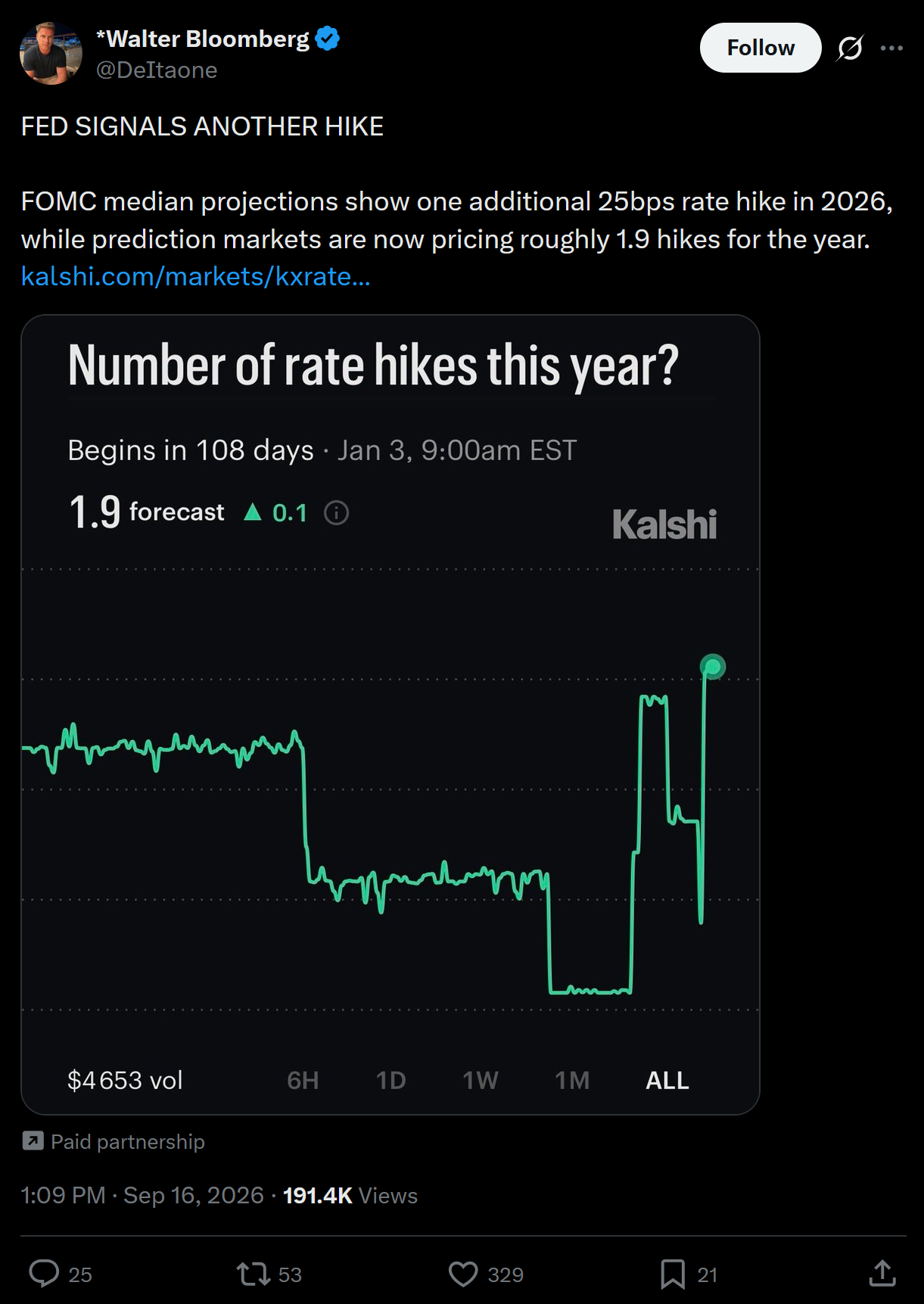
That made September’s decision much less shocking than the headline suggests. Rate markets had placed more than a 90% probability on a quarter-point hike shortly before the announcement. Prediction markets were nearly as convinced, with Kalshi around 87% and Polymarket around 88%. In other words, traders were overwhelmingly prepared for exactly what happened.
The bullish interpretation begins here. When an event is nearly fully priced in, simply confirming it does not necessarily create another major wave of selling. Markets frequently move hardest while expectations are changing. Once the uncertainty disappears, attention shifts toward whatever comes next.
One More Hike Looks Far More Important Than This One
The new Fed projections provide a crucial detail for crypto traders. Sixteen of the 18 policymakers who submitted rate forecasts expect at least one more increase during 2026. The median projection effectively points toward another 25-basis-point hike, taking the target range to 4.00%-4.25% by year-end.
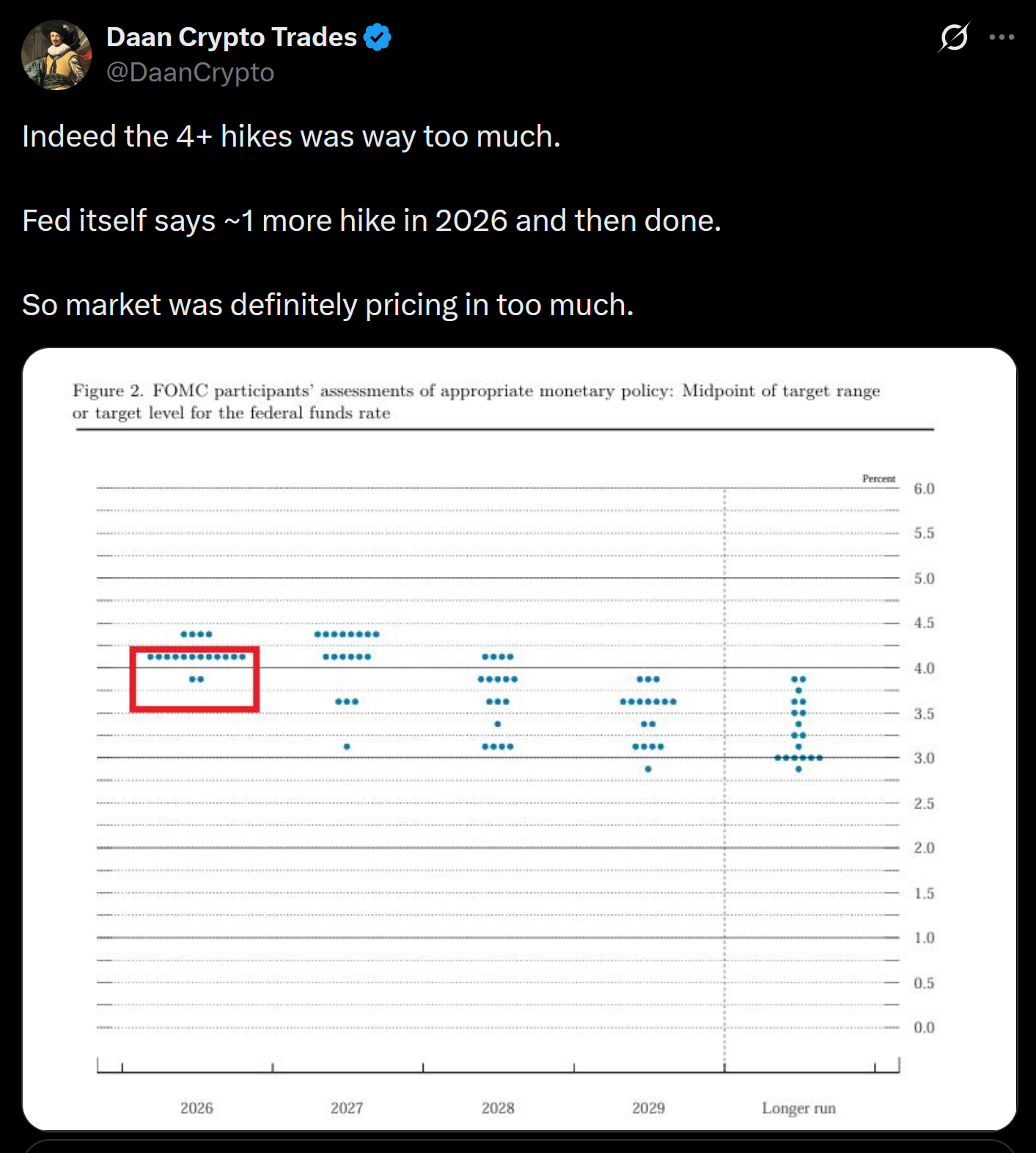
That is hawkish, but perhaps not as hawkish as some markets recently feared. Rate traders had entertained scenarios involving roughly four additional hikes over the coming year as inflation, oil prices, and Treasury yields climbed. The September dot plot instead centers the near-term conversation around one more move during 2026. That does not guarantee only one hike will happen, but it gives traders a much less aggressive baseline than the most pessimistic scenarios circulating beforehand.
There is another important qualifier. The dot plot is not a promise. Each dot represents an individual policymaker’s assessment under current conditions, and future inflation, employment, energy prices, and economic growth could change those expectations quickly. Still, crypto traders now have something more concrete to price than the increasingly aggressive rate speculation that dominated recent weeks.
Crypto Has Been Trading the Fed Before the Fed Even Acts
The buildup was impossible to miss. Santiment’s social data shows conversations surrounding the FOMC, rates, hikes, and 25-basis-point moves exploding as the decision approached. Social dominance jumped sharply as Bitcoin simultaneously slipped into the mid-$75,000 range.
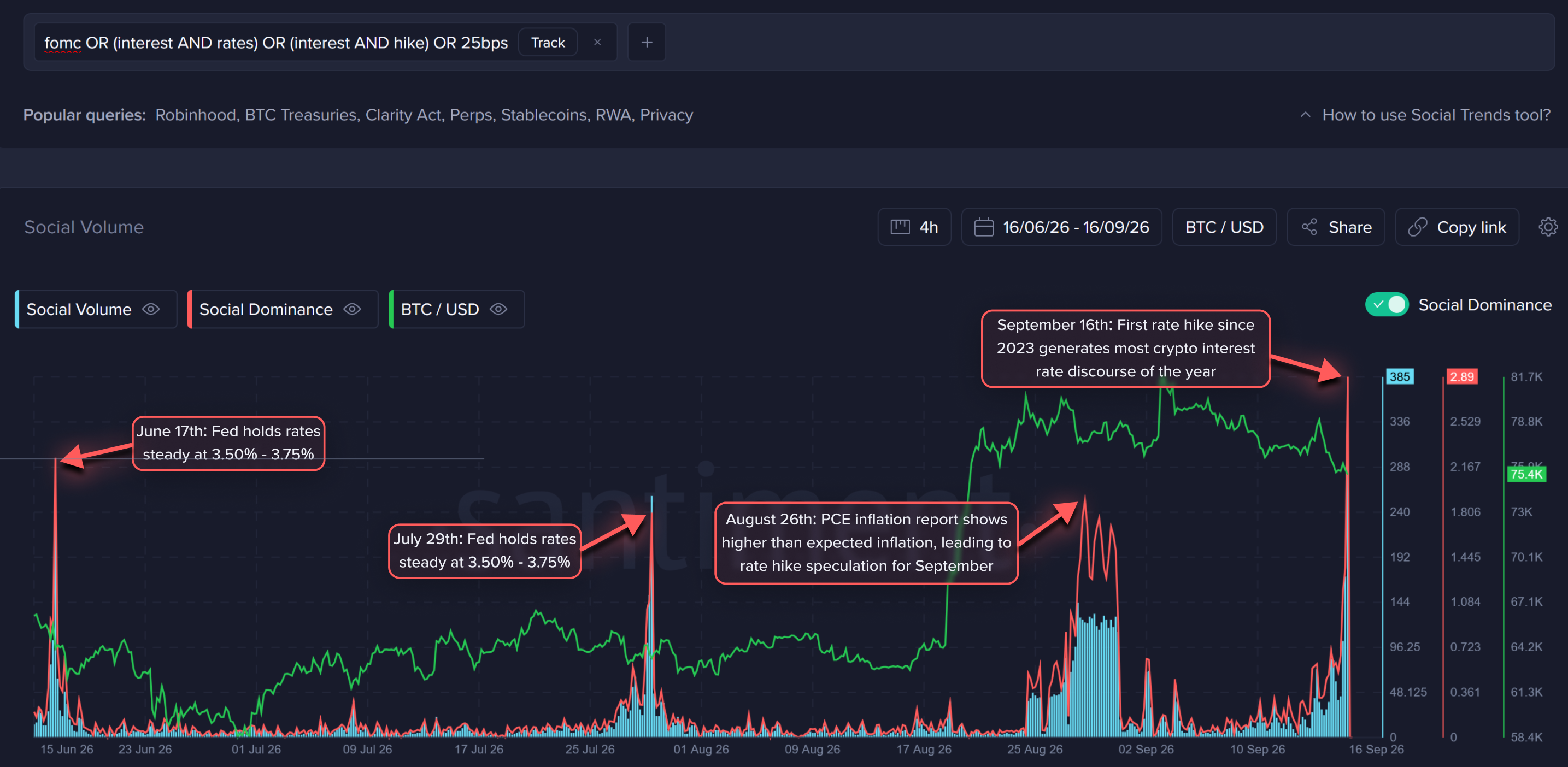
Some of that weakness was already happening before the Fed acted. Bitcoin had fallen roughly 4% following the previous day’s CLARITY Act setback, while Coinbase and Circle shares were each down around 9%. Bitcoin was trading around $75,900 on September 15, leaving crypto to absorb a regulatory disappointment immediately before its biggest macro event of the week.
That makes the immediate post-FOMC reaction harder to attribute solely to interest rates. The hike arrived after crypto had already been hit by falling regulatory optimism, ETF outflows, rising Treasury yields, and liquidations. Bitcoin consequently entered the announcement around $75,000-$76,000 rather than from a position of excessive short-term strength.
The Bear Case Is Still About Liquidity
Crypto’s clearest bearish argument is also the simplest. Higher rates make cash and government debt more attractive. They raise financing costs, strengthen competition from yield-bearing assets, and generally reduce the incentive to reach farther out on the risk curve. Bitcoin may be structurally different from high-growth equities, but crypto still tends to struggle when financial conditions tighten sharply.
The first market reaction reinforced that concern. The dollar index rose about 0.6% after the Fed decision. The two-year Treasury yield climbed roughly seven basis points. The S&P 500 and Nasdaq reversed earlier gains and moved lower as traders absorbed the prospect of additional tightening. Gold also fell more than 1% after the announcement.
A second hike later this year would therefore matter more than today’s widely anticipated move. If inflation remains stubborn, oil stays elevated, and the Fed begins signaling hikes beyond December, risk markets would have to price a higher terminal rate. That scenario would likely be especially difficult for speculative altcoins, leveraged traders, and projects whose valuations depend heavily on abundant liquidity.
The Bull Case Is That Expectations May Have Gone Too Far
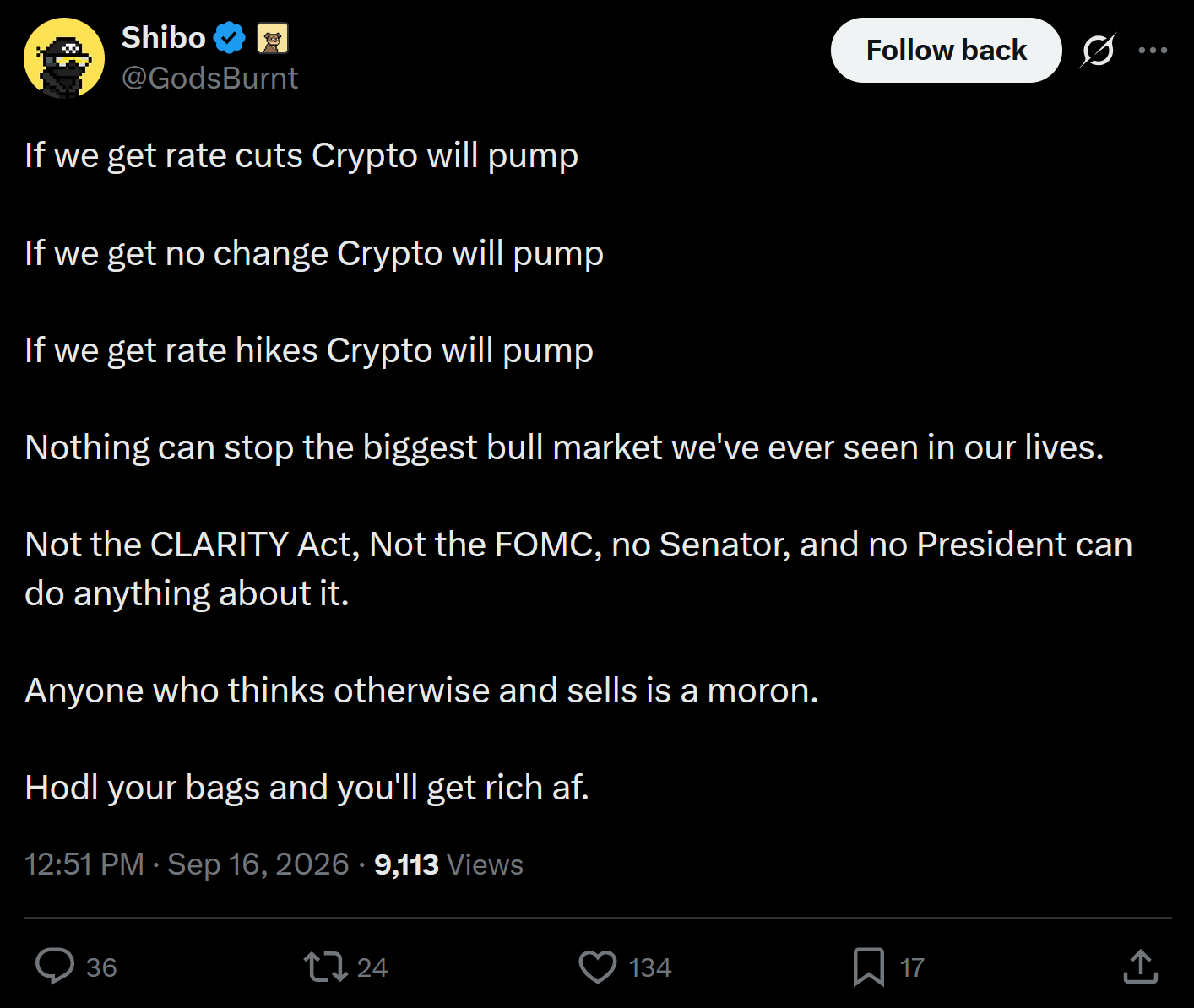
Crypto traders are already pushing the opposite argument. Some believe nearly every possible Fed outcome is being interpreted bearishly before it occurs, even though Bitcoin has repeatedly absorbed significant macro shocks during this cycle. Image 4 captures the exaggerated version of that optimism, where cuts, holds, and hikes somehow all become reasons for crypto to rise.
The more defensible bullish argument is subtler. September’s hike was overwhelmingly expected. One additional 2026 increase is now explicitly reflected in policymakers’ projections. Bitcoin has already corrected from above $80,000 while long-term Treasury yields moved toward multi-decade highs. Some degree of monetary tightening is therefore already embedded in asset prices rather than waiting as a completely new surprise.
There is also a scenario where a credible inflation response eventually helps risk markets. If the Fed convinces investors that one or two modest hikes are enough to contain inflation, long-term Treasury yields could stabilize instead of continuing their recent climb. Markets generally care less about whether rates are high in isolation than whether expectations keep moving unexpectedly higher.
Where Crypto Likely Goes From Here
The near-term setup remains uncomfortable. The Fed has shifted from holding rates steady to actively tightening. The dollar has strengthened, Treasury yields remain exceptionally high, and policymakers have explicitly left another hike on the table. Those conditions normally argue for higher volatility and a tougher environment for speculative crypto assets.
But September’s hike also removed one major uncertainty. Traders spent weeks debating whether the Fed would act. Now they know. The next battle is over how many hikes actually follow, and that creates a much clearer set of catalysts. Softer inflation, cooling energy prices, weaker economic data, or falling long-term yields could quickly reduce expectations for additional tightening. Persistent inflation would do the opposite.
Crypto also has its own catalysts capable of temporarily overpowering macro conditions. The CLARITY Act setback has already shown how strongly Bitcoin can respond to industry-specific policy developments. That means Bitcoin’s next major move may depend on the intersection of two narratives rather than rates alone: whether monetary conditions stop becoming progressively tighter and whether crypto receives clearer regulatory footing in the United States.
The September hike is therefore neither automatically catastrophic nor secretly bullish. The bearish case is that this is the beginning of a longer tightening cycle that drains liquidity and raises real yields. The bullish case is that traders had already priced a much uglier path, the first hike is now behind us, and one additional move may prove manageable if inflation finally begins cooling. For crypto, the direction of expectations from here could matter far more than the 25 basis points that just arrived.
-----
Free two-week trials to Sanbase PRO (to access all mentioned Santiment data in this article, and plenty more) are AVAILABLE HERE!
-----
Disclaimer: The opinions expressed in the post are for general informational purposes only and are not intended to provide specific advice or recommendations for any individual or on any specific security or investment product.