
Deep Dive: Bitcoin Gets a New Retail Gateway in Switzerland!

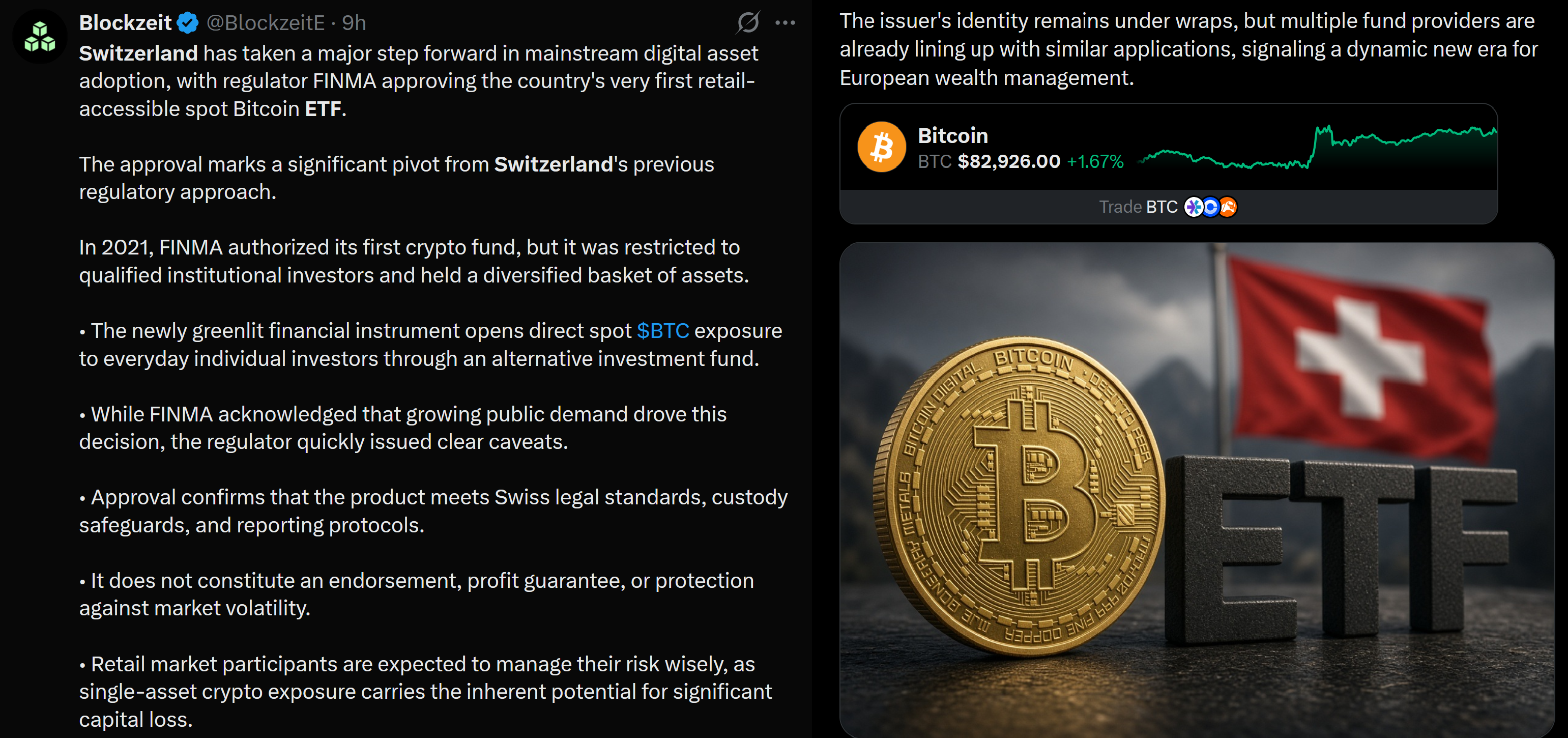
Bitcoin has spent years moving from the edges of finance toward the same investment channels people already use for stocks, bonds, and retirement portfolios. Switzerland has now taken another step in that direction, approving its first ETF that invests directly in Bitcoin under Swiss investment-fund law.
The decision gives everyday investors a regulated way to gain direct Bitcoin exposure without personally buying BTC, managing private keys, or storing a recovery phrase. This news isn’t simply exciting because another Bitcoin product exists. Switzerland already had crypto exchange-traded products. What changed is the legal structure, the audience allowed to buy it, and the willingness of one of the world’s best-known financial centers to bring direct Bitcoin exposure inside its traditional retail fund system.
Switzerland Gives Everyday Investors Direct Bitcoin Fund Access
Switzerland’s Financial Market Supervisory Authority, better known as FINMA, approved the country’s first publicly available exchange-traded fund that invests directly in Bitcoin. The regulator classifies it as an “other fund for alternative investments,” a Swiss fund category that comes with special risk considerations. Unlike a futures-based product, the fund is designed to actually hold Bitcoin.
For someone newer to crypto, the appeal is fairly simple. Buying Bitcoin directly normally means choosing an exchange, understanding wallets, deciding how to store private keys, and accepting responsibility for custody. An ETF places most of those operational tasks behind a familiar investment wrapper. An investor buys shares through the financial system while the fund handles the Bitcoin underneath.
That does not make the investment itself safer from price swings. If Bitcoin falls 30%, a fund holding Bitcoin can fall sharply too. What changes is the way investors access and hold the exposure. Operational complexity becomes easier to manage, while Bitcoin’s market risk remains.
Why This Is Different From Bitcoin Products Switzerland Already Had
One detail has caused some confusion online. Switzerland was not previously a Bitcoin-free zone for investors. Crypto exchange-traded products have traded in Switzerland for years, and FINMA approved a crypto fund for qualified investors back in 2021. That earlier fund primarily held a basket of cryptocurrencies and was restricted to professional or otherwise qualified investors.
The new product crosses a different line. It is a Swiss investment fund open to retail investors and designed to hold Bitcoin directly. Existing Swiss crypto ETPs can resemble ETFs from an investor’s perspective because they trade on exchanges, but their legal structure is different. Many European crypto ETPs are structured as debt securities, while this fund falls under Swiss collective investment rules.
This may sound technical, but it helps explain why the approval attracted so much attention. Bitcoin is not simply being made tradable in another format. It is being accepted inside a regulated fund structure that Swiss households already understand from traditional investing.
One Important Detail Changed After the First Headlines
Some of the earliest social posts said the issuer and launch schedule were still unknown because FINMA’s own announcement did not identify either one. That was accurate based on the regulator’s release alone, but additional information emerged the same day.
BIT Asset Management AG separately announced that it received the approval and identified the product as the Bitcoin Fund ETF, ticker BBIT. The firm says it expects BBIT to begin trading on the SIX Swiss Exchange in November 2026. So the issuer is no longer a mystery, although the exact first trading day has not yet been announced.
FINMA also said other fund providers have already submitted or announced Bitcoin ETF applications. If additional products follow, Switzerland could move from one approved retail Bitcoin fund to a competitive market of issuers fighting over fees, liquidity, custody quality, and investor attention.
FINMA Made an Unusual Exception for Bitcoin
Traditional investment funds are normally expected to spread their risk across multiple assets. A fund owning only Bitcoin obviously cannot do that, so FINMA granted an exemption from its standard risk-diversification rules.
The regulator justified the exception partly through Bitcoin’s unusually long trading history and high trading volume compared with other cryptocurrencies. That is an interesting sign of how regulators increasingly distinguish Bitcoin from much smaller digital assets. FINMA is not saying Bitcoin is low risk. It is saying the market is established and liquid enough for a single-asset retail fund to operate under special conditions.
Those conditions include safeguards around custody and operational security, clear explanations of the risks in fund documents, and Swiss financial-services rules at the point of sale. FINMA also emphasized suitability checks and warnings that investors could lose a substantial portion of their money. Approval is therefore closer to “this product can operate under our rules” than “Bitcoin is a safe investment.”
Regulation Removes Some Risks, Not Bitcoin’s Volatility
That distinction is especially useful for novice investors. An ETF can help reduce the chance of losing Bitcoin because a seed phrase was misplaced, a wallet was configured incorrectly, or funds were accidentally sent to the wrong address. It can also place custody inside a regulated framework with clearer responsibilities.
But none of that protects someone from buying Bitcoin at $90,000 and watching it fall to $60,000. FINMA specifically warned that Bitcoin remains highly volatile and that invested capital can lose significant value. The regulator even highlighted the amount invested as something consumers should carefully consider.
There is also an ideological tradeoff. Some Bitcoin supporters value direct ownership specifically because it removes banks, fund managers, and custodians from the equation. ETF investors gain convenience, but they give up direct possession of the Bitcoin. For mainstream investors, that may be an easy trade. For committed self-custody advocates, it is fundamentally different from owning BTC themselves.
Social Attention Arrived Almost Immediately
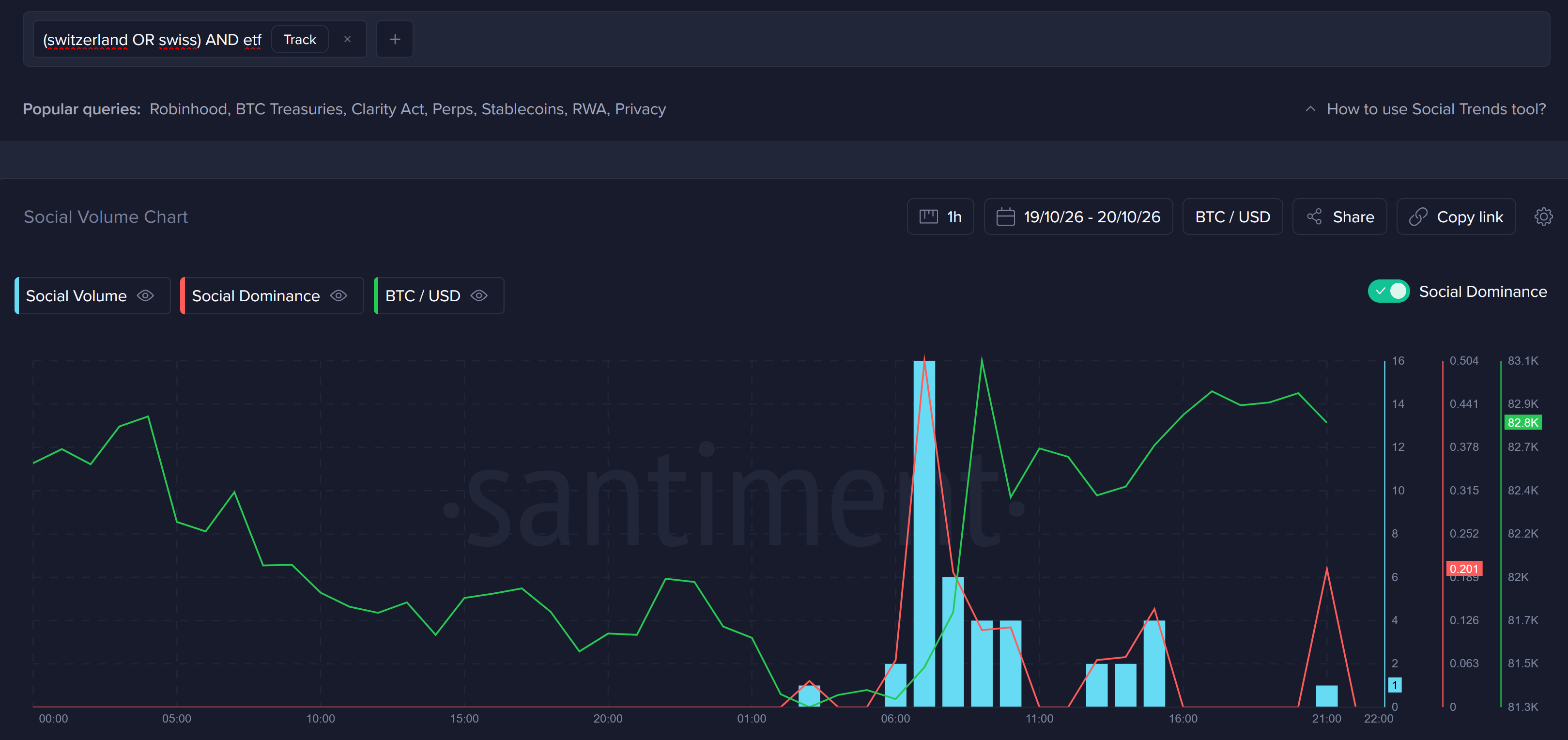
The approval quickly created a burst of crypto discussion, visible in the attached Santiment data. Mentions connecting Switzerland with ETFs jumped sharply during the hours surrounding the announcement, while Bitcoin itself was trading near the low-$80,000 range.
That reaction is understandable. ETF announcements have become a familiar symbol of institutional acceptance since the U.S. spot Bitcoin ETF launches. Traders now tend to interpret new regulated access as potential future demand, even when the approval itself does not immediately create large Bitcoin purchases.
Social excitement should still be separated from actual investment flows. A regulatory green light can attract attention instantly, while assets may enter the fund gradually over weeks or months. For BBIT, November trading activity and subsequent assets under management will tell us much more than the first day of social-media excitement.
The BlackRock Story Adds Another Layer of Optimism
Switzerland’s announcement also arrived just as the U.S. Bitcoin ETF market was producing another unusual development. BlackRock filed for the iShares Bitcoin Managed Protection ETF, a proposed fund designed to provide upside exposure linked primarily to its massive IBIT Bitcoin ETF while adding a degree of downside protection.
For newer investors, think of it as an attempt to redesign Bitcoin exposure for people who like Bitcoin’s upside but are uncomfortable accepting its full downside. The structure would use financial instruments to soften some losses while limiting how much upside an investor can capture. It would not make Bitcoin risk-free, and its protection would depend on the exact structure and holding conditions.
The interesting part is the direction of product development. The first phase of institutional Bitcoin adoption focused on simply making spot BTC available through an ETF. The next phase increasingly asks: can Bitcoin exposure be packaged for retirees, cautious investors, income seekers, financial advisers, and investors who would never accept the full volatility of holding BTC directly?
ETF Money Is Still Flowing, Though the Picture Is Uneven
Investor demand also strengthened around the same time. U.S. spot Bitcoin ETFs, according to our own data, recorded roughly $526.7 million in net inflows in a single Monday session, their largest daily total in nearly a month.
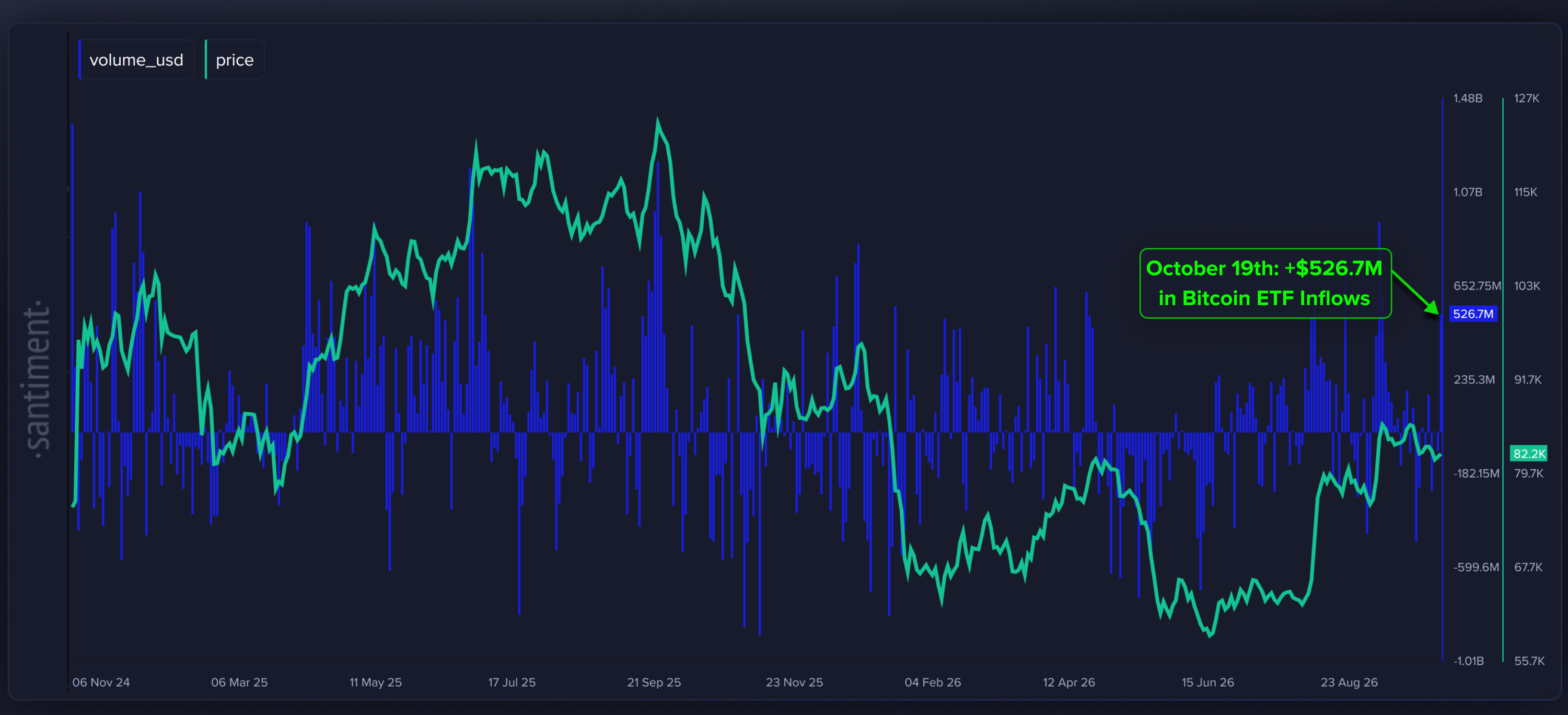
That is bullish evidence, but it deserves some restraint. The flows were heavily concentrated in BlackRock, and the U.S. funds were still slightly negative for October at that point after earlier withdrawals. Bitcoin ETF demand has been persistent, but it has not moved upward in a perfectly straight line.
Still, the direction of travel is hard to ignore. Switzerland is opening direct Bitcoin fund access to retail investors, BlackRock is experimenting with risk-managed Bitcoin exposure, and large U.S. Bitcoin ETFs continue moving hundreds of millions of dollars during active sessions. Bitcoin investment products are becoming less like one special crypto category and more like a growing menu of financial products.
The Bullish Case: Bitcoin’s Potential Investor Pool Keeps Expanding
The strongest bullish argument is not that one Swiss ETF will suddenly create enormous demand. Switzerland’s population and domestic investment market are much smaller than those of the United States.
Instead, each new regulated access point lowers another barrier. A Swiss investor who never wanted to open a crypto exchange account can potentially buy Bitcoin exposure through a familiar brokerage relationship. A wealth adviser has another regulated product to discuss with clients. Other issuers now have proof that FINMA is willing to approve this structure if safeguards are strong enough.
That process can compound. More products can create competition, lower costs, improve liquidity, and normalize Bitcoin inside investment portfolios. BIT Asset Management’s announcement that BBIT is expected on SIX in November will make actual fund flows the next statistic worth watching.
The Bearish Case: Easier Access Does Not Guarantee Higher Prices
There is an obvious trap in assuming every ETF approval automatically translates into a Bitcoin rally. New access creates the ability to buy. It does not guarantee that investors will use that ability aggressively.
Bitcoin also remains deeply volatile. FINMA’s own approval announcement spends considerable space warning investors that substantial losses remain possible. The ETF changes custody and access. It does not change Bitcoin’s fixed supply mechanics, market cycles, leverage, macro sensitivity, or tendency to experience steep corrections.
There is another reason to temper expectations. Bitcoin is no longer starved for financial access in the way it once was. U.S. investors already have enormous spot ETFs, Switzerland already had crypto ETPs, and institutional custody has become much easier to obtain. Each additional product is still useful, but the marginal impact of the twentieth convenient way to own Bitcoin may eventually be smaller than the impact of the first few.
Conclusion
Switzerland’s approval represents another meaningful step in Bitcoin’s transition from a specialist asset into something ordinary investors can hold through familiar financial infrastructure. The distinction is important: FINMA has now approved a Swiss retail investment fund that owns Bitcoin directly, rather than limiting this type of regulated fund access to qualified investors.
At the same time, investors should keep the approval in perspective. Regulation can reduce custody, operational, and access problems, but it cannot regulate away Bitcoin’s price risk.
-----
Free two-week trials to Sanbase PRO (to access all mentioned Santiment data in this article, and plenty more) are AVAILABLE HERE!
-----
Disclaimer: The opinions expressed in the post are for general informational purposes only and are not intended to provide specific advice or recommendations for any individual or on any specific security or investment product.